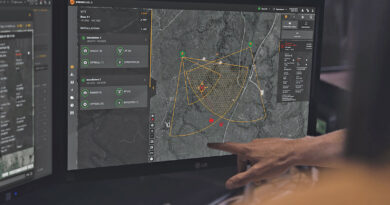
Part II: Scaling Intelligence in Aerospace Manufacturing
In Part I of this series, we explored how robotics, artificial intelligence (AI), and advanced automation are reshaping the aerospace factory floor. Across commercial and defense programs alike, manufacturers are integrating these technologies to increase precision, improve process capability, and stabilize production at historically unprecedented rates.
Yet deploying robotics or AI inside a single factory does not, by itself, create a transformative industrial system. The real shift occurs when intelligence extends beyond isolated production cells and becomes embedded across programs, facilities, and supply chains.
In this sense, the intelligent aerospace factory is only the beginning. The larger transformation is the emergence of the intelligent aerospace enterprise—an integrated production ecosystem where digital technologies connect engineering, manufacturing, logistics, and lifecycle support into a continuously adaptive system (Kagermann et al., 2013; Deloitte, 2023).
For aerospace manufacturers confronting rising production demands, volatile supply networks, and stringent regulatory requirements, scaling this intelligence is becoming essential. The factories of the future will not simply produce aircraft; they will operate as dynamic systems capable of learning, adapting, and optimizing in real time.
Digital Twins and the Rise of the Virtual Factory
One of the most powerful technologies enabling this shift is the digital twin, a virtual representation of a physical system that continuously reflects real-world conditions through operational data.
Digital twins are not entirely new to aerospace. The concept originated decades ago in spacecraft development, where engineers simulated vehicle behavior long before hardware was launched. Today, advances in computing power, data integration, and sensor technology have expanded this concept dramatically. Entire production lines, and even entire factories, can now be modeled digitally and synchronized with their physical counterparts (NASA, 2021; SAE International, 2022).
In practical terms, digital twins allow manufacturers to simulate and optimize production environments before physical systems are installed. Engineers can evaluate line layouts, identify potential bottlenecks, and test production-rate scenarios without disrupting ongoing operations.
Robot paths can be validated digitally to prevent collisions and inefficiencies. Human–machine workstations can be evaluated for ergonomics and safety. Material flow can be simulated to determine the optimal placement of logistics nodes and workstations.
Perhaps most importantly, digital twins connect product design with manufacturing execution. By linking product lifecycle management (PLM) systems with manufacturing execution systems (MES) and enterprise resource planning (ERP) platforms, companies establish a continuous digital thread that traces design intent through production and into operational performance (Porter & Heppelmann, 2014).
This level of digital continuity allows engineering and manufacturing teams to collaborate more effectively while reducing ramp-up risk during new program launches. In an industry where production delays can cascade across global supply networks, the ability to validate manufacturing systems virtually before implementation represents a major strategic advantage.
Production Readiness as a Living Capability
For decades, aerospace programs have relied on milestone-based readiness reviews. Equipment is installed, operators are trained, work instructions are released, and first article inspections are completed. Once these steps are verified, production is considered ready to proceed.
While this framework has supported the industry’s rigorous safety culture, it struggles to keep pace with the complexity of modern aerospace manufacturing.
In intelligent production environments, readiness is no longer treated as a static checkpoint. Instead, it becomes a continuously monitored capability that reflects the real-time condition of processes, assets, materials, workforce qualifications, and quality systems.
Process capability, for example, can now be monitored through continuous statistical analysis of critical manufacturing parameters. Instead of waiting for periodic quality reports, engineers can observe trends in real time and intervene before variation exceeds acceptable limits.
Similarly, predictive analytics allow manufacturers to monitor the health of critical equipment. By analyzing vibration, temperature, torque, and performance data, AI-driven maintenance systems can identify early indicators of equipment degradation, allowing maintenance teams to intervene before failures disrupt production (McKinsey & Company, 2022).
Material traceability has also advanced significantly. Digital systems can now track raw materials, components, and assemblies across the entire manufacturing lifecycle, providing instant visibility into potential supply risks or compliance concerns.
Workforce readiness is evolving as well. In intelligent factories, digital training systems link operator certifications directly to production tasks. If a certification expires or required training has not been completed, the system prevents the operation from proceeding until compliance is restored.
Quality systems benefit from similar integration. Nonconformance reports, corrective actions, and audit findings can be analyzed collectively, enabling organizations to identify recurring patterns and prioritize systemic improvements.
The result is a dynamic readiness profile—one that provides leadership with a continuously updated picture of operational stability rather than relying solely on historical documentation.
The Human Dimension of Intelligent Manufacturing
Despite rapid advances in automation and AI, the aerospace factory remains fundamentally human-centered. In fact, the effectiveness of intelligent manufacturing systems depends heavily on how well they augment human expertise.
As automation expands, the nature of work on the factory floor is evolving. Operators increasingly supervise automated cells rather than performing repetitive manual tasks. Maintenance technicians must be capable of diagnosing both mechanical issues and digital control systems. Engineers must interpret large volumes of operational data and translate those insights into actionable improvements.
These shifts are driving the emergence of new workforce skill profiles. Mechatronics expertise—combining mechanical, electrical, and software knowledge—is becoming increasingly valuable. Data literacy is also critical, enabling engineers and technicians to interpret analytics dashboards and machine learning outputs.
Equally important is the cultural transformation required to support intelligent manufacturing. Connected production systems generate unprecedented transparency through real-time dashboards and analytics-driven insights (Porter & Heppelmann, 2014).
Organizations must cultivate cultures where this visibility is used constructively—to identify opportunities for improvement rather than assign blame. When employees trust that data-driven insights will support collaboration rather than criticism, adoption accelerates dramatically.
In this environment, automation becomes a partner rather than a perceived threat. Human judgment and machine precision reinforce one another, enabling factories to achieve higher levels of safety, quality, and productivity than either could accomplish alone.
Why Many Smart Factory Initiatives Stall
Despite the promise of intelligent manufacturing, many digital transformation initiatives struggle to progress beyond early pilot programs.
The reasons are rarely technological. Instead, they typically stem from architectural or organizational challenges.
One of the most common obstacles is fragmentation. Companies may deploy automation solutions or analytics platforms in isolated departments without establishing a unified digital architecture. While these projects can deliver local improvements, they fail to generate the system-level benefits required for large-scale transformation (Deloitte, 2023).
Another challenge is excessive customization. Highly tailored software solutions may address specific operational needs but become difficult to replicate across facilities or programs. Without standardization, scaling intelligent manufacturing across an enterprise becomes prohibitively complex.
Data quality presents another significant barrier. Artificial intelligence and advanced analytics depend on consistent, reliable data streams. If foundational data governance is weak—due to inconsistent naming conventions, incomplete records, or incompatible systems—confidence in analytics deteriorates quickly.
Cybersecurity is also a growing concern as operational technology networks converge with enterprise IT systems. Aerospace manufacturers must protect sensitive intellectual property while maintaining the connectivity required for intelligent production environments.
Finally, regulatory alignment remains critical. Aerospace production must comply with stringent standards such as AS9100 and NADCAP, and digital manufacturing systems must support these frameworks by providing traceable documentation, auditable records, and robust configuration control.
Organizations that address these challenges early—by establishing clear digital architectures, governance frameworks, and data standards—are far more likely to achieve successful transformation.
Building a Practical Roadmap to Intelligent Manufacturing
For aerospace companies seeking to advance toward intelligent production systems, progress typically begins with a candid assessment of current capabilities.
Understanding where operational bottlenecks exist—and where data visibility is limited—provides the foundation for meaningful improvement.
The next step involves defining a scalable digital architecture. Integration between PLM, MES, and ERP systems forms the backbone of the digital thread that connects engineering decisions with manufacturing execution (Porter & Heppelmann, 2014).
Rather than attempting enterprise-wide change immediately, leading organizations often begin with model areas—pilot production environments where new technologies and workflows can be validated under controlled conditions.
These model areas allow teams to refine processes, evaluate technologies, and demonstrate measurable value before scaling successful approaches across additional facilities.
Workforce development must evolve in parallel. Investments in robotics, automation, and AI require complementary investments in training programs that equip employees with the skills needed to operate, maintain, and improve these systems.
Finally, intelligent factories must be treated as living systems. Continuous improvement programs, disciplined governance structures, and cross-functional collaboration ensure that technological investments translate into sustained operational performance.
The Strategic Ripple Effect Across the Supply Chain
As intelligent manufacturing systems mature, their influence extends well beyond individual factories.
Original equipment manufacturers increasingly expect suppliers to participate in digital ecosystems that support traceability, quality monitoring, and real-time production visibility. These expectations are driving digital transformation throughout the aerospace supply chain.
Connected manufacturing systems also enable new forms of collaboration. Production data can be shared with engineering teams to refine designs, while maintenance organizations can use manufacturing insights to anticipate operational reliability issues (Porter & Heppelmann, 2014).
Even regulatory oversight is evolving. Digital production records provide regulators with richer, more reliable evidence of compliance than traditional paper-based documentation.
In this way, the intelligent aerospace factory becomes more than an internal efficiency initiative. It becomes a strategic platform that connects the entire aerospace ecosystem—from design and manufacturing to operations and lifecycle support.
The Intelligent Aerospace Enterprise
The aerospace industry has always balanced innovation with discipline. Aircraft must push technological boundaries while meeting uncompromising safety and reliability standards.
The intelligent aerospace factory reflects this same balance. Robotics, AI, and automation provide powerful technological capabilities, but their true value emerges only when they are integrated with strong governance, skilled workforces, and disciplined operational practices.
When these elements align, manufacturing evolves from a reactive system into a continuously learning one—capable of adapting to disruptions, scaling production, and improving performance over time.
For aerospace manufacturers navigating rising production demands and increasing complexity, the question is no longer whether intelligent manufacturing will reshape the industry. That transformation is already underway (McKinsey & Company, 2022; World Economic Forum, 2023; Airbus, 2022; Boeing, 2022; Spirit AeroSystems, 2022).
The organizations that successfully scale these capabilities will not simply produce aircraft more efficiently. They will define the next era of aerospace industrial performance.
By Azita Hajihassani,
Ph.D., MBA
www.LeadingDisruption.net
Author bio:
Azita Hajihassani, Ph.D., MBA is a manufacturing and quality systems leader with extensive experience in aerospace, advanced manufacturing, and industrial operations. Her work focuses on production readiness, supplier quality, digital manufacturing, and the integration of robotics, AI, and automation in complex manufacturing environments. Azita Hajihassani, Ph.D. writes on manufacturing innovation, intelligent factories, and industrial transformation, helping organizations bridge the gap between advanced technology and practical operational performance.