The Rise of the Intelligent Aerospace Factory
Part I: The Foundations of the Intelligent Aerospace Factory How Robotics, AI, and Automation Are Reshaping the Factory Floor
Aerospace Manufacturing at an Inflection Point
Aerospace manufacturing has never been static. Each generation of aircraft has demanded new materials, tighter tolerances, and more complex production systems. Yet today’s challenges are fundamentally different in scale and intensity. Commercial aircraft programs are under pressure to achieve production rates that stretch existing industrial models, while defense platforms demand absolute precision, traceability, and regulatory confidence—often simultaneously.
At the same time, manufacturers face labor shortages, fragile supply chains, rising costs, and heightened scrutiny from regulators and customers alike. In this environment, traditional approaches to automation and incremental improvement are proving insufficient. The industry is being forced to rethink not just how aircraft are built, but how factories themselves operate.
This is the context in which the intelligent aerospace factory is emerging—not as a futuristic concept, but as a pragmatic response to real operational constraints.
Beyond Smart Equipment: Defining Factory Intelligence
Many aerospace facilities already deploy advanced machinery: multi-axis CNC systems, automated drilling and fastening cells, composite layup equipment, and digital work instructions. While these technologies improve local efficiency, they do not by themselves create an intelligent factory.
Intelligence arises at the system level. It is the result of connecting machines, processes, and people through a common digital architecture that enables continuous feedback and informed decision-making. In such an environment, data flows in real time from equipment and inspection systems into manufacturing execution platforms, where it is contextualized, analyzed, and acted upon.
Quality data, in particular, undergoes a fundamental shift. Instead of being reviewed after the fact, measurement results and process signals are fed directly back into production control. Deviations trigger immediate responses—adjustments to parameters, additional verification steps, or engineering intervention—before nonconformances propagate downstream.
Decision-making also evolves. Artificial intelligence supports prioritization, scheduling, and intervention decisions by evaluating constraints, risks, and trade-offs continuously. Rather than relying on static plans and manual escalation, the factory becomes adaptive, capable of responding dynamically to disruptions while maintaining overall system stability.
Crucially, this intelligence augments human capability rather than replacing it. Engineers and operators are equipped with better visibility and insight, allowing them to focus on judgment, problem-solving, and improvement instead of repetitive or physically demanding tasks.
Intelligence at the System Level
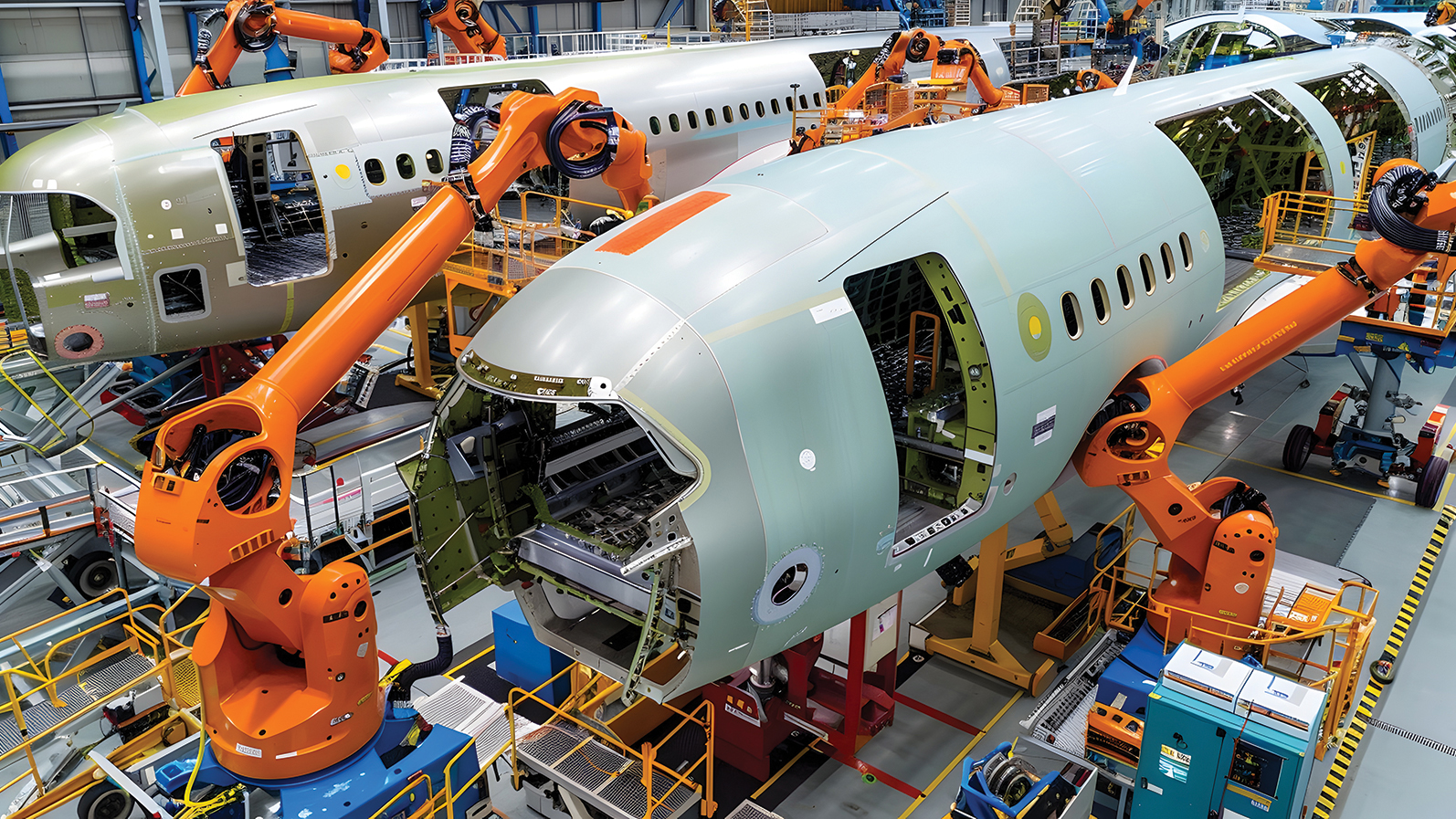
Several leading aerospace manufacturers illustrate how intelligence emerges only when machines are connected into a coherent system rather than deployed in isolation. At Airbus, narrow-body final assembly lines integrate robots, automated torque tools, inspection systems, and autonomous material movement into a unified digital backbone. Data from these assets flows directly into manufacturing execution and analytics platforms, allowing deviations to be identified and corrected during production rather than after completion.
The result is not simply improved efficiency, but greater confidence during rate increases—an essential capability as single-aisle production continues to scale.
Robotics as a Core Production Enabler
Historically, aerospace has been cautious in its adoption of robotics. Low volumes, high product variability, and stringent quality requirements made automation difficult to justify beyond niche applications. That calculus has changed.
Large-scale robotic systems are now integral to aerospace production, particularly in drilling, fastening, and composite fabrication. These systems deliver a level of consistency and precision that is difficult to achieve manually, while also improving ergonomics and throughput. Automated fiber placement, once experimental, has become foundational for advanced composite structures across commercial and defense programs.
Collaborative robots are also gaining traction, supporting tasks such as sealant application, small assemblies, and inspection in confined or ergonomically challenging environments. Unlike traditional industrial robots, these systems are designed to work alongside skilled operators and are integrated into digital production and quality systems, ensuring their output contributes directly to compliance and readiness metrics.
Equally transformative is the rise of mobile robotics. Autonomous vehicles now move large structures, deliver kits, and coordinate material flow within final assembly lines. By digitizing intralogistics, manufacturers gain real-time visibility into material movement—a critical capability for stable rate increases and predictable schedules.
What distinguishes these deployments is not the hardware itself, but the degree of integration. Robotics in the intelligent aerospace factory are not isolated assets; they are connected, measurable components of a larger operational system.
Robotics as a Production-Critical Capability
Robotics have moved well beyond pilot programs in aerospace. Boeing’s automated drilling and fastening systems perform thousands of precision fastener installations on large fuselage sections with consistency that is difficult to achieve manually. These systems generate detailed process data – torque, depth, alignment – that feeds directly into quality monitoring and statistical process control.
Similarly, Northrop Grumman relies heavily on automated fiber placement systems for composite structures used in advanced military aircraft. These robotic systems not only improve repeatability and material utilization, but also provide full digital traceability for each ply, supporting both quality assurance and regulatory compliance.
These deployments demonstrate a broader trend: robotics are no longer auxiliary tools but core enablers of aerospace production readiness.
Artificial Intelligence on the Factory Floor
Artificial intelligence represents a significant departure from traditional manufacturing analytics. Rather than explaining what has already happened, AI enables manufacturers to anticipate what is likely to happen next – and act accordingly.
On the quality front, AI models analyze process data, inspection results, and environmental factors to identify early indicators of deviation. This allows manufacturers to intervene before defects materialize, reducing rework, scrap, and disruption. Quality management shifts from detection to prevention.
Predictive maintenance offers similar benefits. Aerospace manufacturing assets are expensive and often serve as production bottlenecks. AI-driven health monitoring enables maintenance activities to be planned around production needs, minimizing unplanned downtime while protecting asset integrity.
AI also plays an increasing role in production planning and flow optimization. Traditional scheduling systems struggle to cope with real-time disruptions, but AI-enabled approaches continuously evaluate alternatives, dynamically adjusting sequences and routing to maintain overall performance.
The result is a factory that operates proactively rather than reactively – one that manages risk as it emerges, rather than after it has already impacted delivery or quality.
AI-Driven Quality and Predictive Insight
Artificial intelligence is increasingly used to detect risk before it becomes visible through traditional inspection. At Spirit AeroSystems, automated drilling cells capture real-time process data that feeds directly into statistical and machine-learning models. When early indicators suggest drift in hole quality, corrective action can be taken immediately – often before a nonconformance is formally generated.
In defense manufacturing, Lockheed Martin applies predictive analytics to tooling and assembly assets supporting high-rate programs. Rather than relying on fixed maintenance schedules, asset health data is used to plan interventions around production needs, reducing unplanned downtime while maintaining schedule integrity.
These applications shift quality and maintenance from reactive functions to predictive, decision-support capabilities embedded directly into daily operations.
Automation and Production Readiness
In aerospace, automation is often framed in terms of efficiency or labor reduction. In practice, its most critical contribution is to production readiness and operational resilience.
Automation reduces variability in processes with tight tolerances, ensuring repeatability in drilling, bonding, sealing, and curing operations. Digital process control replaces paper-based travelers with configuration-aware work instructions and electronic buy-offs, preventing tasks from being performed unless tooling, training, and conditions are correct.
These capabilities become especially important as programs transition from low-rate to full-rate production. Stable ramp-ups depend on standardized processes, synchronized data flows, and real-time visibility—conditions that manual systems struggle to provide consistently.
Automation, in this context, is not about speed alone. It is about creating a production system that can scale without compromising safety, compliance, or quality.
Laying the Groundwork for What Comes Next
The intelligent aerospace factory is defined less by individual technologies than by how those technologies work together. Robotics, AI, and automation form the foundation of a production environment that is measurable, adaptive, and resilient.
As these foundations take hold, attention naturally turns to the next challenge: scaling intelligence across programs, sites, and supply chains, while ensuring organizations, cultures, and governance structures evolve alongside technology.
That broader transformation—encompassing digital twins, production readiness as a living capability, and the human dimensions of intelligent manufacturing—will be explored in Part II of this series.
By Azita Hajihassani, Ph.D., MBA