Beyond the Importer Trap: The UAE’s Bold Leap to Aerospace Sovereignty
Article by: Bharath Gopalaswamy, PhD
Over two decades, the UAE has engineered a deliberate aerospace industrial transformation, moving from near-total import reliance to a layered domestic ecosystem spanning certified manufacturing, maintenance and overhaul, systems integration, uncrewed platforms, and early export activity.
This brief assesses whether that trajectory constitutes durable capability or remains contingent on state support and favorable geopolitics. The UAE has completed the importer and integrator phases and entered an early exporter phase, where credibility will be determined by sustained performance in delivery, certification, and long-term support not ambition or announcements.
Rather than rivaling full-spectrum aerospace superpowers, the UAE positions itself as a middle-power innovation hub concentrating on selective control of critical value-chain segments: certified manufacturing, sustainment, systems integration, autonomy, and AI-enabled services, backed by patient capital, institutionalized procurement governance, and growing compute infrastructure access.
The UAE’s aerospace project is real and increasingly sophisticated, but structurally constrained by export sustainment risk, supply-chain geopolitics, crowded trainer and UAV markets, and the need to deepen local human capital. Policy success over the next decade depends less on new platform announcements than on the depth of maintenance, software, and regulatory ecosystems supporting them.
Strategic Logic: Middle-Power Aerospace, Not Full Autarky
Aerospace capability has historically concentrated among industrial powers, reflecting high capital requirements, demanding certification regimes, complex supply chains, and long learning curves. For middle powers, full-spectrum autonomy is neither feasible nor necessary.
The realistic objective is controlling enough of the aerospace stack to ensure operational resilience in crises, strategic leverage in security partnerships, and economic spillovers. The UAE’s strategy targets selective depth in four domains:
Manufacturing: Strata and related firms in composites and aerostructures, tied to global OEM programs.
Sustainment: MRO entities such as Sanad and AMMROC positioned as regional maintenance and engine overhaul hubs.
Systems integration: Defense primes including EDGE and Calidus, combining imported subsystems with local command, control, and weapons suites.
Autonomy and AI services: Uncrewed systems, space, and data-driven services relying on software, analytics, and compute.
This focused strategy aligns with the UAE’s broader diversification framework – including Dubai Industrial Strategy 2030 and national space strategies identifying aerospace and space as priority subsectors for knowledge-intensive growth.
Procurement as Industrial Policy
The UAE’s early aerospace posture relied on acquiring advanced platforms for immediate operational credibility. What differentiates the Emirati approach is that procurement was deliberately integrated with industrial strategy through demand concentration, long-term supplier engagement, and structured offset arrangements localizing specific components.
The Tawazun Council emerged as the central node aligning procurement decisions with ecosystem development. By combining contracting authority, offset management, and industrial planning, Tawazun reduced fragmentation that undermined defense industrialization elsewhere. Major buys increasingly function as learning platforms, structured to bring specific capabilities manufacturing processes, quality systems, integration knowhow rather than just hardware.
From Importer to Integrator: Consolidating Capability
The transition from importer to integrator is the most demanding aerospace development phase, requiring sustained investment, tolerance for inefficiency, and political patience, which was all mobilized through sovereign funds and long-term planning frameworks.
Manufacturing integration centers on firms like Strata Manufacturing in Al Ain, producing advanced composite aerostructures for major OEMs under stringent certification regimes. This model rests on certified production requiring rigorous process control and embedded partnerships with global OEMs that transfer tacit manufacturing knowledge.
Sustainment capability has been treated as strategic infrastructure. Investments through Sanad, AMMROC, and other entities target lifecycle control reducing dependence on foreign MRO hubs, improved readiness rates, and positioning the UAE as a regional center for third-party MRO work. For the UAE, sustainment provides recurring revenue less sensitive to new-platform sales cyclicality.
Governance and Ecosystem Coherence
A recurring challenge in aerospace industrial policy worldwide is fragmentation. The UAE has mitigated this through centralized industrial stewardship via Tawazun, alignment with national strategies including We the UAE 2031 and Dubai Industrial Strategy 2030, and linkages to space and advanced technologies coordinated across UAE Space Agency, EDGE Group, and industrial platforms.
This institutional continuity reduces duplication and misalignment. Aerospace industrialization rewards persistence over announcements, and the UAE’s steady policy direction is a material advantage.
Export Ambitions: Calidus and the Path to Exporter Status
Exporting aerospace systems introduces a qualitatively different test. While national demand can sustain local production even with mixed performance, export success requires external customers to trust delivery schedules, training systems, certification standards, and long-term support.
The B-250: Testing Export Credibility
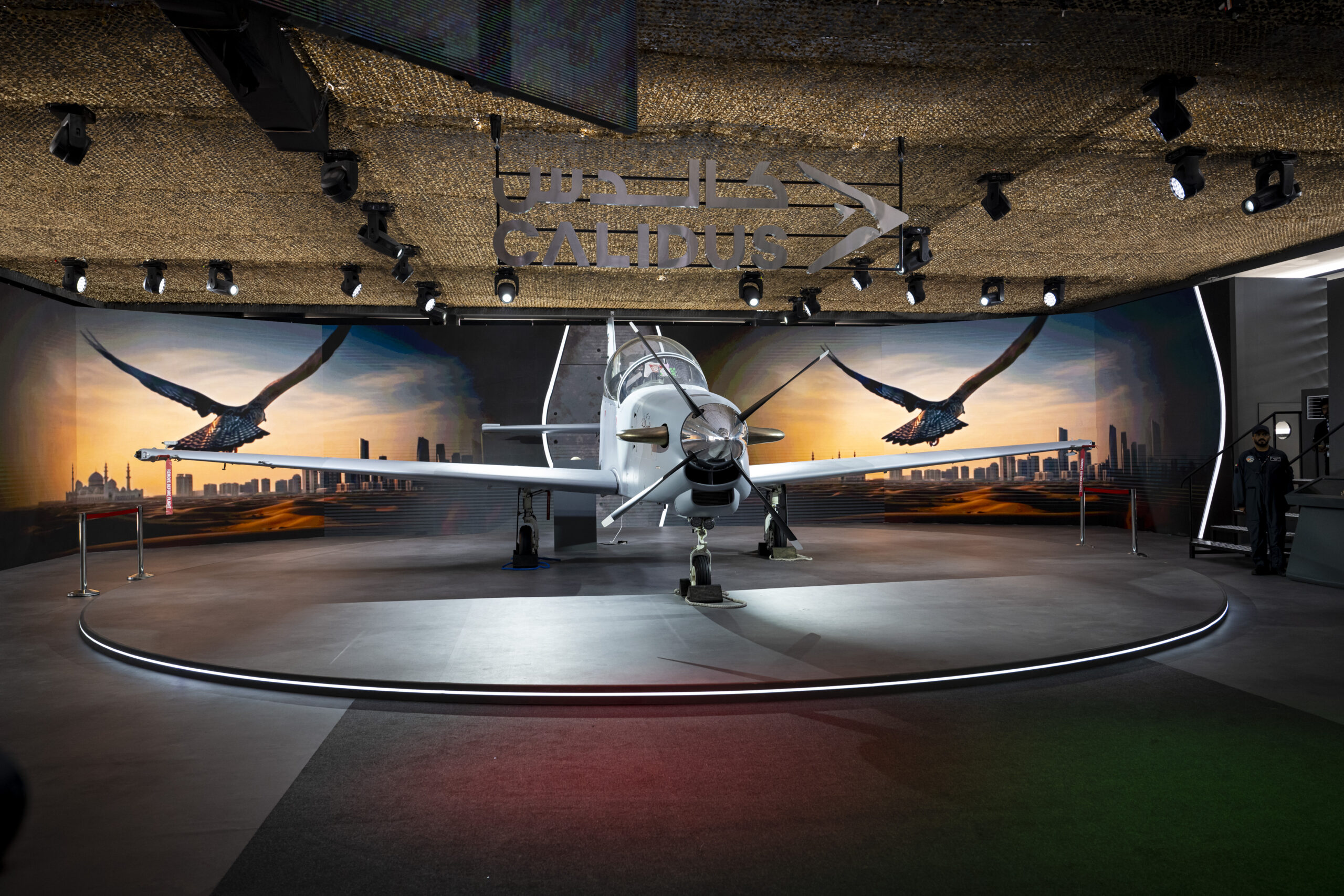
Calidus Holding Group has become a test case for where the UAE sits on the path from integrator to exporter. The Abu Dhabi-based firm’s flagship program is the B-250 aircraft – in both its light attack and advanced trainer versions.
The B-250 is a single engine turboprop light attack aircraft with dual tandem cockpits designed for counterinsurgency, close air support, ISR missions and advanced flight and mission. Key features include a carbon-fiber airframe, a Pratt & Whitney PT6A-68 turboprop engine (~1,600 shp) delivering speeds around 280 knots with endurance up to 9 hours, external payload capacity of ~1,800 kg across seven hardpoints, a modern integrated mission suite with EO/IR sensors, and fully integrated smart weapons mission systems. The trainer version, B-250T, is a single engine all-composite turbo-propeller aircraft with two tandem pilot stations designed to deliver cost-effective and unprecedented training value.
The B-250 is presented as a fully developed and manufactured Emirati aircraft – the first of its kind in the UAE and the region – with complete qualification and testing. The UAE Air Force placed an initial order for the aircraft aimed at demonstrating readiness rates and sustainment performance.
The B-250 is not a paper project rather it’s a fielded, certified platform anchoring domestic industrial skills. Long-term export credibility will be shaped by the ability to address multi-year sustainment, upgrade support, and customer satisfaction, not airshow visibility.
Reported interest from Angola via a Letter of Intent for 12 B-250T provides a concrete illustration of exporter-phase demands. If converted into a firm contract, an Angolan order would test pilot and maintainer training pipelines, spare parts availability, software updates, and aircraft availability in demanding operating environments. Successful execution would validate the UAE exporter narrative; sustainment shortfalls would carry reputational costs beyond a single program.
Expanding the Platform Family
The B-150, a single engine low-wing monoplane for ISR missions, and the B-100, a modern training aircraft that combines the dynamic handling of a jet with the precision of a smart trainer, demonstrate Calidus is exploring an entire platform family. On the unmanned side, Calidus is expanding into the broader uncrewed systems ecosystem, including the UAE’s first integrated counter-drone defense system DAMITA, the short range air defense system the Shield, and partnerships to produce VTOL aircraft targeting ISR and autonomous logistics. These initiatives show the broader UAE aerospace ecosystem moving into systems-of-systems thinking combining manned aircraft, unmanned platforms, and counter-UAS capabilities.
Uncrewed Systems, Autonomy, and Space: Strategic Accelerants
Uncrewed systems and space activities offer structurally different opportunities – shorter development cycles, lower capital intensity, and growing value from software, data, and autonomy.
The UAE drone ecosystem including EDGE’s armed UAVs and maritime uncrewed platforms has evolved from demonstrations to operational systems. The more consequential shift lies in autonomy development: localizing mission software, integrating sensors and electronic warfare payloads across multi-domain platforms, and building test ranges for autonomous operations. This plays to middle-power comparative advantages – autonomy can deliver disproportionate strategic influence without full-spectrum aerospace manufacturing capacity.
In parallel, the UAE has built credible space presence including the Emirates Mars Mission and multiple Earth-observation platforms, underpinned by a National Space Policy and National Space Strategy 2030. Federal Decree Law No. 46 of 2023 established a modern regulatory framework covering licensing, private-sector participation, and spectrum use. The emerging space economy strategy emphasizes downstream services, private-sector participation, and upstream ambitions in satellite manufacturing. For aerospace, space capability is strategically complementary—shared investments in sensors, propulsion, AI analytics, and secure communications feed both sectors, reinforcing UAE positioning as a dual-use technology hub.
AI, Compute, and Development Velocity
Access to advanced AI compute has become a binding constraint in modern aerospace innovation. Training autonomy models, running digital twins, performing predictive maintenance, and fusing multi-sensor data all require substantial compute infrastructure.
The UAE’s investments in AI labs, data centers, and sovereign cloud capacity have direct aerospace implications. Compute availability functions as a force multiplier through risk reduction via digital twins allowing virtual testing, integration speed via AI-assisted integration, and sustainment analytics extending component life and increasing readiness. As global export controls tighten around advanced chips, UAE ability to secure long-term access will be central to sustaining aerospace innovation tempo.
Aerospace industrialization requires long-cycle investment and tolerance for delayed returns. The UAE has deployed patient capital through sovereign funds, allowing manufacturing, MRO, and R&D programs to mature. Talent policy has complemented this with long-term residency options, targeted scholarships, and partnerships with universities and OEMs.
Yet structural constraints remain:
Export sustainment risk: The primary credibility test will be whether the UAE can support export customers reliably over decades.
Certification and quality scaling: Maintaining rigorous quality systems under expansion pressure is non-trivial.
Supply-chain geopolitics: Access to certain avionics, propulsion components, and advanced materials is constrained by export controls.
Crowded markets: Global markets for trainer aircraft and drones are increasingly saturated and price competitive.
These constraints don’t invalidate UAE strategy but define conditions under which exporter ambitions will succeed or stall.
Policy Implications and Recommendations
The UAE’s aerospace trajectory demonstrates that a middle power can convert procurement scale, patient capital, and coherent governance into meaningful aerospace capabilities. The importer and integrator phases have largely succeeded; the exporter phase is underway and will determine long-term durability.
For Emirati policymakers and international partners, several implications follow:
- Prioritize sustainment over new airframes. Strategic value now lies in strengthening export sustainment, training ecosystems, and software upgrade pipelines.
- Deepen regulatory and certification capacity. Robust national airworthiness, safety, and space-sector regulators aligned with international standards will be critical to export credibility.
- Protect and expand AI and compute access. Long-term agreements on advanced chips, AI infrastructure, and sovereign cloud resources should be treated as strategic enablers.
- Use space and uncrewed systems as innovation sandboxes. These domains allow faster experimentation in autonomy, sensing, and data services that can migrate back into crewed systems.
- Anchor talent with institutional depth. Lasting capability will require Emirati engineers and managers embedded in program offices, regulatory agencies, and industrial leadership roles.
- Manage geopolitical exposure. As Emirati aerospace exports expand, foreign policy and defense diplomacy will increasingly intersect with export-control regimes. Institutionalizing risk assessment at the interface of industry and foreign policy will be essential.
Over the next decade, three metrics will offer the clearest signal of whether the UAE has truly become a durable aerospace exporter:
- The performance of early export programs – particularly the B-250 aircraft – in delivery, availability, and customer satisfaction.
- The ability to retain and grow high-skill aerospace talent in global competition for engineers and program leaders.
- The integration of aerospace, space, AI, and advanced manufacturing into a coherent technology ecosystem.
If the UAE can sustain discipline on these fronts and prove that programs like the B-250 family can be supported reliably across multiple customer bases and geographies, it is well positioned to consolidate its status as a middle-power aerospace and space hub. Such a hub would leverage selective depth, autonomy, and compute-driven services to punch above its weight in regional and global security architectures, offering both competitive capability and operational reliability to allies and partners.
Article by: Bharath Gopalaswamy, PhD
Bharath Gopalaswamy, PhD is an aerospace and defense expert with extensive experience in AI, space technologies, and advanced systems. He is the author of Final Frontier: India and Space Security. He can be reached at bharath@districtconsultancy.org