ThinKom and Space Systems Command Successfully Demonstrate GECKO, a Scalable, Multi-Orbit Ground SATCOM System
Live demonstration validates coherent digital beamforming, simultaneous multi-orbit tracking and a transportable, containerized configuration
ThinKom Solutions Inc. (ThinKom) and Systems Delta 88 (SYD 88), a unit of the U.S. Space Force’s Space Systems Command (SSC), have successfully completed a live demonstration of the Ground Entry Combined K/Ka-band Operation (GECKO) system at ThinKom’s facilities. This rapidly deployable, scalable SATCOM node combines reliable, multi-orbit connectivity with high performance, entirely integrated into a standard 20-foot ISO shipping container to provide a discreet, “hide-in-plain-sight” transportable ground entry point where traditional infrastructure is unavailable.
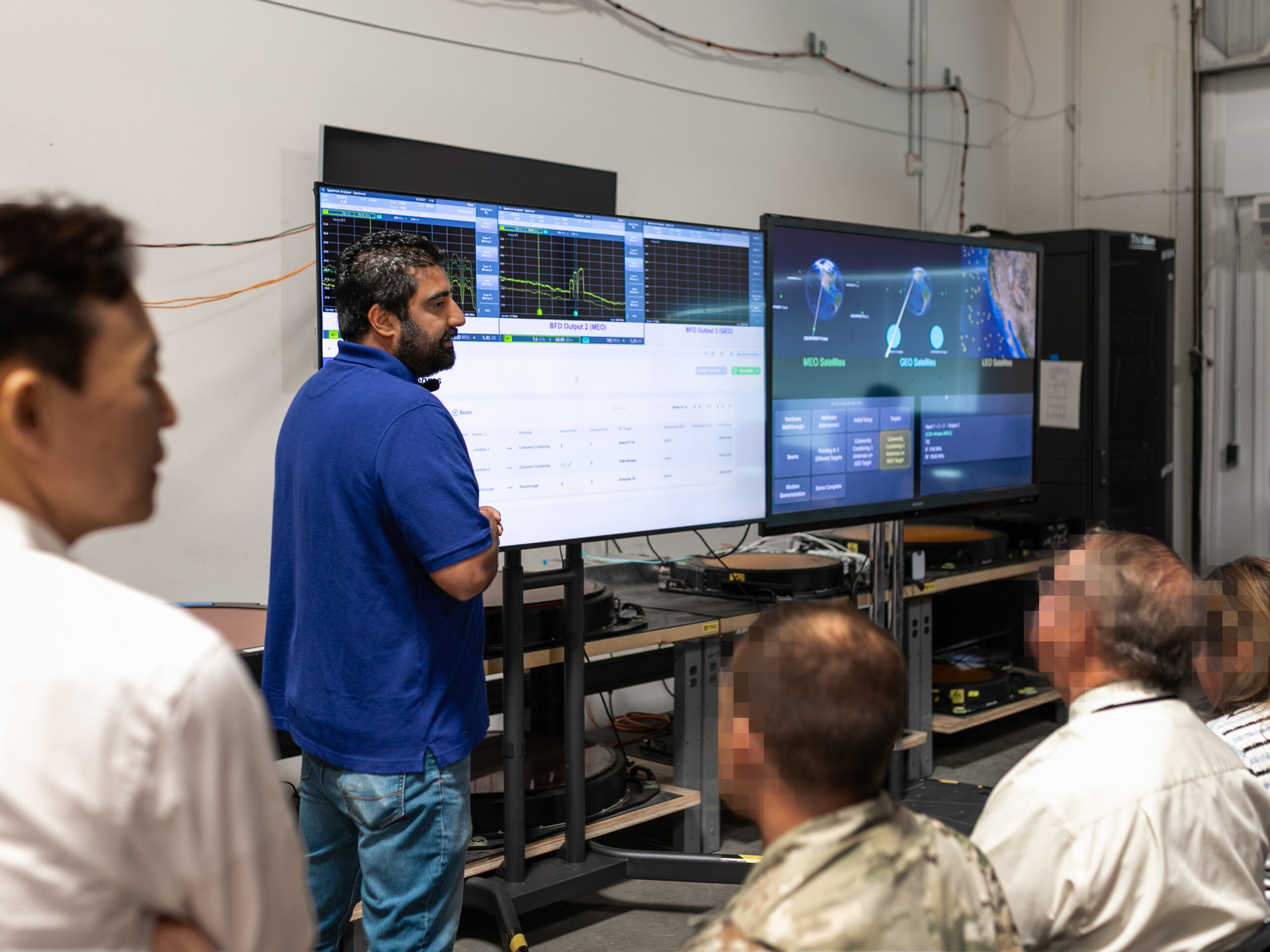
The GECKO system utilizes ThinKom’s low-profile Variable Inclination Continuous Transverse Stub (VICTS) phased array modules paired with an advanced digital Beam Forming Device (BFD). Designed to scale modularly as mission requirements evolve, the demonstrated configuration features three K-band receive arrays (17.7–21.2 GHz) and one Ka-band transmit array (27.5–31.0 GHz). During the live demonstration, the system coherently combined three receive antennas, significantly increasing the signal-to-noise ratio to 2.5x the level of a single array. The BFD then utilized these same antennas as three independent beams to simultaneously track one Medium Earth Orbit (MEO) and lock on two different Geostationary Earth Orbit (GEO) satellites.
This proven capability ensures robust, phase-continuous operations across satellite constellations, delivering a resilient SATCOM system that overcomes the single-link limitations and vulnerable visual footprint of large, traditional parabolic dishes. In addition to being a high-availability hybrid network node, system capability requirements can be split between systems, bypassing localized atmospheric attenuation through distributed geographic site diversity.
“Working with SSC on the GECKO project is another opportunity to put secure, reliable communications where they’re needed most,” said Bill Milroy, CTO and co-founder at ThinKom. “Our goal is to give warfighters communications capabilities that can be deployed quickly, remain concealed, and keep them connected in dangerous and contested environments.”
Developed through a Small Business Innovation Research (SBIR) project in partnership with Air Force Research Lab (AFRL) and SpaceWERX under SYD 88/S9, this event marks a critical milestone in the broader Global Backup Gateway (GoBaG) initiative, a high-priority military project funded by the U.S. Space Force’s SSC.
About ThinKom
Available in S- through E-band frequencies and a range of fixed-site and mobile form factors, ThinKom’s modular, digitally combined ground stations are configured to customer-specific network, SWaP and performance requirements.
Based in Hawthorne, California, ThinKom Solutions, Inc. is a leading manufacturer of high-performance phased array satcom antennas and antenna systems for commercial, government, and defense applications, including Inflight Connectivity (IFC), Counter-Uncrewed Aircraft Systems (C-UAS), Ground Stations and Intelligence, Surveillance, and Reconnaissance (ISR). ThinKom’s adaptable antenna systems leverage proven, proprietary, and patented VICTS technology to deliver fast, resilient, and reliable performance in all of our core markets.
About SpaceWERX
As the innovation arm of the U.S. Space Force and a unique division within AFWERX, SpaceWERX inspires and empowers collaboration with innovators to accelerate capabilities and shape our future in space. Headquartered in Los Angeles, SpaceWERX employs 40 military, civilian and contractor personnel executing an annual $457 million budget. Additionally, SpaceWERX partners with Space Systems Command’s Commercial Space Office (COMSO) as a collaborative program. Since it was aligned under AFRL in Aug. 2021, SpaceWERX has awarded over 1,470 contracts worth more than $1.46 billion to strengthen the U.S. defense industrial base and drive faster technology transition to operational capability.
About AFRL
The Air Force Research Laboratory is the primary scientific research and development center for the Department of the Air Force. AFRL plays an integral role in leading the discovery, development, and integration of affordable warfighting technologies for our air, space and cyberspace force. With a workforce of more than 12,500 across nine technology areas and 40 other operations across the globe, AFRL provides a diverse portfolio of science and technology ranging from fundamental to advanced research and technology development.