The UK’s digital strategy for the Future Combat Air System (FCAS) and its role in enabling the next generation of combat air capability.
FCAS Digital Vision And Purpose
- FCAS aims to become the most digitally advanced global combat-air enterprise, working faster and more collaboratively.
- Digital integration, automation and continual technology adoption will support operational advantage and capability upgrades throughout the system’s life.
International Programme And Integration
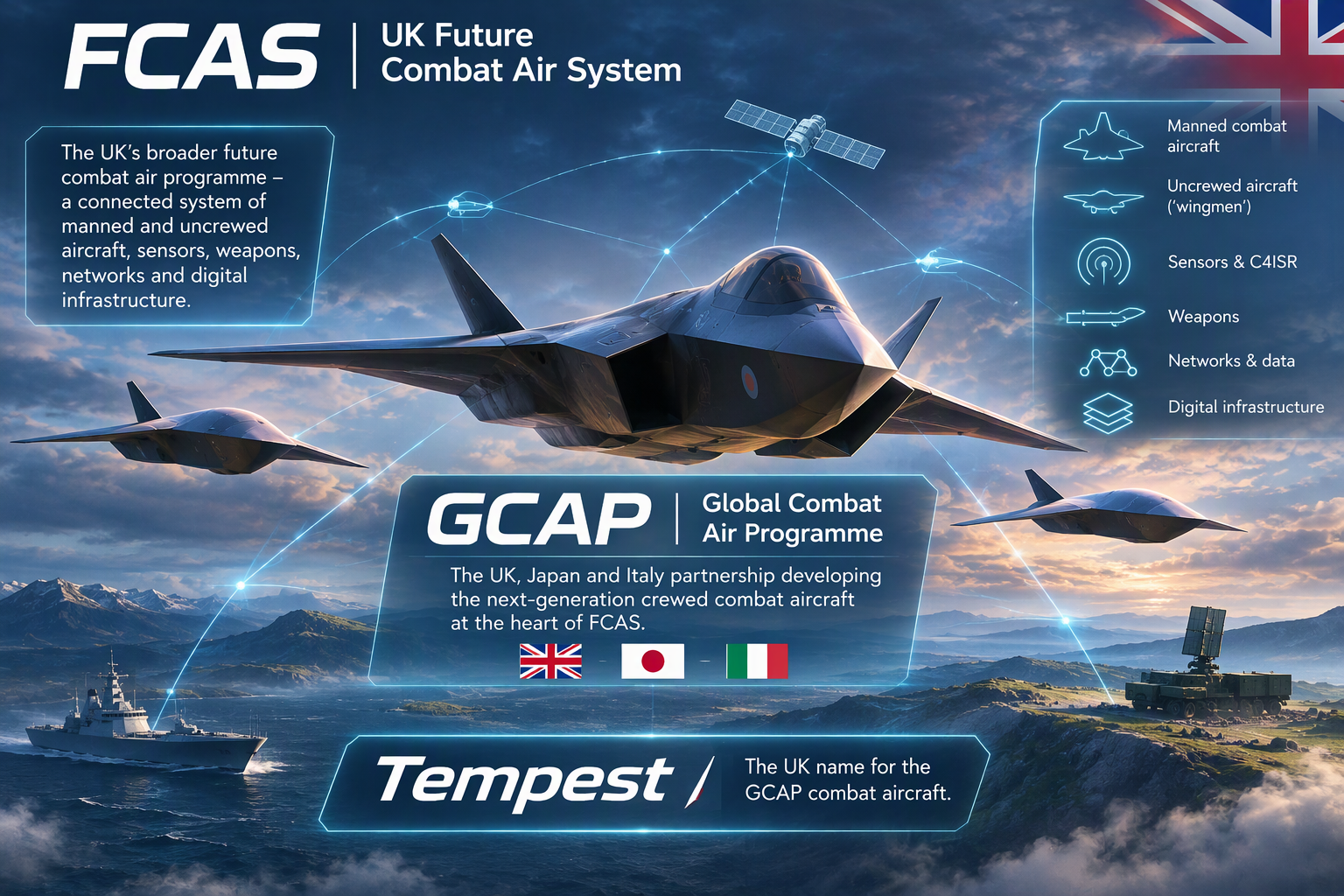
GCAP, led by the UK, Japan and Italy, delivers the Core Platform. FCAS integrates it with UK-specific systems, autonomous platforms, effectors and wider defence capabilities.
The programme must align international partners, industry, MOD systems and allies while balancing shared standards with national security and intellectual-property requirements.
Digital Engineering And Collaboration
Model-based engineering, connected digital threads and immersive simulation are intended to accelerate design, testing, certification and upgrades.
Global collaborative environments must support secure work across organisations, security classifications and domains, with scalable infrastructure and high-performance computing.
Data Governance And Cyber Resilience
FCAS will manage large, varied data sets as strategic assets, using common standards, metadata, governance and automation to enable timely human and machine use.
Cyber security, resilient infrastructure, data protection and controlled access are essential across development and operational environments.
Support, Workforce And Adaptation
Digital technologies, accessible data and automation will improve maintenance, training, supply chains and through-life support.
A digitally skilled workforce, Digital First culture and continual learning will help FCAS adapt quickly to evolving requirements and technology.
Through-Life Support and Digital Models
FCAS support systems must align with GCAP and wider MOD programmes, drawing on shared capabilities, data, and common standards.
Digital models can improve support, configuration, prognostics, testing, training, and weapons integration.
Innovation and Technology Adoption
An aligned innovation pipeline will connect FCAS with Defence initiatives, industry, SMEs, and academia to assess and integrate emerging technologies.
Rapid adoption of AI, autonomy, quantum technologies, and other advances will sustain capability, cyber resilience, and UK industrial growth.
Digital Workforce and Skills
FCAS needs an adaptable, digitally skilled Whole Force across military, government, industry, and international partners.
Leadership, inclusive recruitment, continuous training, and cyber awareness will help embed digital skills across all professions.
Digital First Ways of Working
A collaborative Digital First culture will use technology, information, and AI insights to improve efficiency and decision-making.
Continuous learning, secure practices, and international and industrial collaboration will support lasting improvement.
Interoperable Multi-Domain Warfighting
A secure, adaptable digital foundation will connect FCAS with UK forces, allies, and partners across different operating configurations.
Integrated crewed, uncrewed, and autonomous capabilities will share information to support mission enablement and faster, more effective targeting.