Indra Group Accelerates Into The Future, Doubling Its Global Presence As A Leader In Dual-Use Technologies For Critical Industries By Integrating And Enhancing Its Capabilities With IndraMind
- With its Forward2030 strategic plan, it will be transformed into a next-generation company that simultaneously executes, evolves and expands its business, with a growth plan that improves its profitability and productivity while more than doubling its revenues with respect to the end of 2025
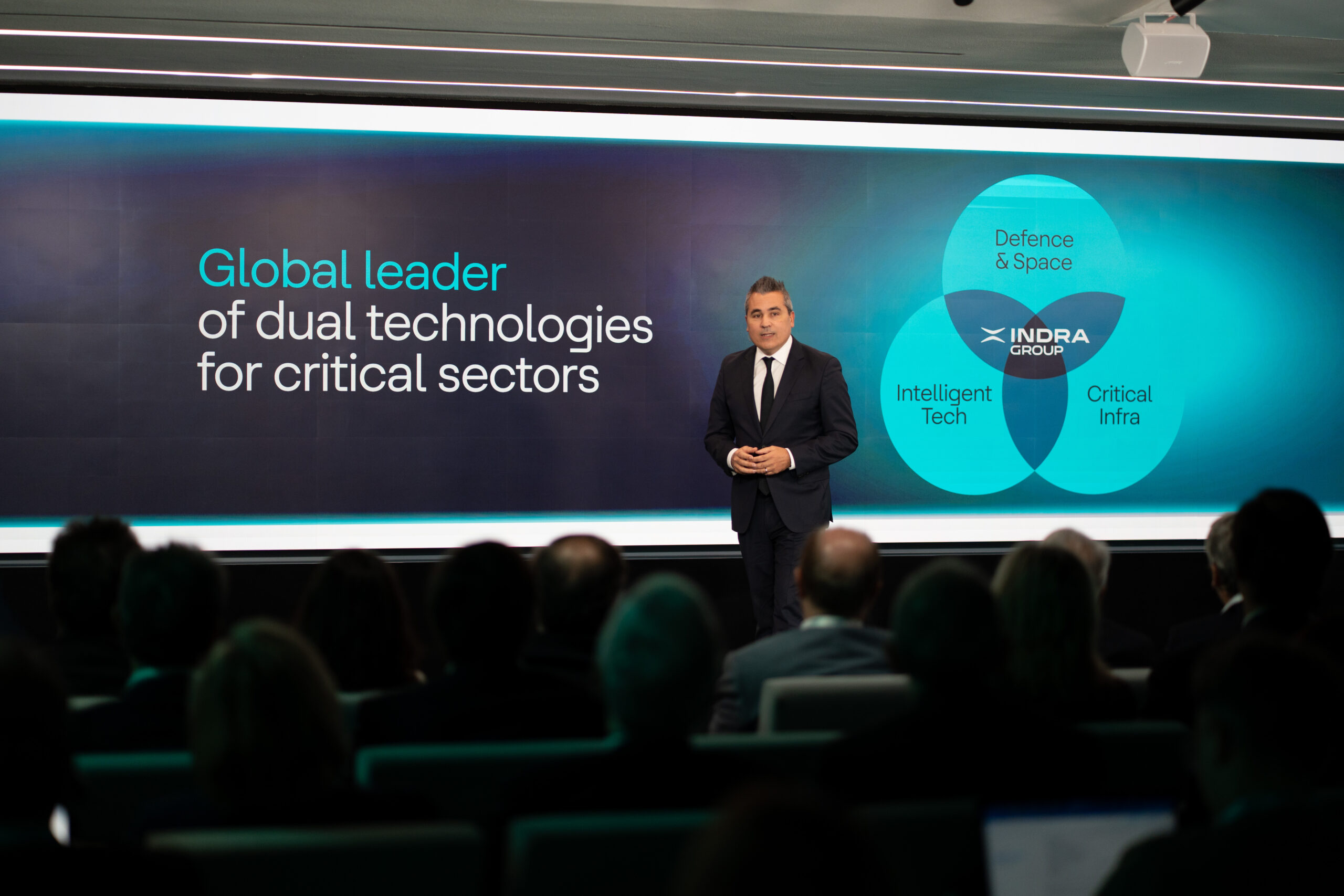
- To achieve this, it will evolve into a single integrated system that connects the Group’s capabilities and unlocks its full potential, with a unique value proposition as a global leader of dual-use technologies for critical sectors focusing on Defence and Space, Smart Technology, and Critical Infrastructures
- IndraMind is becoming a cross-cutting strategic asset for the Group, connecting the military and civilian domains while offering a sovereign layer of AI, command and control, and integration, and, with a €400-million backlog, positioning itself at the forefront of Spanish sovereign artificial intelligence
- It will become a driver of growth and profitability alongside Defence and Space, combining backlog execution and distinctive proprietary products so as to expand throughout Europe; meanwhile, Air Traffic and Mobility will be at the forefront of international growth, focusing on North America, Europe, and the Middle East, while Minsait will provide professionals and higher-value-added technological assets
- Indra will assign €1 billion of its resources to RDI and develop a unique group-wide offering to double the economic potential of its products by 2030, and it will invest €240 million in talent transformation through an unprecedented re-skilling and up-skilling program
- As for its financial goals, by 2030 Indra aims to achieve revenues totaling over €12 billion, an EBIT above €1.5 billion, and an EBIT margin greater than 12.5%, with its cash generation amounting to more than €3.1 billion between 2026 and 2030
- Indra Group’s ambition is to achieve €20 billion in revenues by 2035
Indra Group presents its new Forward2030 strategic plan today as part of its Investor Day, seeking to reinforce its position as a global leader of dual-use technologies for critical industries with a unique value proposition based on three pillars: Defence and Space, Smart Technology, and Critical Infrastructures.
To achieve this, Indra will evolve towards a single integrated system that connects all of the Group’s capabilities and brings them to their full potential through IndraMind, ongoing innovation, and a new operating model, one which is capable of meeting today’s needs while building a competitive range of products for the future in order to reinforce its position as a product company. The Group’s combined strength will enable the company to create unique value propositions and enhance its technological talent.
“The aim of Forward2030 is to turn Indra into a new company that ceases to be a mere business aggregator and becomes an integrated and synergistic firm. Indra will base this transformational project on three pillars that we’ve called E3. These pillars will seek to execute, evolve, and expand its business from day one and, in parallel, integrate AI into all its processes with a unique competitive offering powered by IndraMind’s capabilities. Indra will thus meet its delivery deadlines and ensure quality while positioning itself for the future”, explains Indra Group chairman Ángel Simón.
Simón highlighted the changes in the Group’s corporate governance, emphasizing that “this strategic plan is the result of the work and unanimous agreement of Indra’s Board of Directors, which has simplified its structure and reorganized its committees so as to focus on overseeing and supporting the task that lies ahead for Indra’s CEO and the entire team”.
Josep Maria Recasens, Indra Group’s CEO, stresses that the Forward2030 plan will seek to transform Indra into a “nextgen” company capable of executing the current programs with quality and reliability, while building the technology, industrial capacity, and partnerships set to determine its competitiveness five to ten years hence.
“The boundaries between the civilian world and defence are disappearing, and this will change the rules of the game. This new approach will require the scale and resilience of well-established players within the industry and the flexibility and innovation of newcomers. Indra Group natively brings both sets of capabilities to the table, and its track record in defence, critical sectors, and technological services places it in a unique position to succeed in this new environment“, he pointed out.
“Indra has solid foundations to build on, starting with an order backlog worth over €22 billion, but it will also be reinforced by a unique product offering that gives us scalability. Forward2030 thus lays the groundwork to enable Indra to collect €20 billion in revenues by 2035, become a truly global company, with 50% of its revenues generated abroad, and continue expanding its margins through a combination of higher-value businesses and operational excellence“, explained Recasens.
Indra Group’s CEO outlined the three “E”s model underpinning the new plan:
- Execute-E1 – Deliver the order backlog and routine activities on time and ensure quality, focusing on the customer, the industrial scale, and reliability to honor commitments.
- Evolve-E2 – Transform the way the Group operates to maximize its potential as a single integrated system, shifting from executing programs to developing a competitive product portfolio.
- Expand-E3 – Export competitive products and double down on IndraMind so as to harness new opportunities, with next-generation solutions for hybrid warfare in the military and civilian fields.
Meeting delivery deadlines and quality as a competitive edge
Approximately 70% of Indra Group’s €22-billion order backlog will be converted into revenues by 2030, thus providing a high degree of visibility. In addition, €12 billion alone constitutes the physical order backlog scheduled for delivery by 2030. This primarily consists of deliveries under the Special Modernization Programs (SPMs), air traffic control radars for the United States, equipment for Transport for London, and deliveries for the IRIS2 space program.
Indra has established the conditions for a successful delivery by implementing an integrated operating model (COO), defining a scalable make-vs-buy model, and building a stable industrial, engineering, and partner-based footprint with a fast, cost-effective, and replicable industrialization model. Moreover, the company is investing ahead of demand, having defined a clear roadmap for each of its most important programs, and demonstrating its ability to meet its deadlines.
This entire transformation is designed to reduce the backlog conversion risk and create a more scalable and capital-efficient Indra with higher margins.
Expanding the portfolio to increase competitiveness
As part of its evolution, Indra is investing in products and RDI, with a €1 billion investment of its resources between 2026 and 2030 (four times more than it has invested over the past five years), and setting itself greater goals by doubling its investment as a percentage of its revenues. In this way, it will seek to accelerate its transformation into a company with a greater focus on products and technology, in partnership with the entire ecosystem, and become more resilient in the face of geopolitical uncertainties through dual-use technology.
Indra has planned the evolution and launch of more than 200 products, following an unprecedented industry-by-industry analysis converging in a single Group portfolio with 70% dual-use potential, integrated AI in 90% of cases, and development cycles that are up to three times faster.
Dual-use emerging technologies that multiply product and market opportunities will also be prioritized. These include artificial intelligence, advanced electronics, new sensors, advanced communications, quantum technologies, autonomous systems, and directed energy.
In this regard, Indra expects to expand the reach of its products and double its TAM (total addressable market) and the economic potential of the Group’s products, with an upturn in revenues of between €3 billion and €5 billion by 2035.
Transformation towards a single integrated system
In order to execute and evolve, the organization is being transformed by a new operating model which is less complex and more flexible and specialized, connecting the Group’s capabilities and unlocking its full potential through a unique value proposition. It is thus turning diversity into a competitive edge by addressing as a Group customer needs that no single business could meet on its own.
People lie at the heart of this transformation. Indra intends to maintain a stable workforce of around 56,000 employees and enhance their technological talent by means of an unprecedented re-skilling and up-skilling program.
Another key to Indra’s growth is its ecosystem of over 2,100 alliances, with partners that evolve from their role as suppliers and become vital partners in the company’s strategy.
International growth
Indra Group’s international growth is a result of its ability to meet its deadlines, ensure quality, and create a competitive range of products in line with the E3 model. The latter’s success is best exemplified by the Air Traffic business, around 88% of whose revenues come from the international market, an end-to-end offering comprising 16 products that cover every stage of the flight, and proven delivery capabilities reflected in its all-time high figures in 2026. Other examples include its Lanza radars and ticketing systems for public transportation.
Indra’s goal is to replicate this formula across the rest of its strategic offering, with the aim of making more than 50% of the Group’s 220-plus products exportable by 2030.
The new strategic plan regards three regions as priorities: Europe, North America, and the Middle East.
Scaling next-gen solutions with IndraMind
In keeping with the Forward2030 plan, IndraMind will become a cross-cutting strategic asset that unifies the Group by connecting the military, security, and critical civilian domains, while providing sovereign AI, command and control (C2), and integration capabilities.
Beyond its impact on the Group’s transformation, the goal for 2030 is to turn IndraMind into the go-to firm in Spain for sovereign artificial intelligence, with a leading AI platform and a competitive portfolio of next-generation solutions, and subsequently expand it abroad.
IndraMind already boasts a €400-million order backlog, having developed 15 solutions and signed contracts for eight of them, and it employs over 3,000 experts in AI. By 2030 it will have scaled up to €1.2 billion in revenues, with a balanced 50/50 split between defence solutions and civilian solutions.
In contrast to other competitors, its sovereign offering in the area of Security and Defence extends across the AI value chain, encompassing cognitive superiority, autonomous operations, command and control, and greater cyber resilience.
Defence and Space: an engine of growth, profitability, and a change of scale
Together with IndraMind, Defence and Space will become drivers of growth and profitability, combining the execution of its order backlog and distinctive proprietary products to expand throughout Europe.
In Defence, Indra will seek to establish itself as a major prime contractor in Europe, based on a backlog amounting to around €11.4 billion, a new generation of ground vehicles, and its cutting-edge solutions in command and control, electronic warfare, radar, communications, autonomous systems, drones, and next-generation technologies.
One of its featured products is Land Next Gen, a modular, hybrid-electric, manned/unmanned, software-defined ground platform with seven types of missions. Indra plans to invest around €20 million of its resources in its development and make it available in 2028–2029. Its new LAB-X production model will make the development cycle three times faster, and IndraMind will help transform the data obtained into knowledge.
Meanwhile, Space will radically change its scale following the acquisition of Hispasat and Hisdesat, driven by the €1.9-billion European IRIS² program and the SPAINSAT-NG and PAZ II programs. The goal is to become Europe’s leading integrator of end-to-end missions and a leading technological player in dual-use space applications by 2030. The space initiative is thus presented not merely as commercial growth, but as one which is directly linked to defence, European sovereignty, and strategic autonomy.
The priorities include executing the major programs, developing proprietary technology (especially in payloads, Direct-to-Device, and the LEO ground segment) and harnessing new opportunities such as SEOT NG, Space Shield, and Robust PNT.
Minsait changes its model: from volume to value
Minsait will undergo a profound transformation and continue transforming its business mix toward a higher-value offering based on AI, data, proprietary solutions, and strategic services, all with an ambitious goal: to increase its strategic/AI offering from around 40% in 2025 to 70% by 2030.
Through this transformation, Indra Group will aim to position Minsait as a strategic partner and an orchestrator of its customers’ transformations, with technological solutions ranging from AI to any subsequent technological evolutions, contribute technological assets, provide customer access to the Group as a whole, and become a destination for technological talent supported by a workforce enhanced by AI and intensive re-skilling. Another of its goals will be to geographically rebalance the business towards higher-value and lower-risk activities.
The expected financial effect will be to increase the EBIT margin from around 6.4% in 2025 to 8% in 2030.
Air Traffic & Mobility: at the forefront of internationalization
Air Traffic and Mobility will lead Indra Group’s international growth, thanks to their proprietary products and their well-established positions in the three priority regions.
Air Traffic will aim to become the world number one in terms of revenues, backed by its global presence, its industrial capacity to execute an order backlog worth more than €1.4 billion (with no additional CAPEX), with over 450 radars delivered and more than 185 contracted in the United States, and the speedier marketing of products such as its digital tower, UTM platform, and automation systems.
Meanwhile, Mobility will seek to leverage its existing references, particularly to accelerate its internationalization and become a global flagship of urban mobility, rank among the top five global toll operators, and become a leader in smart mobility technology. It will start with an order book worth approximately €1.7 billion and major projects for strategic customers such as Transport for London, the Washington Metro, and several highways in the US.