Hang On In There
Aircraft engines have a fixed Time On Wing before being removed for maintenance. Manufacturers usually try and extend that time over the years but some of the latest models were unable to meet the original requirements. Ian Harbison reports.
It seems engine manufacturers overreached themselves. The push for higher temperatures and pressures for greater fuel efficiency and the use of more exotic materials dd not achieve the expected results, resulting in complex rectification programmes.
CFM
The CFM LEAP engine has been seriously affected by reliability problems. In December, the company received FAA and EASA certification for an updated HPT hardware durability kit for the LEAP-1A engines that power Airbus A320neo family aircraft. The kit is part of a Durability Improvement Package (DIP) and is designed to more than double Time On Wing (TOW), especially in hot and harsh environments, and includes the HPT stage 1 blade, HPT stage 1 nozzle, and forward inner nozzle support.
To ensure that the improvements would address durability challenges in those conditions, CFM worked with a team of geologists to engineer dust that mimicked what engines experience in these environments around the world. Using a proprietary dust ingestion system, the company was able to replicate HPT blade wear that operators were seeing in the field. This allowed CFM to design, test and validate improvements to increase the durability and TOW of these parts.
The LEAP-1A durability kit is now incorporated into all deliveries and shop visits and the company is working with Boeing to certify the LEAP-1B durability kit in the first half of 2026.
The company says it has now resolved early reliability issues and LEAP engines are now performing at CFM56 levels, meaning low levels of flight schedule interruptions. The focus is now on two areas that will bring LEAP engines to full maturity: durability, which means longer time on wing (TOW); and mature, low levels of burden, which translates to smoother, more predictable operations.
To reduce the burden, it introduced the reverse bleed system (RBS) to the LEAP-1A last year. This is a cooling system that reduces the need for on-wing fuel nozzle replacements.
RBS has been shipped on new and overhauled engines since mid-2024, with additional retrofits happening in the field. More than 40% of the LEAP-1A fleet is now operating with the RBS, with the system performing as designed. Once the system is fully deployed throughout the fleet, CFM anticipates fuel nozzle replacement to generally occur only during performance restoration shop visits. It is now working closely with Boeing to introduce the RBS to LEAP-1B engines.
Installation training for the RBS is available at four CFM facilities: the GE Customer Technical Education Center (CTEC) in Springdale, Ohio; Safran Aircraft Engines Customer Training Center (CTC) in Montereau, France; Aero Engine Maintenance Training Center (AEMTC) in Guanghan, China; and CFM Aircraft Engine Support South Asia (CFMAESSA) in Hyderabad, India.
The company says these durability enhancements have supported a win rate of over 70% on the A320 family since 2023, but that has come at a price. Announcing the first half year results for Airbus, where the commercial performance in the first half of 2025 had been strong across the company, CEO Guillaume Faury said. “We are producing aircraft in line with our plans but deliveries are backloaded as we face persistent engine supply issues on the A320 programme.”
In fact, at the end of June there were around 60 grounded aircraft awaiting delivery, the majority with LEAP-1A engines. This is expected to peak over the summer before it normalises and, said an Airbus spokesperson, the company will continue to work closely with the engine makers to recover in the second half of the year and to deliver on 2025 commitments.
GE Aerospace
The GEnx engine, which was launched in 2011 and powers the Boeing 787 and 747-8, had a durability kit introduced in 2021.
This resulted in a more than 2.5 times increase in TOW, with the fleet leader in hot and harsh environments approaching 4,000 cycles and still running. This means customers are keeping engines on wing about five years between shop visits and even longer in neutral environments. The company says that has been a market differentiator, with a 90% plus win rate since 2023.
And durability has become a key feature of engine development. The GE9X, for the Boeing 777X, is most tested engine in GE Aerospace history, with more than 30,000 cycles, the equivalent of six years of commercial flying. Drawing on GEnx and LEAP experience, the GE9X is the first engine to have dust testing completed prior to launch, resulting in a second iteration of the HPT blades.
Speaking at the GE 2Q25 Earnings Call, Lawrence Culp, GE Aerospace – Chairman of the Board, Chief Executive Officer, commented on the CFM RISE Open Fan project. To date, over 350 tests have been completed with an early focus on durability. This included advancing new HPT blade cooling technology and testing full-size fan blades, along with more than 3,000 endurance cycles.
He added that RISE’s Open Fan architecture gains efficiency through the fan system rather than the core. This reduces the need to push the core to higher temperatures as much as a ducted engine, a key driver of today’s engine removals.
Pratt & Whitney
Amy Comer, Vice President, GTF Programs, who says AOGs have stabilised and are expected to come down in the second half of the year. The company remains on track for a more than 30% increase in MRO output for the full year, which is a key enabler to reducing AOGs. That increase is a combination of added capacity and improvements in-shop turnaround time, which continues to trend positively.
Part of this comes from continuing investment in the GTF MRO network of 21 global maintenance facilities to support the growing fleet, and it will continue to expand. Announced so far in 2025 have been plans to open a new GTF MRO facility with Sanad in Abu Dhabi, the first GTF MRO facility in the Middle East; an expanded agreement with Delta TechOps for a more than 30% increase in annual GTF overhaul capacity for the PW1500G engine that powers the A220 aircraft; an agreement to expand GTF overhaul capacity across all of MTU’s facilities, increasing MTU’s annual capacity to up to 600 shop visits across all GTF models; and the addition of ITP as the twenty-first shop in the GTF MRO network and the eighth in Europe.
She adds that the company is in a transformative period for MRO, with the acceleration of new technology applications such as robotics, adaptive machining/welding, additive manufacturing, real-time tooling and material location systems in facilities. One example is the robotic system at the Eagle Services Asia facility in Singapore that assembles the rotors of the High-Pressure Compressor, maintaining tight assembly tolerances, repeatedly, with key process quality data recorded and trended.
In addition, approximately 40 component repair facilities are in the Global Service Network that complements the global engine centres. The ability to develop and execute innovative repairs at the part level is critical for optimising material flow.
Improvements have also been made in the production process and GTF engines being delivered today are of a significantly improved standard from those early in the program, she notes. MRO also has a role to play. From earlier this year, new hot section parts have been incorporated during shop visits that should provide a significant benefit to TOW, especially in harsh environments. These include an optimised cooling configuration for the combustor and HPT. This new configuration will be installed in production engines from early next year.
New durability ratings are being developed to provide the option for a lower thrust rating to reduce hot section temperatures during climb and extending TOW. Certification is ongoing and the rating will be incorporated with an engine software update in 2026.
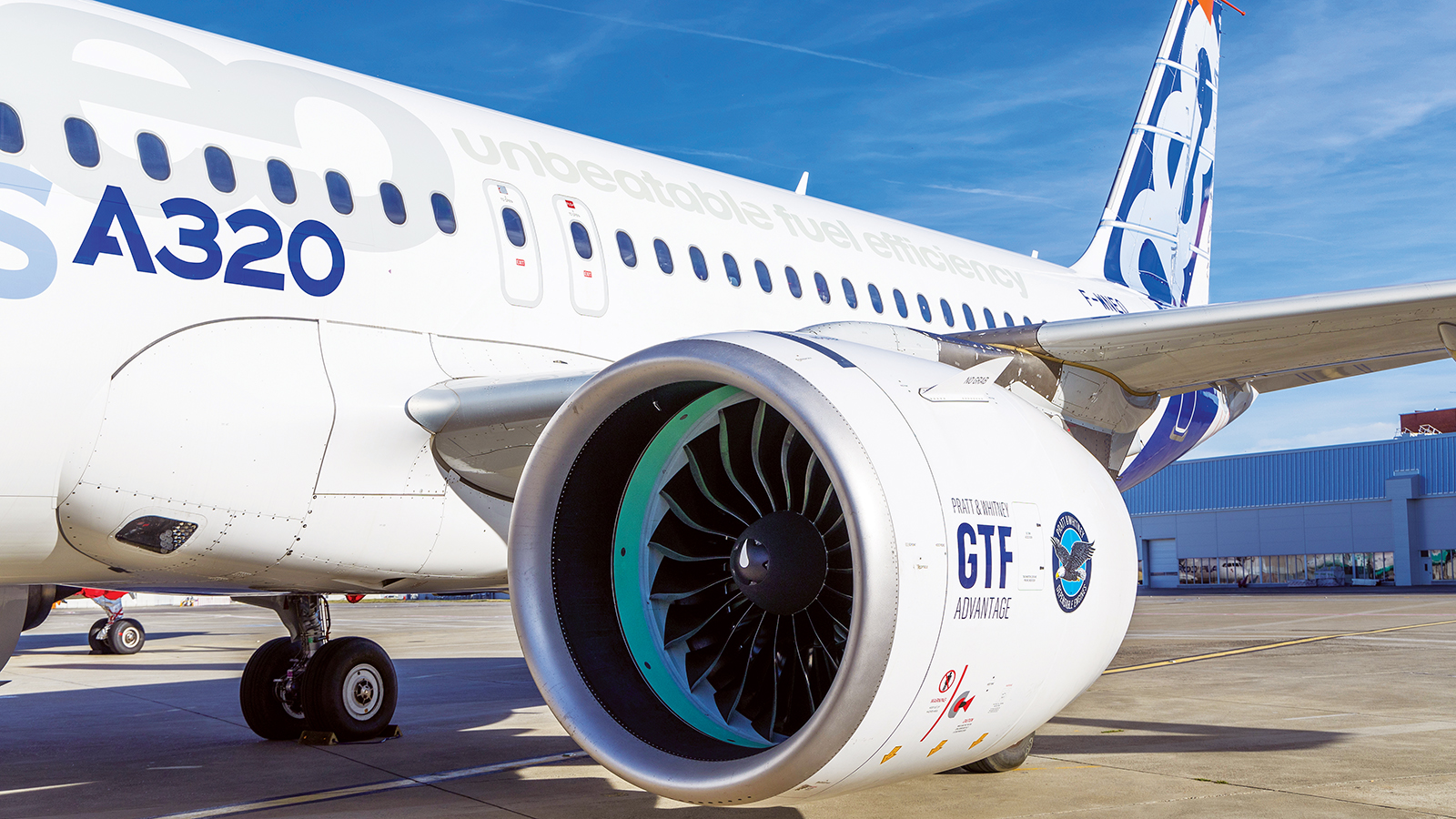
In addition to rectification, Pratt & Whitney has also been developing new technology for the GTF. The biggest project is the GTF Advantage engine for the Airbus A320neo Family This offers significant operator benefits, including: 4% more take off thrust at sea-level airports and 8% more at high-altitude airports; up to two times longer on wing compared to the current engine; better fuel efficiency; and fully intermixable and interchangeable with today’s GTF engine model.
It also includes fully redesigned life-limited parts and technology enhancements throughout the gas path. It is fundamentally more durable, with increased airflow through the core to lower operating temperatures. This has been achieved by taking advantage of the thrust growth capability of the engine and an optimised compressor to cool down the engine.
The hot section enhancements include an advanced airfoil design with improved coatings The High Pressure Turbine (HPT) and combustor also feature optimised cooling hole size, shape and location, with improved hole drilling techniques to reduce oxidation.
The GTF Advantage test programme incorporated extensive endurance testing to advance product maturity at entry into service and FAA Type Certification was achieved in February. The company remains on track to ship the first production engines to Airbus late this year with entry into service anticipated in 2026.
She says Pratt & Whitney is strategically managing the production cutover for GTF Advantage in a controlled manner and aims to transition the PW1100G-JM production line to the Advantage specification by the first half of 2028.
There is a spin off from Advantage for the current GTF engine, an upgrade option called Hot Section Plus, which brings the GTF Advantage hot section to the current PW1100G-JM engine model. It will capture 90-95% of the GTF Advantage durability improvements with just 35 part numbers, resulting in nearly double the TOW. Certification flight testing of Hot Section Plus is under way on the compny’s Boeing 747 flying testbed in Mirabel, Canada and it is planned to make the package available to customers for purchase, with incorporation during MRO visits, next year.
Rolls-Royce
For Rolls-Royce, the focus is on the Trent 1000 engine that powers the Boeing 787. It recently announced the first of two Durability Enhancement Packages that will more than double the TOW before scheduled maintenance is required.
The first Durability Enhancement Package includes a 40% increase in cooling to the new HPT blade and updates to the combustion system, fuel spray nozzles and engine electronic controller software.
This has been installed in new engines since January 2025, which will begin deliveries to customers in the second half of 2025, but it has also been distributed to maintenance facilities globally, and engines are now re-entering the fleet with the Phase 1 improvements in place. Within two years all of the Trent 1000 fleet will have been upgraded.
These upgraded components were originally introduced in 2022 on the Trent 7000 engine that powers the Airbus A330neo. The company says they are performing better than expected and, in some cases, more than tripling TOW.
Phase two of the Durability Enhancement Package is currently being tested at Rolls-Royce’s facility in Derby, UK and will bring a further 30% improvement in TOW across the Trent 1000 and Trent 7000 fleets. It features advanced coating on combustor tiles in non-benign environments; cooling and coating changes to high pressure nozzle guide vanes; weight reduction and coating improvements to High Pressure Turbine blades; and a redesigned combustor-to-turbine interface taken from the latest variant Trent XWB-84 EP. This further enhancement will start entering the Trent 1000 fleet from early 2026.
The new technologies are part of a £1 billion Durability Enhancement Programme that is intended to meet the company’s mid-term targets to increase average Time on Wing across the Trent fleet, which includes the Trent 1000, Trent 7000, Trent XWB-84 and Trent XWB-97. The company announced earlier this year that this target would double from its initial ambition of a 40% average increase to 80% by 2027.
Looking at those other engines, for the upgraded Trent 1000 TEN, also for the 787, Phase 1 includes optimised HPT blade aerofoil shape and cooling, optimised HP NGV cooling and coatings, a new combustor rear inner case and a software update. Phase will introduce advanced coatings on combustor tiles in the hotter part of the engine, HP NGV film cooling changes and coating optimisation, HPT blade weight reduction and coating optimisation and redesigned combustor to turbine interface based on the Trent XWB-84 style.
The Trent XWB-84 EP, for the Airbus A350, is using lower metal temperatures to improve TOW.
The Trent XWB-97, for the Airbus A350, has a three phase improvement programme. Phase 1 includes increased Turbine Gas Temperature (TGT) margin, seal segment and modification and Turbine Clearance Control optimisation. Phase 2 includes improved coatings for the HPT) blade and seals and a further increase in TGT margin. Phase 3 sees an optimised combustor, redesigned HPT blades and high pressure nozzle guide vanes (HP NGV), HPT ceramic matric composite seals and the use of advanced disc materials from the UltraFan demonstrator programme.
Conclusion
It seems the manufacturers have learnt their lesson. While the rectification programmes are delivering benefits and there are further improvements to come, there are still large numbers of aircraft sitting on the ground (see Table 1).
By Ian Harbison