The Virtual Flight Test
How Digital Twins are Reshaping Aircraft Certification
Today’s supercomputers can model hypersonic airflow across a complex airframe in a fraction of a second. Unfortunately, getting human review committees to update, reconcile, and sign off on the corresponding PDF hazard analysis binders can take a fiscal quarter or more. This operational lag—which could be described as “extreme human runtime latency”—is often the silent killer of aerospace innovation.
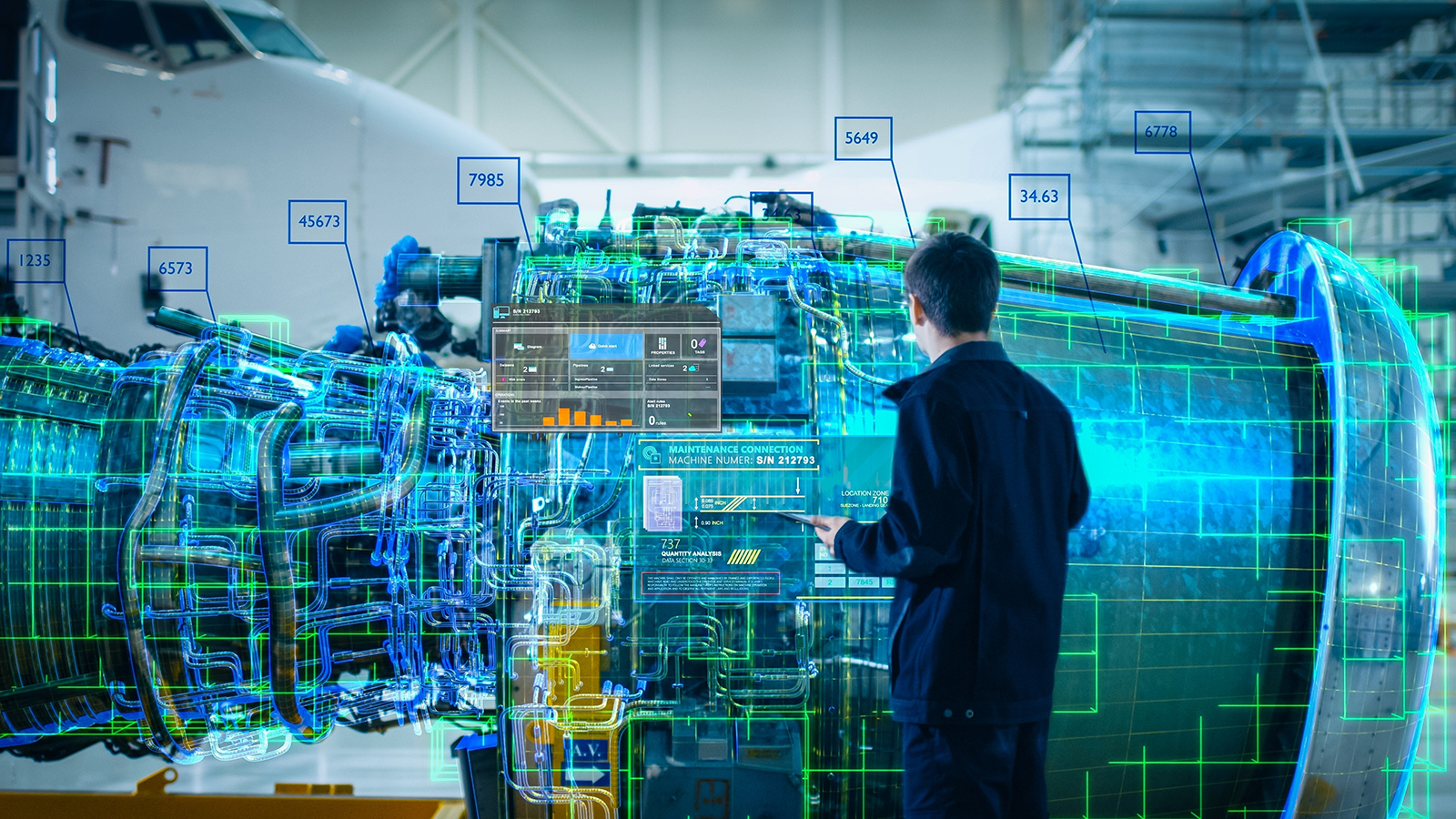
Today, the aerospace industry is overcoming these administrative delays through “digital twins.” These are virtual models of physical systems that act as a bridge between the physical and digital worlds throughout an aircraft’s entire lifecycle. During the design phase, digital twins allow engineers to simulate and validate systems virtually. Once the aircraft is built, the twins are continuously updated using real-world data generated by the physical equipment in service.
The payoff: By using digital twins, aerospace companies are able to compile accurate performance profiles and identify potential issues quickly. The result is a much faster and more accurate path to type certification, backed by solid, documented research, as well as highly optimized fleet maintenance once the aircraft takes to the skies.
Speeding Up Certification via Digital Twins
The reason that digital twins are so useful for speeding up aircraft certification is due to the rigorous standards and structured engineering frameworks that govern them.
A case in point: “The Boeing Company adheres to and supports the DOD (U.S. Department of Defense) Instruction 5000.97 definition of digital twin,” said Boeing in answers provided to Aerospace Innovations. “A more concise definition that is supportive of DOD 5000.97 definition is often utilized by Boeing: ‘A digital twin in aerospace is a replica of a physical aircraft, system, or component that is continuously updated with real-world data throughout its lifecycle. Digital twins maintain a persistent, bidirectional link between the physical asset and its virtual counterpart.’”
The Boeing spokesperson explained that Boeing organizes this capability based on its Model-Based Engineering (MBE) Diamond, pairing the systems engineering design phases directly with synchronized virtual models. “Digital twins are assembled based on use cases representing the product and consist of one or more models that are maintained in synchronization with the current state of the corresponding system,” he told Aerospace Innovations magazine. “The composition of the digital twin and integration with the physical product is realized through the digital thread by enabling the data required for virtualization and simulation.”
This being said, “it is important to look beyond design and certification alone,” noted Rob Mather, IFS’ Vice President of Aerospace & Defense. “In that context, the digital twin becomes a living representation of the asset as it operates in the field, not just a model of how it was expected to perform when it left the factory.”
For Leonardo Helicopters, digital twins support the entire rotorcraft lifecycle, from development and certification to training and mission preparation. “Over the years, we have developed a robust flight-modeling framework and a range of applications that leverage different components of the helicopter digital twin,” said Dario Iannucci, the company’s Head of Digital Transformation & Sustainability. “Our models are continuously enhanced using data collected from millions of flight hours across the global fleet. To support this ecosystem, we have also implemented a dedicated Rotorcraft Digital Twin framework that ensures traceability, configuration control, and continuous improvement through structured change and problem-report management.”
Meanwhile, emerging IT platforms are reimagining the digital twin by integrating design geometry and safety compliance into a single executable model.
For instance, “BusbySim is a new platform that builds a digital twin of an aircraft and puts it to work completing real safety engineering workflows,” said Caroline Welsh, founder of BusbySim. “The problem we’re solving is that every aircraft that flies has to prove it is safe, and today that proof is built by hand by engineers, often working in silos across different tools, docs, sheets, you name it. Every time the design changes, the analysis has to be changed, and this process is often slow, painful, and it’s extremely easy to miss things. As a result, errors are rife, and the safety case is always at least one step behind the design.”
Welsh said BusbySim’s approach to digital twins eliminates this division. “In BusbySim, the design and the safety analysis aren’t separate documents, they’re one live model,” she explained. “The aircraft’s functions, architecture and requirements all live in one place, and so does the safety evidence: the FHAs, the fault trees, the FMEAs. Change the design and the safety case moves with it, and an engineer reviews and approves every step along the way.”
The practical impact of BusbySim’s integrated approach was recently validated during an active flight program.
“BusbyFlyer showed what’s possible when the digital twin extends into assurance and certification, linking the live design model directly to the evidence needed for regulatory approval,” said Dr. Katrina Thompson, Director at the UK Digital Twin Centre. “Having that evidence accepted by the regulator on a flying aircraft is practical evidence that digital twins can transform how complex systems are designed, assured and certified. That’s exactly the kind of demonstrable impact the UK Digital Twin Centre and the Adoption Accelerator programme is here to deliver.”
Winning “Credit for Simulation” from Regulators
Reducing required physical flight test hours by using virtual simulations is not something that EASA and the FAA do casually. This is because regulators do not grant certification credit based on theoretical models alone. They demand documented proof that the digital twins’ conclusions are accurate and replicable in the physical world.
“At Boeing, our model-based engineering data architecture is built around three core principles that directly address regulatory expectations for simulation credit: traceability, quantified uncertainty, and configuration control,” the Boeing spokesperson said. “Traceability means that every model’s output can be traced back through its input parameters, boundary conditions, material properties, and underlying assumptions to validated test data that anchors it. Uncertainty quantification refers to our framework propagating uncertainties from material variabilities, manufacturing tolerances, and operational loading spectra through our models, producing statistical distributions of outcomes rather than deterministic predictions. And under configuration management, our digital system model enforces strict version control of the digital twin at every level—model geometry, mesh parameters, solver settings, material databases, and load definitions. When we present simulation evidence to regulatory bodies, we can reproduce any result exactly and demonstrate that the model configuration matches the type design configuration being certified.”
But do digital twins actually speed up certification in the real world? Leonardo Helicopters says yes. “One tangible example is the AW169 automatic landing capability, where a significant portion of the design, testing, and tuning activities was carried out within the Rotorcraft Digital Twin environment,” said Iannucci. “This approach enabled a substantial reduction in development time while also minimizing the flight-testing effort required on the prototype, accelerating the path from concept to certification.”
Overcoming Validation Hurdles and Supply Chain Friction
Of course, validating high-fidelity computer models against actual physical flight test data presents complex technical and organizational hurdles.
“The fundamental challenge is the continuous calibration of model simulations to the physical product,” the Boeing spokesperson said. “This necessitates a control loop to evaluate the validity of the digital twin effectivity.” He cited four primary obstacles:
Data complexity and volume: Aligning variables across millions of individual parts and configurations per aircraft.
Data provenance and governance: Ensuring consistent naming, source validation, and lineage tracking.
Integrating lifecycle data: Reconciling real-time operational sensor feeds with baseline physical flight tests.
Security and IP protection: Balancing regulatory data transparency with commercial trade secret protections.
Meanwhile, making digital twins work reliably and accurately across global aerospace supply chains remains an industry-wide challenge.
“One of the key challenges in advancing the Rotorcraft Digital Twin is integrating data from vendors and partners,” said Iannucci. “While digital engineering capabilities are rapidly evolving, industry-wide standards for data exchange and interoperability are still maturing. This makes the seamless integration of component-level digital twins into the overall helicopter model more complex. To address this challenge, Leonardo Helicopters has developed a dedicated Rotorcraft Digital Twin framework that includes standardized interfaces and data dictionaries, enabling controlled, consistent, and traceable data exchange across different systems and models.”
Iannucci also highlighted the ongoing problem of creating digital twins for legacy aircraft fleets.
“Newly designed helicopters are born digital, so maintaining their datasets over time is now as standard a process as maintaining paper-based datasets was 20 years ago,” he said. “The greater challenge is maintaining the digital configuration of aircraft that were not originally designed in a fully digital environment and still rely on a combination of digital and traditional data. This also requires support personnel to develop a hybrid document-management mindset that can effectively manage both types of information throughout the aircraft lifecycle.”
Proving ROI in Dollars, Hours, and Availability
When applied correctly, digital twins deliver dramatic reductions in program schedules, labor hours, and operational expenditures.
A standout proof of this point is the U.S. Air Force’s T-7A Red Hawk trainer jet.
“The T-7A Red Hawk is an all-new advanced pilot training system for the U.S. Air Force, widely considered the first digital pathfinder jet,” said the Boeing spokesperson. “Using model-based engineering and 3D design tools, the T-7A represents an aircraft with a 75% increase in first-time quality, an 80% reduction in assembly hours and a process that cut software development time in half. In just 36 months, the production-representative jet, called T-X, aircraft moved from firm concept design to first flight, which occurred in 2023.”
In field maintenance, using digital twins boosts aircraft availability and fleet revenue. Mather cited one situation where “An IFS customer identified a component issue that, if left unaddressed, could affect other systems, increase maintenance costs, and drive unplanned removals in locations where removing the engine would be highly disruptive,” he said. “Using the digital twin, the team modelled different incorporation rates and maintenance approaches for the fix. The analysis showed that a task normally performed off-wing could be done safely on-wing with the right controls in place. That reduced disruption for the operator, helped avoid downrange removals, protected availability, and reduced maintenance risk.”
In commercial drone development, BusbySim has demonstrated order-of-magnitude time savings during live safety certification—and created a viral real-world sensation.
“We’ve been working with Flyer AI, founded by former RAF test pilot Justin Paines. Flyer build autonomous aircraft for last-mile package delivery,” explained Welsh. “In April 2026, they delivered the world’s first drone fish and chip delivery to none other than James May, complete with a gin and tonic. To get there that fast, we built Flyer’s aircraft as a live model in BusbySim and generated the safety analysis from it in the required format. The systems-level functional hazard assessment went from blank sheet to draft in one working day. Flyer’s own engineers had budgeted two months for it. In the same way, the Preliminary System Safety Assessment took two days with BusbySim drafting, against an expected three months.”
Paines offered an emphatic endorsement: “BusbySim’s tooling makes one of the hardest tasks in design and development—systems engineering and systems safety management—an order of magnitude quicker and simpler,” he said. “I would have given my right arm for this tool in some of my previous work, with Joby and Vertical particularly.”
AI as an Active Safety Partner
Artificial intelligence (AI) is rapidly shifting digital twins from static analytical models into active engineering advisors. This shift saves money and time for aircraft operators and maintainers alike.
“In BusbySim, an integrated AI advisor reviews the model continuously against the standard you’re working to,” said Welsh. “It looks for single points of failure, probability budget violations, and architectural weaknesses. Rather than just flagging an issue, it proposes the specific change, which the engineer sees in full before deciding whether to accept or edit it. This also means junior engineers using BusbySim get a senior-level review every time they save, rather than waiting weeks for a senior colleague to have capacity.”
AI also makes sense of data that is too unstructured and vast for humans to understand.
“AI can help refresh models faster, work across larger and less structured datasets, identify trends earlier, and support faster, more confident decisions,” Mather noted. “The opportunity is not prediction for its own sake. It is helping organizations turn complex fleet data into timely, actionable insight with much greater speed and fidelity.”
At Leonardo Helicopters, AI’s predictive capabilities are being aligned directly with emerging regulatory frameworks to deliver better results.
“Our objective is to leverage the Rotorcraft Digital Twin and advanced analytics to anticipate potential issues before they occur, ranging from technical failures to material and spare-part shortages,” said Iannucci. “At the same time, we are preparing for the future adoption of AI in certified aviation environments. To facilitate this process, Leonardo Helicopters is already aligning its development approach with the guidelines and principles outlined by Certification Authorities, helping to establish a robust foundation for the certification and regulatory framework of future AI-enabled solutions.”
Navigating IP and Cybersecurity Risks
Sharing high-fidelity digital twin data across international supply chains and regulatory agencies introduces significant intellectual property and cybersecurity risks.
Boeing safeguards proprietary engineering data using strict zero-trust security protocols, a cybersecurity model that assumes no user or device is safe by default and requires constant verification.
“Boeing addresses these risks through strict governance frameworks implemented in its zero-trust security strategy,” the Boeing spokesperson told Aerospace Innovations. “Role-based and attribute-based access controls regulate who can view or modify sensitive data. Consolidating data into a centralized, secured platform avoids dispersing sensitive data across insecure mediums like emails or spreadsheets. Detailed audit trails and provenance tracking ensure all access and modifications are monitored.”
IFS recommends managing cybersecurity risks by exchanging specific operational data outputs rather than transferring raw digital twin models.
“A practical way to address that is not to share the full digital twin, but to agree on the inputs and outputs that create value for both sides,” said Mather. “Operators provide enough fleet information to make the model more accurate, and in return they get forward-looking insight that helps with readiness, budget planning, capacity planning, parts availability, and maintenance execution.” He cited major sustainment initiatives—such as the Rolls-Royce TotalCare program and Arcfield’s CF-18 avionics support—as prime examples where aligning operational value eliminated data-sharing hesitation across supply chains.
For its part, BusbySim manages supply chain risk through granular, role-based visibility.
“Where a digital twin needs to expose something to a partner across a supply chain, the answer is controlled visibility,” Welsh explained. “Partners see the interfaces and the evidence they need, and nothing else. The idea is that you don’t have to hand over the whole model.” She added that BusbySim is currently working on expanding its models to cover cybersecurity airworthiness standards ED-202A and ED-203A, ensuring cyber threats are tracked in lockstep with physical failure modes.
The Next Frontier: AAM and Beyond
As the aerospace industry advances into Advanced Air Mobility (AAM), eVTOL architectures, and novel hydrogen propulsion, digital twins offer an efficient development path for agile startups.
“For new entrants, the opportunity is to build the digital thread from the start. That is much better than trying to retrofit it later,” said Mather. “Digital twins can support design analysis and reduce the need for the traditional ‘fly, break, fix, fly again’ cycle by giving teams a clearer picture of how an aircraft or system is expected to perform before it is fully fielded.”
Welsh pointed out that single-source digital models fundamentally democratize who gets to certify aircraft.
“Plenty of good aircraft die at the business case rather than in the wind tunnel, because the compliance bill grows bigger than the development bill,” Welsh added. “Certification has always been for the big players. But now, a cash-strapped team building a new airframe doesn’t have to build a safety case from a blank page and then rebuild it every time the design shifts, because the architecture and the safety case are the same model. That single source of truth is what lets a handful of engineers carry a certification workload that used to need a department. Our bet is that the proof can move at the speed of the design, and when it does, it changes how quickly new innovations can take to the sky.”
As for the future of digital twins? “The next wave of progress will come from better automated data capture, stronger digital thread continuity, richer IoT sensor integration, improved data cleansing and validation, and the use of AI to refresh and analyze complex models faster,” said Mather. “The value is moving beyond a system of record and toward a system of execution: capturing the operational reality of the asset, applying intelligence to that data, and helping organizations make better decisions across maintenance, logistics, capacity, supply chain, readiness, and lifecycle planning.”
“Boeing is moving aggressively to leverage the value of the digital twin and the associated capabilities it will enable,” the Boeing spokesperson concluded. “This includes enhanced individualization, increased lifecycle support, and a collaborative industry ecosystem.”
Ultimately, digital twins are much more than a revolutionary solution for certification challenges. They are becoming the connective tissue for the entire aircraft lifecycle, ensuring that the rotorcraft and drones of tomorrow are not just designed faster, but are safer, smarter, and more cost-effective to operate than ever before.
By James Careless