Advances in Avionics Displays
Avionics displays are the vital interfaces between aircraft systems and human operators. The data shown on these displays dictates what pilots need to do next, while keeping them informed about aircraft conditions and possible operating issues.
With so much riding on the performance of aviation displays, their manufacturers are constantly improving them to respond to customer needs. In this article, we’ll examine the advances driving the development of avionics displays, and the products that manufacturers are bringing to market that incorporate these advances.
Better Pictures, Bigger Screens, More Control
A variety of technological advances are driving the improvement of avionics displays, with manufacturers successfully translating these ideas into products.
One of these companies is CMC Electronics, an avionics products firm based in Montreal, Canada with U.S. operations in Reston, Virginia and Sugar Grove, Illinois.
Dr. Martin Bitter is an Optical Scientist with CMC Electronics. “Modern cockpit displays have seen significant image fidelity improvements thanks to advances in LED and LCD technology — bringing brighter screens, richer colors, and higher contrast for reliable readability across all lighting conditions,” he said. “Improved image quality is the foundation to continuously enhance the situational awareness of the pilots. Prime examples are the implementation of synthetic and enhanced vision systems: SVS overlays 3D terrain, runways, and flight-path visuals, while EVS integrates sensor-derived imagery into displays.
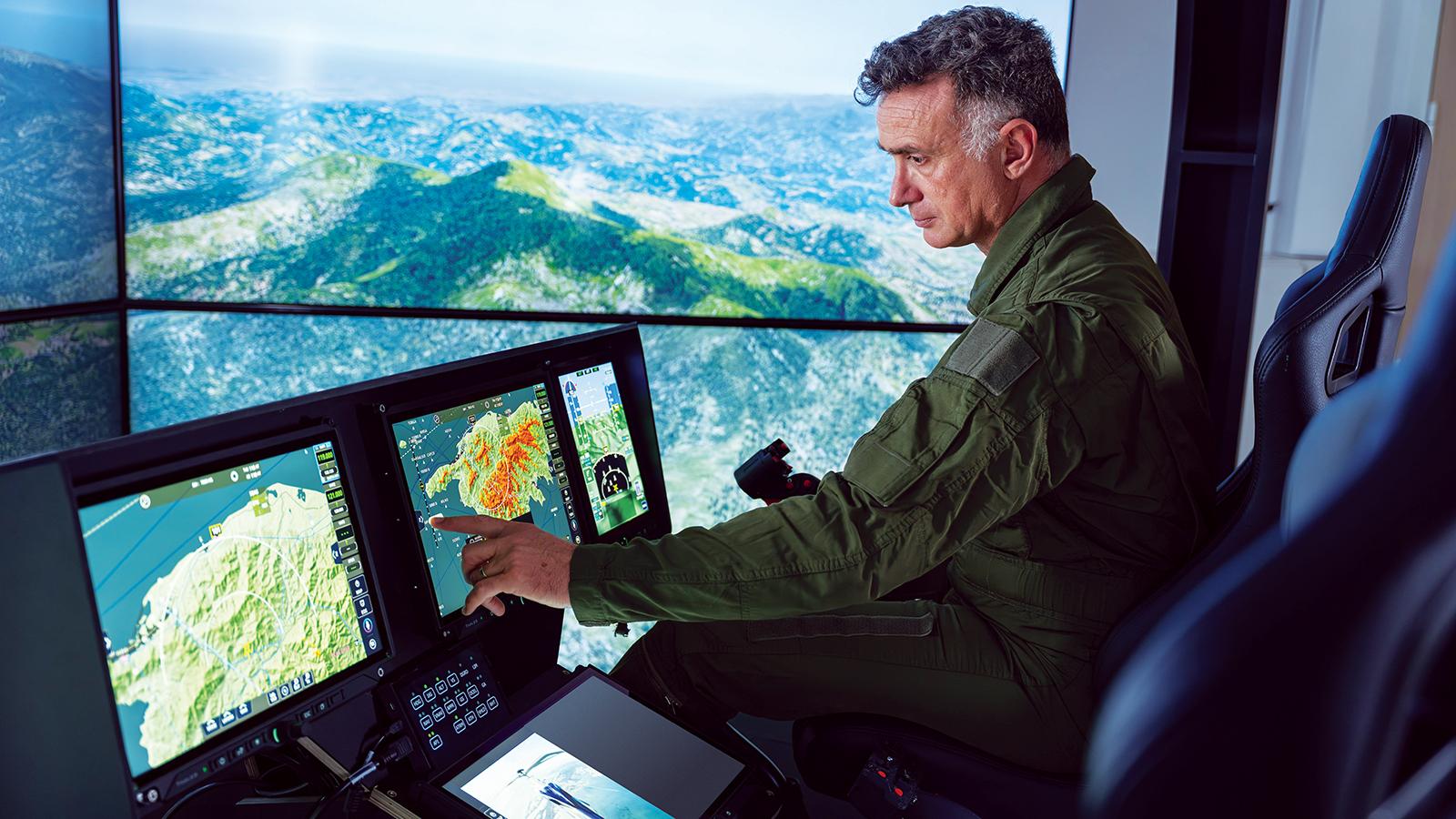
Avionics displays are also trending toward larger and wider formats, with resolutions approaching 4K, unlimited viewing angles, and imperceptible refresh rates. “The so-called large-area displays (LAD) are increasingly more common on new generation aircraft, replacing clusters of smaller screens with a wide format and high-resolution screen,” said Dr. Bitter. “This further improves situational awareness by centralizing relevant information close to the pilot’s gaze.”
Honeywell Aerospace also builds avionics displays, along with cockpit/cabin electronics, power systems, and wireless connectivity systems. Jeffrey Woirhaye is the company’s Senior Director Product Management of Cockpit Systems. “When it comes to avionics displays, recent advances include bringing touch-enabled displays to the flight deck, which provides easy access to information and familiarity due to use on consumer devices,” he said. “Features which consumers take for granted are now being implemented on avionics. Controls such as multi-touch, pinch zoom and more are becoming standard across our products and expected by pilots.“
Woirhaye agreed that displays are getting bigger, but he added that they now have more processing power to integrate information from various sources. This is why primary flight displays now support synthetic vision and 3D symbology to provide better stabilized approaches, traffic visualizations and flight path awareness. “Features such as track-based synthetic vision have been proven to measurably improve approach flight path accuracy,” he noted. “Honeywell has also established strategic partnerships with key hardware providers to ensure that development roadmaps are aligned, which also allows a better integration of hardware and software. This results in better performance and increased capability of the entire system.”
“The goal of these advances is to make the display’s information presentation more intelligible and understandable,” said Arnaud Petitdemange, Thales’ Displays & Interactivity Cockpit Equipment Chief Engineer. “For avionics displays, as well as in consumer electronics, advances focus on enhancing intuitiveness through an improved man-machine interface, making the cockpit a professional and comfortable desktop,” he said. “The introduction of tactile screens, with secure touch interactivity, and larger displays is a key contribution to the crew’s awareness and efficient operations.”
Dror Yahav is Chief Executive Officer of Universal Avionics.
His company has been creating commercial aviation solutions for over 40 years, including advances such as Flight Management Systems, Synthetic Vision Systems (SVS) and Combined Vision Systems (CVS). Universal Avionics has also developed advanced head-mounted displays and multispectral Enhanced Vision Systems (EVS).
“Universal Avionics is advancing avionics displays throughout the cockpit, ranging from flight display systems with connected cloud apps, to pilot-worn displays that enhance head-up operations,” said Yahav. “Just like the most advanced fighter jets, commercial pilots can perform all phases of flight while looking out the window. Enhanced vision systems capture imagery at night and in all weather conditions, overlaid with 360-degree synthetic vision (SVS) to allow for safe and seamless operations, even when flying in low visibility. This is then intuitively augmented across the pilot’s natural view, supporting situational awareness and operational flexibility.”
By providing pilots with comprehensive visual information, today’s avionics displays enhance flight safety. “When the data collected across these systems is integrated, information can be virtualized in real-time, reducing the cognitive load that comes with interpreting traditional 2D screens,” Yahav explained. “Pilots can perform complex tasks on head-down displays just by looking and pointing at virtual objects. This allows pilots to make faster, more accurate decisions, particularly critical during high-stress operations.”
Dominiek Saelens is Senior Product Manager of Avionics with ScioTeq, which has also spent 40 years designing and manufacturing products for the aviation, air traffic control, and defence and security markets. In addition to noting the trends outlined above — which he views as being driven by consumer electronics and a desire for less clutter in the cockpit — Saelens cites the continuous search for lower weight airborne devices that consume less power as influencing the design of modern avionics displays.
“The reason for this trend is obvious: It allows more features to be installed in the same space,” he told Aerospace Innovations magazine. “Again, this is the same trend as in consumer electronics. Think how small your very powerful smartphone is nowadays with minimal power consumption for extended duration between battery charges. In ScioTeq’s displays, this is made possible by using more efficient parts in smaller packages, such as mini-LEDs and new LCD technologies that allow for bezel-less displays.” As well, Saelens pointed to modular system designs resulting in displays that are physically separated from onboard computers, open-source software being used to break manufacturers’ proprietary lock on avionics’ operating systems, and the introduction of AI-enabled flight computers to provide even better data to avionics displays.
New Avionics Display Products
Now that we understand the trend and needs driving avionics display improvements, let’s consider some of the advanced products that are now on the market.
Asked what is new and different from CMC Electronics, Dr. Martin Bitter cited the TacView Plus portable mission display. Equipped with a small built-in QWERTY keyboard, the TacView Plus is purpose-built to support electronic flight bags and mission computer capabilities. “This compact 8.4” smart display with NVIS compatibility is designed to enhance situational awareness for military, paramilitary, law enforcement, and civil aircrews,” said Dr. Bitter. “Its ruggedized design withstands even the most challenging environments, while advanced cybersecurity protection safeguards sensitive information.”
CMC Electronics’ third generation Digital Head-Up Display (DHUD) was designed to be a significant advance in HUD technology. To achieve this goal, the DHUD’s digital light engine has been built to be brighter and more reliable than the cathode ray tubes (CRTs) used in traditional analog HUDs. “Exceptional image quality across a large field of view is a key differentiator from the competition,” Dr. Bitter noted.
Honeywell Aerospace has released numerous new avionics displays that offer simplified and direct touch interfaces. “Displays like our Touch Screen Controller and our 13.1” display unit bring higher resolution synthetic imagery and symbology to flight crews,” said Jeffrey Woirhaye. “Honeywell’s displays and avionics are also built with connectivity as part of the core technology. With better connectivity, the pilot has better awareness of the surrounding environment, conditions on your destination (or alternate) and the health of the aircraft.”
At present, Honeywell is very focused on its Honeywell Anthem integrated flight deck system, which its avionics displays are designed to fit into. ”Built upon our Epic product line, Honeywell Anthem adds additional safety, capability and simplicity to flight operations,” he said. “The Honeywell Anthem user interface has been completely redesigned with a modern color palette and a further increase in resolution above Honeywell’s current displays, allowing faster recognition of information and simplified data entry.”
The Honeywell Anthem integrated flight deck has been built using a “touch-first” design approach. “This means all functionality must be capable of being performed via touch controls while still providing OEMs the flexibility to add physical controls,” said Woirhaye. “By optimizing the interface for touch control first, menus and touch targets are optimized and easy to access regardless of their final mode of control. This design approach also ensures the system is not reliant on any physical controls, allowing a growth path towards future automation and autonomy.”
ScioTeq’s approach to sales is to target civil and defence markets at the same time. As a result, “we develop and qualify generic products from which we can easily derive variants,” Dominiek Saelens said. “As such, we typically can offer mOTS (modified Off-The-Shelf) products to customers, reducing time-to-market, development cost and risk for that customer-specific variant. True COTS is a rare thing in the industry.”
Over the past five years, ScioTeq has brought the following DAL (Digital Assurance Levels) / RDU (Rugged Display Unit) avionics displays to the market:
RDU-3068: a generic 6” x 8” rugged DAL-A video display with HMI and I/O. configurability. Three RDU-2068 variants are flying, one is in development and several more are in discussion.
RDU-4208: a generic 20” x 8” rugged DAL-A large area display with HMI and I/O configurability: Five variants are in development for late 2026. A civil variant (FDU-4208) is coming as well sometime in 2029.
RDU-4047/FDU-4047: a generic 4” x 7” DAL-A video display with HMI and I/O configurability. Both defense and civil variants are available. One variant is flying, four more are in development.
PU-5200 (matching the trend to split monitors from computers: a generic 5th generation display. The supporting computer is being offered as an open-source platform through MOSArt. Other variants, including those for the civil market segment, will follow.
Thales has been focusing its attention on large screen touch-enabled avionics displays. “Our first introduction of new generation displays was made on the Airbus A350,” said Petitdemange. “This is the culmination of years of development to guarantee that large touch-screen displays provide the same comfort and interactivity as consumer hand-held devices (mobile phone and tablets) while meeting the challenges of the air transport environment and certifications requirements.”
These enhancements are central to Thales’ next generation FlytX flight deck system. It comes with large, smart touchscreen displays available in 8”, 10” and 15” to fit any cockpit size. “The result of in-depth research conducted in cooperation with pilots, ergonomists, physicians, engineers and key technology experts in the field of displays, the FlytX design is focused on intuitive and task-oriented interfaces,” Petitdemange said. “The overall philosophy has been to maximize touch-screen interfaces and make them intuitive notably through contextualization on a map, while keeping the right level of other controls in a multimodal approach.”
Compared to legacy avionics displays, Thales FlytX is 30 to 40% smaller in size, weight and power consumption (SWaP) compared to legacy avionics. This reduction has also led to a decreased number of Line Replaceable Units, the virtualization of control panels, and the use of an Integrated Modular Avionic platform to run different avionics applications securely on the same computing platform.
Universal Avionics is the final new product entrant in this story. First on its list is ClearVision, the company’s Enhanced Flight Vision System featuring a SkyLens head-mounted display for intuitive out-the-window flight operations. “ClearVision takes in imagery from our EVS-5000 multispectral camera, which enables an unmatched 50% visual advantage and can see LED runway lights that limits the effectiveness of older camera systems,” said Dror Yahav. “This EVS imagery, together with 360-degree SVS, becomes a Combined Vision System that pilots have full control of.”
Next is Aperture, an augmented reality (AR) vision system that combines sensors and video cameras with advanced AI Machine-learning processing/analytics and voice recognition for a complete 360-degree composite view of the flying environment. “Obstacles, traffic, weather, taxi instructions, and much more can be intelligently displayed in real-time, both heads-up with ClearVision and head-down on a glass cockpit like Universal’s InSight,” Yahav said.
Besides being added to new aircraft, the InSight integrated flight deck system has gained momentum as a retrofit upgrade. It is now certified and flying on Falcon, Hawker, and Citation jets today. Development is ongoing for other aircraft like the De Havilland Canada Dash-8 and CL-215/415/515 Waterbombers.
“With InSight, operators are able to replace old and obsolete equipment, reducing maintenance issues, downtime, and costs for our customers, ultimately allowing them to continue flying their aircraft for another 15 years,” Yahav said. “These modern displays give pilots high-resolution digital information — like synthetic vision, terrain awareness, airport maps, and engine data — on integrated screens that are lighter, more intuitive, and help pilots fly simpler and safer. It brings an aircraft at risk of getting stuck in the past to the high-performance standards necessary for efficient operations today.”
Some aircraft cockpits are limited in the amount of space available or are unable to upgrade legacy display setups, but still need to add modern functions, such as ADS-B In. In those cases, a head-wearable display like Universal Avionics’ SkyLens can overcome this limitation by allowing pilots to access this functionality directly without extensive flight deck modifications.
Easy to Install
Whether selected for new aircraft or retrofitted into old ones, avionics displays require some form of installation. Thankfully, today’s flat panel models are easy to put in place.
Better yet, the manufacturers we spoke to have taken steps to make the installation process even simpler to perform. A case in point: “CMC Electronics has established an extensive range of field-proven optical, mechanical, and processing building blocks ready to be customized into solutions,” said Dr. Bitter. “The principles of flexible, open architecture are followed to enable a seamless integration into existing and future cockpits. Panels and displays can be swapped or upgraded without redesigning the entire cockpit.”
The same is true for Honeywell Aerospace. “Legacy hardware has traditionally required a centralized avionics bay taking up valuable cabin space,” Woirhaye said. “Newer avionics are designed to be modular, allowing placement within the aircraft closer to the source of the data or the needs of the equipment. This reduces wiring lengths and also can free up space within the aircraft.”
ScioTeq’s avionics displays can be DZUS-mounted to center pedestals, bolted to the instrument panel, or ARINC 600 tray-installed. “In most cases, installation requirements are downflowed from the integrator/OEM,” said Saelens. “In addition, the transition to ARINC 818 and high bandwidth Ethernet protocols is simplifying wiring harnesses as well.”
Thales’ new avionics displays are incorporated in its new FlytX flight deck, so adding them to new aircraft is part of that overall installation process. As for retrofits of FlytX 15’’ displays into existing cockpits? “The average time to exchange is less than 15 minutes with simple and robust racking systems,” Petitdemange replied. “The exchange can even be hot-plug replaced.”
Dror Yahav closed this section by noting a salient point for this Universal Avionics product: “A head-worn display system like SkyLens has fewer components installed in the flight deck compared to a fixed HUD, making installation possible in just three days,” he said. “For integrated flight decks like InSight, installation typically takes around six to eight weeks. With fewer LRUs than previous systems, installation and maintenance is streamlined and can be completed during a customer’s major maintenance check.”
What’s Coming Next
We have seen how advanced avionics displays have become in recent years. So what advances are on the horizon?
Actually, quite a lot. According to Dr. Bitter, the adoption of cutting-edge display technology from the consumer world has been slow in avionics due to stringent reliability and lifetime requirements. But change is on its way. “As high-resolution LCDs, micro-LED and OLED displays are becoming more mature, CMC Electronics is actively working on adopting many of these technologies in their future avionic products,” he said. “Improved contrast, clarity, and color fidelity, higher brightness and lower power consumption are the critical design targets.”
Dr. Bitter added that CMC Electronics is currently developing the TacView Pro as its next generation portable mission display. “The 10.4” multi-touch display has an increased resolution of 1920 x 1200 pixels and showcases much improved display colors and brightness,” he explained. “An increase in processing power with AI capabilities is enabling future AI applications.”
Over at Honeywell Aerospace, “we are always thinking ahead,” said Woirhaye. “Honeywell has a robust roadmap of display technologies and avionics development. We have solutions for the Advanced Air Mobility, Part 23, Part 25, and Air Transport Markets. AI is truly becoming a game changer. We expect its adoption will need to be measured, but we are already seeing its ability to be used, from testing ‘what if’ scenarios and refining efficient algorithms for aircraft performance to maintenance applications.”
ScioTeq’s avionics unit foresees a future where avionics displays will be customized to fit specific aircraft flight decks, rather than being purchased on a ‘one-size-fits-all’ basis. “Especially for high-end new platforms, OEMs want to use all available space and not any longer compromise on this by choosing COTS/mOTS solutions,” Saelens said. “As such, there is a trend towards more custom glass size development, especially for the high-end platforms. Of course, the ultimate is to use free-form and/or curved LCD glass. This can be enabled by using new display technologies, like micro-LEDs.”
Universal Avionics has a different take on the future. “Displays are reaching their limit in terms of technological hardware advancements, which is why Universal is focused on optimizing the information that is presented on these displays,” said Yahav. “Software-based enhancements and system integration helps ensure continuous improvements and enables connections to emerging technologies. The emergence of AI is an integral part of our roadmap for avionics display development. At the same time, Universal’s Aperture AR system is being flight tested on business jets and mission aircraft to fuse real-time video, audio, and traffic data, augmenting this information onto pilot displays. Aperture is expected to be available with visual ATC traffic directions across tablet displays in the next year, with features added to the EFIS and head-up displays to follow in the next three-five years.”
As for Thales? “We constantly innovate and improve our existing products,” Petitdemange said. “Our aim, for optimum comfort and efficiency, is a full seamless cockpit with large, high integrity displays and interactivity multimodality which uses complementarity between touch, controls and vocal interaction.”
In conclusion, avionics displays are shaping up to be some of the most informative, useful, and workload-reducing devices in aircraft cockpits today, and even more so going forward. Such results are a tribute to the power of modern technology, and the innovation of the manufacturers who make these displays.
By James Careless