GCAP – The future of Air Dominance?
Two main issues face the Global Combat Aircraft Programme in 2026. A long-running campaign to present the F-35 Joint Strike Fighter as a viable alternative to GCAP continues, while there are conflicting needs to keep the programme on track to meet ambitious timelines, but also to think about bringing new partners on board to
make the sums add up.
The Global Combat Aircraft Programme (GCAP) is a joint venture by the UK, Italy and Japan, whose aim is to develop and produce a next-generation combat air platform for the three partners and for export customers. A manned ‘sixth generation’ combat air platform will lie at the heart of a wider ‘system of systems’, augmented by unmanned adjuncts (UCAVs) and effectors (weapons), and integrated with other platforms and systems across the military domains. But the partners will each pursue their own systems of systems outside the GCAP construct.
Though it is often referred to as a ‘fighter’, the core manned aircraft within the GCAP system of systems will have formidable air dominance capabilities, but will also be a long-range strike aircraft, an ISR platform and a significant contributor to the information dominance fight. In Britain, at least, it will continue to be called Tempest.
The GCAP programme has its roots in the Anglo-Italian Future Combat Aircraft System and the separate Japanese FX/F-3 programme, both of which date back many years. These efforts started to come together from 2017, as the three nations realised that they had broadly similar and compatible requirements, and timescales. It soon became clear that any programme to develop a viable aircraft (and its supporting system of systems) would be prohibitively expensive for a single nation to develop.
The programme partners quickly realised that existing fifth generation aircraft would be inadequate to meet emerging requirements, and that there was no existing off-the-shelf solution that would meet their military requirements. A new aircraft and supporting system of systems promised to provide next generation Combat Air capabilities, and would deliver the military capabilities, strategic relevance required, while also delivering sovereignty and prosperity advantages
The ‘high level’ benefit of producing a new, cutting edge combat air system of systems independently – rather than simply buying one from the US – lies in the operational advantage of having genuinely sovereign freedom of action, freedom of modification, the ability to integrate one’s own choice of weapons, and to iterate and upload sovereign mission data with agility. These will be key to keeping pace with a rapidly evolving threat.
Perhaps the greatest ‘threat’ to the GCAP programme comes from Lockheed Martin’s F-35 Joint Strike Fighter, and the energetic lobbying campaign that has been mounted in that aircraft’s favour.
For many years there has been a determination in some quarters to pursue ‘harmonisation’ with the US forces, operating exactly the same equipment in exactly the same way. This has been accompanied by a prejudice against locally developed equipment, and programmes, which are often perceived to be afflicted by delay, severe cost increases, technical difficulties and failures, producing a disappointing end result. By contrast, US programme difficulties and failures are minimised or ignored.
The F-35 is undeniably the most effective and capable combat air platform in service today, and it brings a tremendous capability to its operators, representing a quantum leap by comparison with today’s ‘4th generation’ fighters. The F-35 has the most advanced sensor suite of any fighter in history, providing unmatched situational awareness, while the aircraft’s LO (Low Observable) capabilities allow it to operate effectively in contested environments, and to survive in an enemy IADS (Integrated Air Defence System).
In 2026, no other in-production, in-service combat air platform can offer the same capabilities as the F-35, although it suffers from very poor availability and very high support and sustainment costs. It also imposes a very high degree of reliance on the US, US-dominated supply chains and US-operated support and logistics infrastructure. This results in a real lack of operational sovereignty. As the US becomes a less and less reliable ally, there are real fears that non-US F-35s could effectively be rendered ineffective or inoperable at the whim of the US government.
And the F-35 is not a new design. It is more than a quarter of a century since the X-35 made its maiden flight on 24 October 2000, and it is 20 years since the first F-35A made its maiden flight in December 2006. The world has changed in that time, and the threat is continuing to change, at an accelerating pace.
Jonathan Smith, VP Capability and CTO, Future Combat Air (GCAP), for Leonardo UK’s Electronics Division is eminently well equipped to understand what is required in a ‘sixth generation’ manned combat air platform, since he is one of the few men to have flown both the F-22A Raptor and the F-35B Lightning II operationally.
Smith was the RAF’s second ever F-22 exchange pilot, before becoming the UK F-35 Lightning II Tactics and Development Staff Officer. He then converted onto the F-35B in October 2015 subsequently becoming the Executive Officer and later Commanding Officer of No.17 Test and Evaluation Squadron, the UK’s Test and Evaluation Squadron for the F-35B, at Edwards Air Force Base, California. Returning to the UK, Smith became the UK F-35B Requirements Manager, Air Capability, until April 2020, when he joined Leonardo and the Tempest project.
Smith’s career has given him an unparalleled insight into the capabilities of fifth generation combat air platforms, their strengths and their weaknesses, and a real understanding of what the next generation of combat air will need to ‘bring to the table’.
Smith is clearly something of an enthusiast for the F-35, today, calling it: “A tool designed for a job and one that does that job very well.” But while the F-35 can do the job in the context it is sat in right now, he believes that: “The ability of the F-35 to do that job in a future context is going to be significantly challenged. Yes, the F-35 is very good, but it was designed to do something in a constrained epoch that we’re now moving out of.”
“FCAS, Tempest, whatever we want to call it is, is a tool being designed for a job in a different threat context in a different epoch. That’s the space, that’s the capability gap that we’re designing the Tempest to fill,” Smith says.
Many believe that while the F-35 will remain relevant, it will be most relevant and most effective when operating within a combat air ecosystem that is populated by what Smith calls “additional tools, like the FCAS, Tempest and NGAD.”
“When you look at the F-35, yes, it’s a fantastic platform, but it will increasingly have its limits and where those limits appear, we have to have something that can fill those capability gaps. There’s no doubt about it,” Smith insists, pointing out that tomorrow’s contested environment will make today’s operating environment look almost benign.
The F-35 will be the ‘low end’ platform in tomorrow’s high:low mix, augmenting the new ‘sixth generation’ platforms. Smith says that these are being “designed and developed to meet a specific challenge in a specific time that maybe you can’t quite iterate an F-35 up to. You can’t continually expect your current platforms to meet to meet the threat context and meet the performance levels that you need as time goes by.” A generational shift in platform system capability will be required if mission success is to be ensured.
Smith believes that: “the threat is going to evolve, is going to get harder and it’s going to evolve and get harder faster.” The answer is not be to design and deploy a more capable fighter aircraft – which would itself soon be outpaced by the ever-developing threat.
Smith says that while the solution will initially be a new and more capable platform, it will be a new kind of platform, more capable, but also more capable of being upgraded and adapted to meet the developing threat, keeping up with that change and continuing to “deliver those levels of lethality, survivability and information dominance.”
Reiterating why procurement of the F-35A would be a poor choice for FCAS, Smith pointed to the ongoing US NGAD development programme, and insisted that: “All the people that say we should just buy American should perhaps learn the lessons that the Americans themselves are learning – you can’t continually patch things to do the job. You could then start to get into arguments about the national value framework and things like that, but certainly from my point of view as a technician, as an operator, I don’t really need to have those sort of arguments although they are absolutely valid.”
And as well as being operationally essential, a new combat air system of systems also promises considerable industrial and economic benefits.
Could Trilateral become Multi-national?
The three national Prime Ministers announced the establishment of the Global Combat Air Programme in December 2022, aiming to jointly develop a next generation fighter. At an industrial level BAE Systems, Leonardo and Mitsubishi Heavy Industries announced a trilateral collaboration agreement the following September.
The British, Italian and Japanese Governments signed a treaty to establish an international agency to manage the GCAP programme, the GCAP International Government Organisation (GIGO). It was agreed by the three governments that the resulting next generation combat aircraft would be delivered by 2035.
BAE Systems, Leonardo and JAIEC announced their agreement to set up a proposed Joint Venture Agreement in December 2024, and the Edgewing joint venture company was launched in June 2025.
To develop and deliver a next generation manned combat air platform by 2035 represents an extremely ambitious timescale, and the consortium cannot afford any delays. For this reason, the partners have publicly dismissed any chance of allowing new partner nations into the development programme, since this would inevitably mean re-opening workshare negotiations.
In April 2026, a team of Financial Times reporters, including Lucy Fisher and Sylvia Pfeifer in London, Leo Lewis and Harry Dempsey in Tokyo, and Ilya Gridneff in Toronto reported that officials in Tokyo and London had said that an ‘observer status’ mechanism had been devised to create a pathway into GCAP that would avoided complicated and time-consuming processes to expand the core trio of the UK, Italy and Japan.
Japan’s timescales are particularly pressing, as the JASDF urgently needs to replace its ageing Mitsubishi F-2s and Boeing F-15Js, and so cannot afford the delays that would result from any nation joining the development phase of the programme. On the other hand, spreading costs between more partners, and leveraging a larger order book would be extremely welcome. Sir Grant Shapps, British Secretary of State for Defence from August 2023 to July 2024, observed that the GCAP aircraft “can only be truly successful if the market is greater than the UK, Italy and Japan.”
Financial pressures are already hitting the programme, with delays to the UK’s defence investment plan (DIP) limiting recent funding to a three-month interim, stop-gap £686mn contract for key engineering and design work, that will run only to the end of June. It is hoped that the DIP (which sets out UK defence spending priorities over a 10-year period) will unlock larger, longer-term investment.
Observer status would allow a new potential customer/partner nation access to some confidential project information prior to deciding whether to participate in the production phase, or to simply buy the system as a customer. Saudi Arabia could be a potential observer (though it has a little known FCAP programme with the UK that is based on some Saudi participation in FCAS/GCAP), and Poland, Sweden, Australia, and Singapore have all been mentioned as potential partners. The threat of the Franco-German-Spanish SCAF project collapsing in acrimony and recrimination could potentially lead to Germany (and perhaps Spain) joining GCAP as customers or industrial partners.
The FT reported that Canada is lobbying to be admitted to GCAP programme, in an effort to “diversify defence procurement and grow partnership with like-minded allies,” reflecting a growing dislocation with the US. It was said that Canada had sent a formal request to the UK and that letters to Japan and Italy would follow shortly.
There were early concerns as to Japan’s attitude to defence exports, after decades of stringent restrictions. Shapps noted that it would be “helpful if Japan were to revise, carefully and sensibly, the three principles governing its defence technology exports.” In April 2026, the Japanese government announced that previous restrictions (effectively limiting exports to non-lethal systems for transport, surveillance, warning, rescue, and minesweeping) were being relaxed to allow weapons systems to be exported to those 17 countries with which Japan has defence agreements.
Tempest will offer unprecedented air dominance capabilities but at a cost, and not all operators will need all of those capabilities. BAE Systems is known to have undertaken studies of a potential ‘second core manned aircraft’ within the FCAS system of systems, probably based on the so-called Concept Class 5, probably using the same sensors/mission systems and perhaps the same powerplants with a different role emphasis. This offered a smaller, cheaper, aircraft more focused on air superiority, and less on payload and ultra long range. This would be more ‘exportable’ than the full-up Tempest, for less wealthy nations but also to allow Tempest operators to achieve significant combat air ‘mass’.
Tempest described
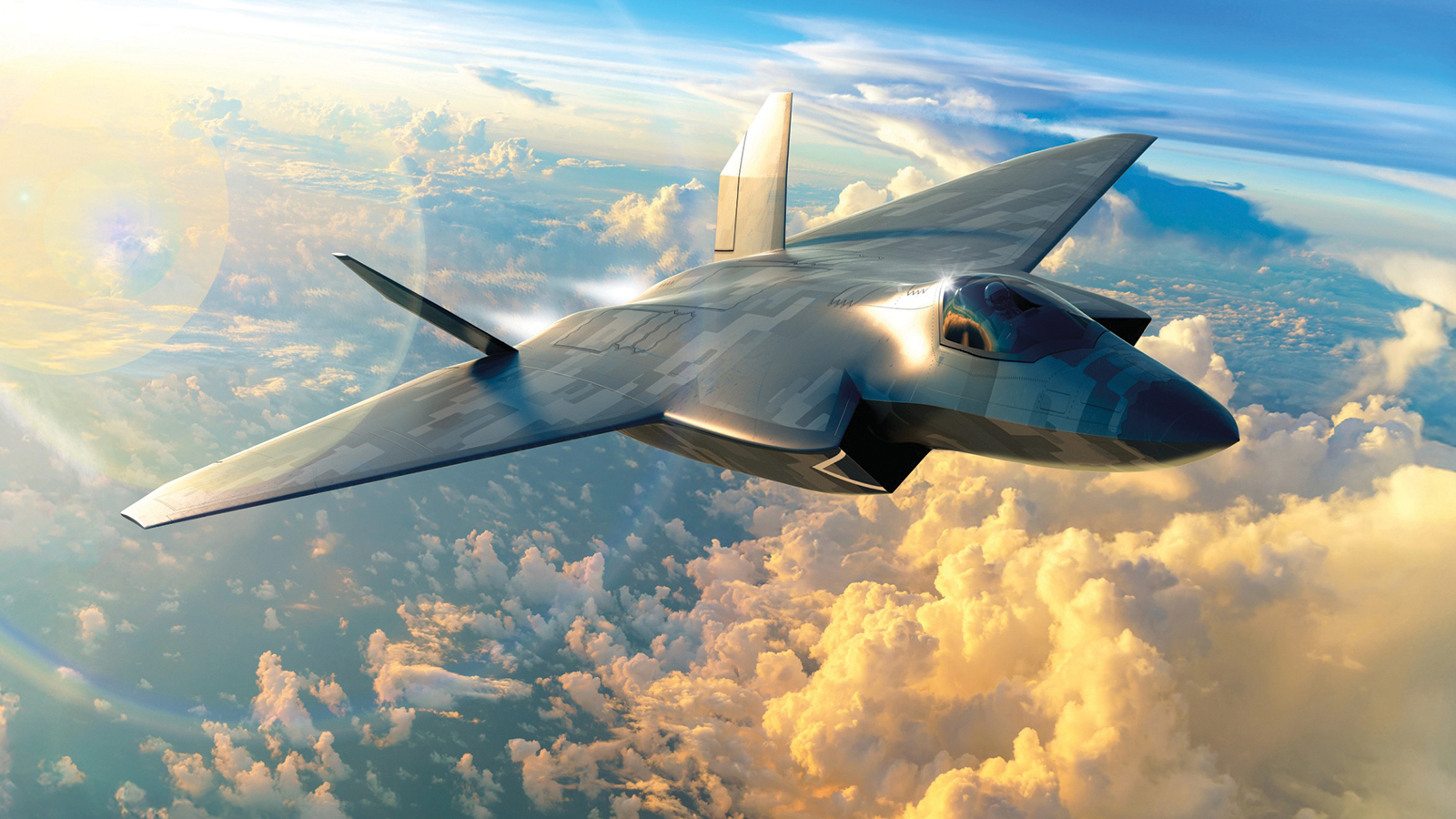
A refined Tempest concept was unveiled at Farnborough in 2024, with a new Delta wing that promises good turn performance, low drag in cruising flight, and massive internal fuel volume. This would potentially give the Tempest a longer combat radius on internal fuel than most current combat air platforms can achieve with external fuel tanks. It may also confer an unusual degree of agility for so large an aircraft. The design is clearly optimised for low observability (radar stealth) with significant internal weapons carriage.
The aircraft that does eventually enter service in 2035 may look nothing at all like the model displayed at Farnborough, or illustrated in dozens of GCI artworks and videos. Some details of the current concept have likely been ‘finessed’ for security reasons while the concept shown represents no more than an illustration of what UK concepting to date shows could meet today’s UK requirement. And digital techniques (including computational fluid dynamics) allow concepting to be undertaken at a previously unimaginable pace, resulting in large numbers of different configurations being assessed and analysed.
BAE Systems’ managing director of Future Air Combat Systems, Herman Claesen ackowledged that the design would continue to be to tested and evolved ahead of the Trinational Joint Design and Development phase, launched last year, when Italian and Japanese requirements might have been expected to start to shape the design. This may not be the case, as BAE Systems’ concepting was based on one requirements document, as Claesen explained: “All the requirements managers from the three countries have established one single set of requirements, and our engineers are currently concepting against that requirement set, and you can see a physical product outside.”
Broad hints were dropped that we may be closer to seeing a definitive GCAP design than has sometimes been realised.
“We are rapidly homing in on the final configuration, and the outer mould line of the aircraft is always one of the big milestones that we need to be achieving,” Claesen said.
But what is inside GCAP is every bit as important as what the aircraft looks like on the outside.
The philosophy of the Tempest design is based around an open architecture, which will make it easier and quicker to enhance and upgrade capabilities so as to keep pace with the threats. For this reason, Tempest insiders suggest that the aircraft will not have an FOC (Final Operational Capability) date, instead being constantly updated and upgraded throughout its service life.
The aircraft features an advanced Integrated Sensing And Non-Kinetic Effects and Integrated Communication System (ISANKE/ICS). ISANKE has been compared to a ‘spider’s web’ of capability sitting across an aircraft, with integrated systems rather than separate sensors. It will also incorporate inputs from offboard sensors across all domains. This will give the Tempest a fully integrated fused sensing capability, providing the pilot with a greatly enhanced view of the battlespace and conferring an unparallelled situational awareness picture, maximising survivability and unlocking the full potential of sixth generation sensing.
The MRFS (Multi-function Radio Frequency System) will provide capabilities beyond those normally associated with a traditional radar, collecting and processing unprecedented quantities of data (claimed to be equivalent to the internet traffic of a large city). Development of Tempest’s ISANKE & ICS builds on existing and new technology, including the ECRS.Mk 2 radar under development for the Typhoon and the universal radio frequency sensor, known as JAGUAR, being developed as a research tool and demonstrator by the UK (Leonardo) and Japan. Two demonstrators will be built, one in each country, with the work and learning shared to maximise national expertise. The ISANKE system will also incorporate significant electronic warfare capabilities, making it more resilient in tomorrow’s congested and contested battlespace.
The Infrared and Electro-Optical system combines Infra-Red Search and Track, Electro-Optical Targeting and Distributed Electro-Optical systems, and provides passive detection and tracking of threats. It is the deep integration of these onboard and offboard sensors that makes Tempest a true ‘6th Generation’ platform. This deep integration is also exactly what will enable allied air forces to quickly and accurately locate targets, while also denying adversaries’ surveillance technology.
Tempest’s Integrated Communication System (ICS) will connect the ISANKE system into the wider FCAS system-of-systems. ICS therefore incorporates vehicle and tactical datalinks, with Beyond Line Of Sight (BLOS) capabilities. The system will dynamically self-optimise to operate to best advantage in any given tactical situation, and to enable ISANKE to operate as an adaptive mesh across formations of widely separated manned and unmanned aircraft.
The various elements of ISANKE-ICS will be tested on board a dedicated large aircraft testbed, based on a converted Boeing 757. This aircraft, known as Excalibur, has received aerodynamic modifications, and is now waiting for the installation of Tempest sensors and systems.
A quite separate Combat Air Flying Demonstrator (previously known as the Crewed Combat Air Demonstrator, and before that as the Flying Technology Demonstrator) is in production. This is not a Tempest prototype, but will be used to develop both technologies and to develop the SQUEP (suitably qualified and experienced personnel) that the GCAP programme will require. It is, after all, several decades since UK industry last developed a ‘clean sheet’ combat air aircraft, and the Combat Air Flying Demonstrator will provide personnel with invaluable skills and experience, ‘rehearsing’ for GCAP/Tempest.
As the Farnborough air show draws near, many expect big news from the GCAP programme. Aerospace Innovations will bring you the full story.
By Jon Lake