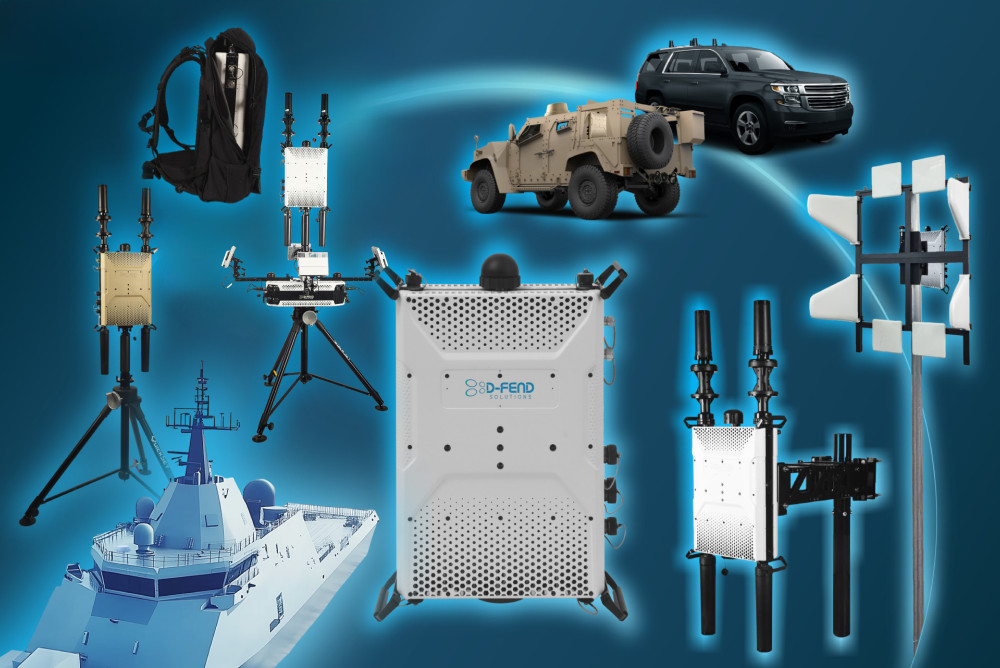
Why the Existence of Small, Prolific Drones Requires Rethinking U.S. Counter-UAS Defense Operations
By: Lior Mishan, Product Strategy Lead at D-Fend Solutions, and Gordon Kesting, Vice President of U.S. Sales and Business Development at D-Fend Solutions
America’s traditional air defense systems were designed to defeat high-value aerial threats including aircraft, cruise missiles, advanced unmanned platforms, and other incoming threats. The existing architecture prioritizes maximum engagement capability against sophisticated targets where performance must outweigh cost considerations.
The proliferation of small commercial Group 1-2 drones, however, has introduced a fundamentally different operational problem. These devices are inexpensive, disposable, and increasingly ubiquitous across both civilian and industry environments. Defending against them now requires a different model, one that optimizes for effectiveness as well as sustainable success.
No Single Technique Can Defeat Every Threat
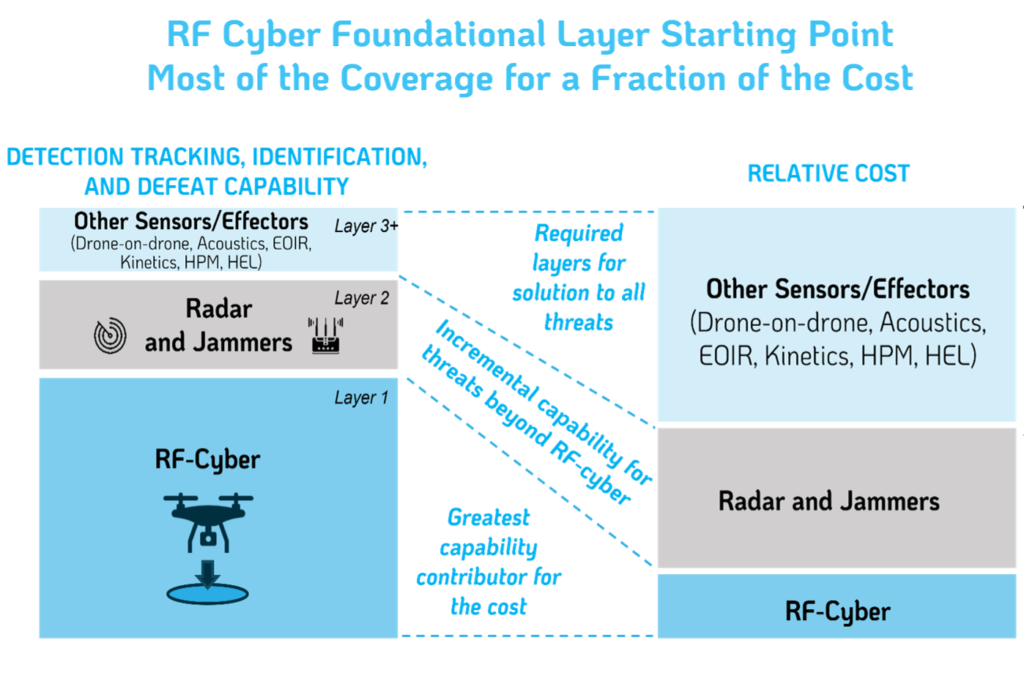
Counter-drone defense must be organized around a layered architecture, with each tier working to offset the weaknesses of others in addressing specific threats. No single method can defeat the full spectrum of small UAV threats. The objective is not maximum capability at every step, but the most appropriate allocation of engagement resources based on both effectiveness and cost-to-defeat.
Layered air defense is not a new concept. Historically, the most advanced systems were designed around the most dangerous threats, thus receiving the greatest emphasis in planning and investment. Today’s small commercial drones invert that logic. Their low cost, large numbers, and widespread availability shift the burden of defense toward scalable, less expensive layers.
A modern architecture must therefore combine multiple capabilities. RF (radio frequency)-Cyber systems are highly effective against most commercially available drones that rely on RF communications. More sophisticated defensive layers remain essential for hardened military UAVs and other targets beyond RF-Cyber coverage. Success comes not from relying on a single technology, but from integrating multiple layers that collectively address the full threat spectrum.
Why Cost-To-Defeat Must Be the Primary Metric
For years, our counter-drone strategy has been driven primarily by established performance metrics such as detection range, precision, and probability of intercept. Those metrics remain necessary. However, against today’s abundant low-cost drone threats, they are no longer sufficient. A primary measure for viability and success is cost-to-defeat.
The challenge is increasingly evident. Commercial drones worth less than one thousand dollars can trigger defensive responses costing hundreds of thousands of dollars of cost per engagement. In some cases, a single interceptor missile may exceed half a million dollars per shot. While these interactions may be tactically successful, they create an unfavorable and often unsustainable exchange ratio.
By this measure, an inherent misalignment becomes apparent. Legacy air defense architectures were built to counter fast, maneuverable, and high-priced military threats. When applied to small commercial drones, seriously disproportionate resources are expended against targets that are cheap, numerous, and easily replaced.
Even when every engagement is tactically successful, sustained attacks can create operational strain through finite interceptor inventories, replenishment delays, and high per-engagement costs. These systems remain highly effective but were designed for fundamentally different environments.
Why Layering Delivers Both Effectiveness and Sustainability
In both national security and civilian protection arenas, the majority of dangerous drone incidents involve commercially available platforms that depend on RF communications for command and control, telemetry, navigation, payload operation, or data transmission. Because most real-world drone threats depend on these links, modern RF-Cyber systems are capable of countering the majority of today’s hostile, unauthorized drones.
Unlike traditional electronic-warfare tools limited to broad interference or jamming, software-driven RF-Cyber systems can often detect, identify, track, and directly assume control of a drone without physical contact. Rather than simply denying spectrum access, they can engage the communications of the platform itself, enabling more precise and scalable defenses while minimizing disruption to surrounding infrastructure or nearby communities.
For this reason, RF-Cyber capability increasingly represents a first, foundational layer of modern counter-UAS architecture. It provides a scalable, non-kinetic capability that addresses the majority of commercial drone threats at extremely low cost-to-defeat, reducing collateral risk while preserving higher-end intercept systems for the limited set of threats that require direct contact.
This distinction becomes especially relevant in high-volume situations. A system may successfully defeat individual drones yet still fail operationally if each engagement consumes disproportionate resources. Sustainable defense depends not only on interception capability, but on maintaining affordable and operationally effective cost-to-defeat across repeated engagements.
The economic impact is significant. A large proportion of small-drone threats can be addressed through comparatively low-cost RF-Cyber measures, allowing premium interceptors and other scarce assets to remain focused on the smaller category of high-consequence threats that demand direct contact.
Tactical efficiency alone is no longer the best benchmark. A system capable of defeating a single drone at extremely high cost may be impressive but will be operationally unstable in sustained engagements. Systems must be evaluated not by whether they can defeat a threat, but by whether they can do so repeatedly, affordably, and at scale. The most relevant metrics are:
– effectiveness against the relevant drone threat set
– sustainable cost-to-defeat per engagement
– percentage of threats addressed by the foundational layer
– operational endurance under sustained conditions
– preservation of high-end intercept capacity for advanced threats
Low-cost drones are effective exactly because they exploit the gap between legacy air-defense systems and the reality of modern threats. The future of counter-drone defense lies in building layered architecture that allocates capability efficiently across the full spectrum of modern drone threats while maintaining both operational effectiveness and economic sustainability.