In the mix: Hybrid-electric aircraft gain traction
If the Ian Dury and the Blockheads hit song, Reasons to be Cheerful, Part 3, were to be updated, hybrid-electric aircraft could well be added to the list, given the positive sentiment pervading the sector.
Alessandro Sgueglia, Referent Future Projects and R&T engineer, and technical coordinator of HERACLES at ATR, says the company has all the reasons to be optimistic, citing its turboprops as the ideal test bed for this as they are already a proven benchmark in regional aircraft efficiency.
“Over the past decade, we’ve seen major breakthroughs in electric motors, power electronics, thermal management, and battery systems. These developments now make it possible to integrate hybrid electric propulsion into a regional aircraft platform to demonstrate its performance and safety,” he says.
ATR is the lead for the HERACLES project (acronym for Hybrid Electric Regional Aircraft Concept for Low EmissionS), part of the Clean Aviation Programme, the European Joint Undertaking dedicated to advancing breakthrough technologies for emission reduction. The primary objective of HERACLES is to define and design the Ultra Efficient Regional Aircraft (UERA) concept. The UERA is an innovative aircraft concept targeting a 30% reduction in CO2 emissions compared to the current ATR 72-600. This performance ambition is enabled through the integration of several technologies, such as hybrid electric propulsion incorporating batteries, an advanced airframe, and innovative integrated aircraft systems.
“The whole industry is investing to make the hybrid electric technology a reality, and to ensure that the solution will be viable for future concepts. We’re not relying on hypothetical future technologies; we’re building on components that exist today and are progressing rapidly,” Sgueglia asserts.
A shared confidence
Michael Derman, CEO of EVIO, which is developing the EVIO 810, a regional aircraft for the 50–100 seat market, agrees that the optimism is genuine—not as a distant concept, but as something quickly becoming practical and economically viable.
“At its core, a ‘strong hybrid’ approach like EVIO is pursuing represents the most feasible path forward for airline economics in regional aviation. Fuel is the single largest operating expense for most airlines, so reducing fuel burn through electrification directly improves route economics,” Derman says.
As Jérémy Caussade, President and Co-founder of Aura Aero, states, “Hybrid-electric is not a compromise solution; it is the technology that can bring cleaner commercial aviation to market first.” Aura Aero is developing ERA, which will be available in four versions: Passenger (16 to 19 seats), Exclusive (8 to 9 seats), Cargo (up to two tons of payload), and Medevac, for medical evacuation.
Electra, the company behind the EL9 Ultra Short aircraft, is also unsurprisingly optimistic. “We’re on the cusp of introducing a whole new way to travel with hybrid-electric aircraft,” the company says.
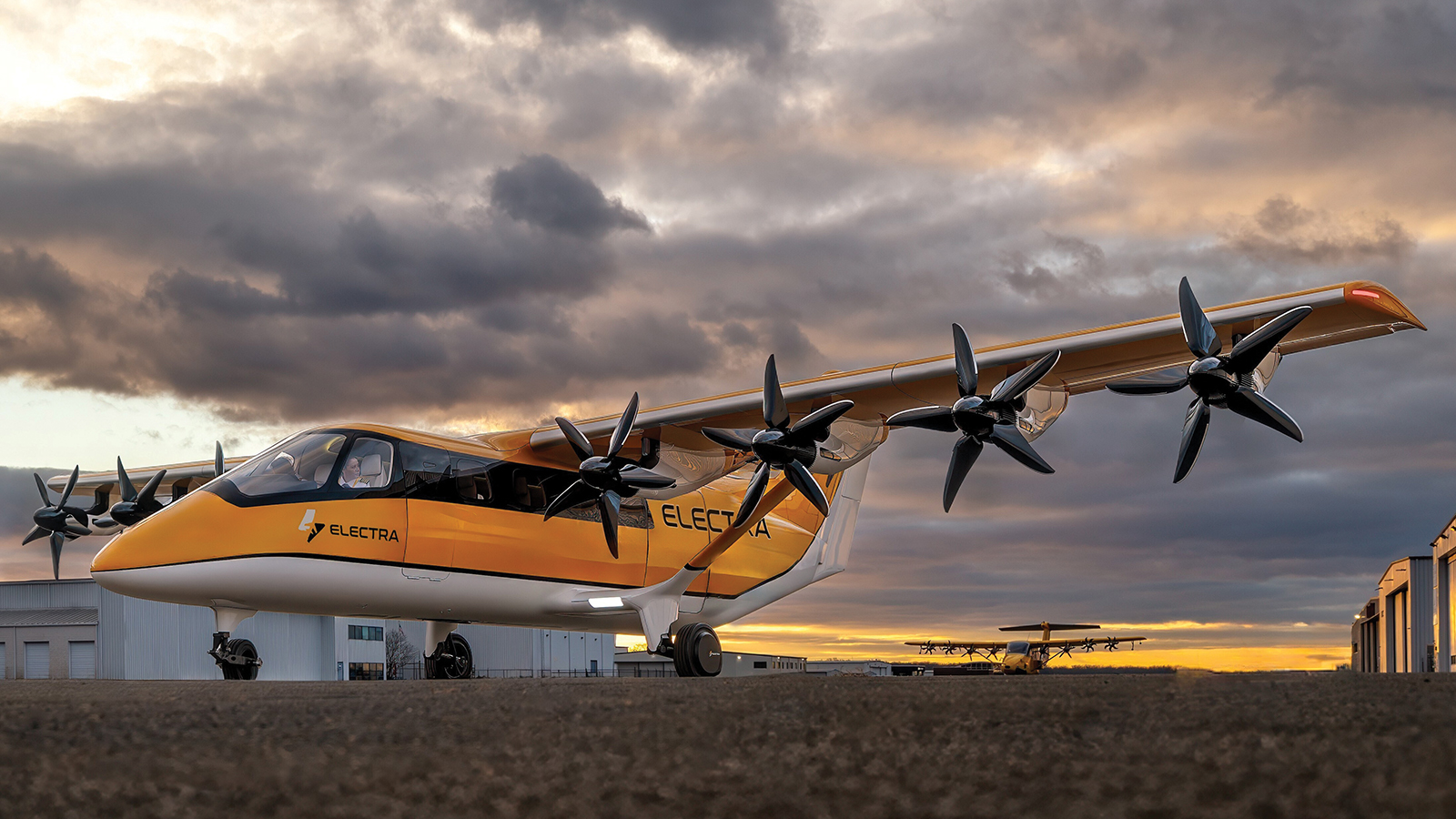
“What we’ve done at Electra is harness blown-lift and hybrid-electric architecture to build an aircraft with novel capabilities, including the ability to take off and land in 150 feet or less,” Marc Allen, President & CEO, Electra explains.
“We’ve been flying our EL2 technology demonstrator for two years, with nearly 200 flights under our belt. The platform is both transformative and practical. And it will open the door to Direct Aviation, which means flying from where you are to where you want to be.
“Hybrid-electric power, combined with blown-lift, is the unlock to transforming the way we travel, and it’s exciting to see it becoming a reality. It’s not science fiction. It’s here.”
For Derman, the opportunity is not just here, it’s getting bigger. “This is just the beginning of the value curve. As battery technology continues to improve, operators will gain even greater flexibility in how they deploy our aircraft, whether that is extending electric-only range, optimising routes, or increasing payload efficiency.
“Those improvements translate directly into additional operational savings and new route opportunities, reinforcing the long-term economic case.
“From a design standpoint, the focus has to remain on what works in real service—aircraft that integrate seamlessly into existing networks while improving cost, performance, and experience. Hybrid-electric systems strike that balance today, while positioning operators to capture even greater benefits as the technology continues to advance,” he states.
For ATR’s Sgueglia, the ecosystem is aligned like never before. “Clean Aviation brings together airframers, engine manufacturers, research centres, and regulators around a shared objective. This collective effort accelerates development, reduces risk, and ensures that certification pathways evolve in parallel with the technology. This alignment is one of the strongest reasons to be optimistic.”
Challenges to overcome
According to Electra, the future of the Advanced Air Mobility sector can be evaluated through the Rule of Six.
To succeed at scale the company says, AAM aircraft must deliver expanded access, quiet aviation, meaningful payload, practical range, and uncompromising safety at an affordable price. Only by meeting all six of these requirements will AAM earn trust, serve communities, and connect people reliably and safely.
Electra’s EL9 Ultra Short addresses the range and infrastructure limitations that have hindered the advancement of fully electric AAM aircraft. “Our aircraft is best suited for trips between 50-500 miles and is able to carry 3,000lbs of cargo. Because we can take off and land in under 150 feet, we don’t need new specialised facilities. The EL9 Ultra Short aircraft uses unique access points like existing runways, parking lots, and soccer-sized fields,” says Allen.
As it matures, the sector is entering an important phase that requires continued progress in areas such as technology maturation, ecosystem development and affordability.
“Ongoing advancements in battery technology will continue to unlock new levels of performance and economic value for operators, while innovations in system integration are enhancing reliability and simplifying maintenance and certification pathways,” says Derman. “At the same time, EVIO is actively advancing thermal management and safety systems, while contributing to the development of robust infrastructure and regulatory frameworks—laying a solid foundation for scalable, widespread adoption.
“At EVIO, we are actively driving this transition forward. Our approach centres on a highly integrated propulsion system, combining targeted innovation with proven, off-the-shelf components. This strategy minimises risk, accelerates certification, and enables faster deployment—positioning hybrid-electric aviation as a practical, scalable, and economically compelling solution today, with even greater potential ahead.”
ATR says it will also focus on the integration of thermal and electric systems. “There is more to hybrid propulsion than adding a battery to an engine. It requires to completely rethink power distribution, thermal management, safety architectures, system redundancy, and certification pathways,” says Sgueglia, “It also means new weight‑distribution strategies, new operational profiles, new maintenance philosophies. This is why demonstrators like ours are essential; they validate the architecture at aircraft level, not just component level.”
Sgueglia also points out that certification of the hybrid electric propulsive system will require close collaboration with EASA.” We are working with them to progress on the certification pathways for these new technologies. EASA is on board the HERACLES and DEMETRA projects for this purpose: understand and grow the Certification Readiness level of new technological bricks and of the integrated aircraft as a whole.”
“Later down the line, aircraft economics and customer profitability remain the number one market driver for regional operators,” Sgueglia continues. “As a result, any new technology that will be integrated into the aircraft will need to deliver clear economic value and remain affordable to ensure broad applicability.
Caussade believes that the challenges are also both technological and structural.
“On the industrial side, like many entrepreneurs in France, we face two major hurdles. First, there is still a lack of entrepreneurial culture, which should be more strongly embedded in engineering education. Second, and more critically, there is a significant shortage of industrial-scale financing. This gap is both surprising and detrimental to long-term value creation, and it clearly requires a collective response at national and European levels,” he says.
“Beyond financing, another key challenge is ensuring that innovation addresses real operational needs. In many parts of the world — especially islands and remote regions — aviation is not a luxury, but a necessity for connectivity, safety and economic development. The world does not revolve around major capitals, and regional aviation plays a vital role.
“This is exactly where ERA comes in. Designed as a 19-seat hybrid-electric aircraft, it directly responds to these essential mobility needs. In many ways, regional aviation operates like a taxi service: short routes, frequent rotations — a perfect match for hybrid propulsion.”
Not just green
The case for hybrid-electric aircraft goes beyond environmental sustainability, to a broader idea of business and industry vitality.
Sgueglia believes that hybrid‑electric propulsion could significantly reduce fuel consumption and operating costs, especially on short regional sectors where conventional engines are less efficient. “This translates into lower direct operating costs, as well as reduced exposure to fuel price volatility and improved profitability on thin or marginal routes, provided key technologies such as the batteries reach expected performance matched by significant improvements costs. This is exactly what our regional operators are asking us in order to meet their own decarbonisation targets. For them this is a major competitive advantage,” he says.
Sgueglia confirms that ATR’s electrification strategy is still under definition. “Depending on how and when electric propulsion is used, it could reduce noise during take‑off, climb and approach. This could translate into extended operating hours at noise‑constrained airports, new routes closer to urban areas, and improved passenger comfort. Noise is becoming a strategic constraint for aviation, and hybrid‑electric aircraft could offer a real solution.”
For airlines, Derman says the key motivation is commercial viability. “The EVIO 810 aircraft is designed to restore route profitability and expand regional networks by reducing maintenance requirements and improving overall operational cost-efficiency. The design also brings significantly lower costs for cargo variants while our high electrical power supply on board the aircraft may find defence and surveillance applications that conventional or even “mild hybrid” aircraft cannot offer.”
Electra’s Allen cites additional motivations and interests in hybrid-electric aircraft including the ability to integrate ultra-short access points seamlessly into communities, delivering on the promise of Direct Aviation.
He contends that Electra’s EL9 Ultra Short addresses the range and infrastructure limitations that have hindered the advancement of fully electric AAM aircraft. “Our aircraft is best suited for trips between 50-265 miles and is able to hold 3,000lbs of cargo. Because we can take off and land in under 150 feet, we don’t need new specialised facilities. The EL9 Ultra Short aircraft uses unique access points like existing runways, parking lots, and soccer-sized fields.
“And with a small and efficient turbogenerator used for cruising and batteries used for take-off and landing, the EL9 Ultra Short delivers a reliable and safe service with quiet operations,” he says.
Programme progress
With over 2,200 pre-orders from more than 60 commercial customers worldwide, including both airlines and helicopter operators, Allen claims the EL9 Ultra Short is already one of the most in-demand aircraft in the advanced air mobility sector and the only one to offer the benefits of Direct Aviation.
The EL9 Ultra Short can carry up to nine passengers and luggage (50lbs each), or up to 3,000lbs of cargo and has a ferry range of up to 1,100 nautical miles, with in-flight battery recharging that eliminates the need for ground charging stations. The hybrid-electric system, which involves distributed electric propulsion and blown lift to enable ultra short take-offs and landing, uses a turbogenerator for cruising and batteries for take-off and landing.
Electra expects to begin test flights for the EL9 in 2027, with certification and commercial service entry anticipated in late 2029 and into 2030.
Electra is also participating in the US Administration’s inaugural Advanced Air Mobility and Electric Vertical Takeoff and Landing Integration Pilot Program (eIPP) where it will work with partner states to advance the integration of AAM aircraft into existing systems and accelerate their safe deployment.
The EVIO 810 is a clean-sheet hybrid-electric regional aircraft designed specifically for the 50–100 seat market with unique attributes for airfreight and the defence communities. The baseline aircraft is configured for 76 seats, with a higher-density 88-seat option also being considered. The company has secured conditional purchase agreements and options for 450 aircraft from major undisclosed airlines.
The target for first flight is around the turn of the decade, with entry into service in the early 2030s.
In terms of mission profile, the EVIO sees under 500 nautical miles as a strong fit for the aircraft in hybrid operation, while all-electric capability is focused on shorter missions.
This approach delivers several important benefits: lower fuel consumption, improved operating economics, reduced noise and lower emissions, especially around airports. It also creates a pathway for increasing value over time as battery technology continues to improve.
“Because this is a purpose-built strong-hybrid aircraft, the propulsion architecture influences the design from the outset. It shapes system integration, energy storage, power distribution, control systems and overall mission optimisation,” notes Derman.
The company is collaborating with Pratt & Whitney Canada in support of that propulsion architecture and enjoys investment and technical support from Boeing.
“We are currently in the final stages conceptual design phase and expect to announce additional partners and suppliers soon, who are actively involved in progressing development activities in support of our Integrated Propulsion System efforts,” Derman advises.
Aura Aero says it is building a highly advanced smart platform that happens to be an incredibly efficient regional aircraft. “We are integrating technologies typically reserved for top-tier commercial airliners or advanced defense platforms, scaling them perfectly for the 19-seater regional market to drive down operating costs and maximise safety,” says Caussade.
Its ERA aircraft uses a serial hybrid propulsion system. Power and propulsion are decoupled: while propulsion is fully electric and is ensured by eight motors from Safran Aircraft Engines US, distributed over the wing, power generation is hybrid and is assured by a combination of four battery packs and two turbogenerators. Such decoupling allows power generating units to work at their optimal point, regardless of the operating point for propellers and electric motors, and vice versa.
The choice of the number of engines is motivated by technology specificities: for electrical engines, in fact, there is no advantage of scale in increasing power concentration, in sharp contrast with thermal engines. There are however disadvantages associated with such concentration, including the need for complex cooling systems, which can be avoided by using many smaller engines. Furthermore, distributing many smaller engines over the wing enables a better aero-propulsive integration.
As Caussade explains, batteries are installed on-board through a modular architecture that enables improved safety and upgradability: in the future, whenever technology improvements will enable it, AURA AERO will be able to propose its customers upgrades based on more energy dense modules, to be installed in place of the existing ones, hence allowing the aircraft to improve its performance over program life.
As Sgueglia explains, the studies, maturation activities and demonstrations conducted across HERACLES and its associated projects will inform the feasibility of EVO, ATR’s next-generation aircraft concept which is targeting an entry into service around 2035, and which envisions a major leap in efficiency, cost-effectiveness and environmental responsibility. The powerplant represents the most impacting system, accounting for 20% of the overall CO2 reduction. It will be developed by Pratt & Whitney Canada, together with Collins Aerospace for the electric engine and Ratier Figeac for the propeller.
Sgueglia says that the main reason behind the choice of the ATR 72-600, the “cherry on the cake” of the programme, as a testbed platform is the representativeness: to validate the maturity of hybrid-electric technologies (up to Technological Readiness Level 6), the hybrid powerplant needs to be tested on a representative platform in a representative environment. “Since the UERA concept is designed for the 50-100 passenger segment and uses the ATR 72-600 as a reference point to quantify improvement targets, the selection of this aircraft was a natural and coherent choice.” Additionally, the ATR 72-600 represents around 75% of the ATR total in-service fleet, making it the most representative platform of its class.
“More broadly, regional CS-25 aircraft provide the first commercially relevant scale at which low carbon propulsion architectures can be validated under real airline operating conditions. Testing hybrid-electric technologies at this level is a critical step in the innovation chain: it ensures that technology pathways remain aligned with the operational and economic realities of airlines, while generating insights directly transferable to future larger aircraft concepts, including next-generation Short/Medium Range (SMR) aircraft,” states Sgueglia.
Eliminating bottlenecks
Hybrid‑electric aircraft rely on new components; batteries, high‑voltage systems, power electronics.
To secure production rates, ATR is partnering with multiple suppliers to mitigate risks, aligning roadmaps with European industrial capabilities, ensuring that critical technologies remain manufacturable at scale. This is essential to avoid the supply‑chain fragilities seen in other sectors.
EVIO is also building the supply chain with rate in mind from the outset—partnering with experienced suppliers, leveraging existing aerospace ecosystems, and avoiding bottlenecks tied to novel or capacity-constrained components.
Derman says the company is designing the program from day one around scalability and manufacturability, not just performance.
“A core part of our strategy is selective innovation. We are focusing our engineering effort on the integrated propulsion system, where we see the most differentiation, while incorporating proven, off-the-shelf components across the rest of the aircraft wherever possible. This reduces development risk, simplifies the supply chain, and shortens lead times. Where we see value in innovating, such as in the integrated propulsion system, we have identified leaders in their respective fields to collaborate with and ensure the concepts consider all costs, from development to production, logistics, maintainability, and aftermarket support.
“This aircraft is designed specifically for a segment that is very cost sensitive.”
According to Derman, the EVIO 810 architecture supports lower operating and maintenance costs over time, which reinforces adoption and allows production to scale more efficiently as demand grows.
“Overall, our approach is to balance innovation with industrialisation—ensuring we can move quickly from development into high-rate, cost-effective production that supports broad market uptake.”
Aura Aero is working closely with several small and big companies in its supply chain, such as Safran, Thalès and many others.
Caussade says the ERA program is progressing as planned — naturally, with its share of challenges. “INTEGRAL E, which shares several innovative components with ERA, has helped us further de-risk the program.
“We reached a major milestone in early 2025 with the technical validation and the signing of key supplier contracts, and we’re set to cross another critical step by the end of the year. In between — meaning within the next few weeks — we’ll begin manufacturing parts for the first prototypes, with a first flight now expected in less than two years.”
The company has secured 700 aircraft on letters of intent for ERA, representing more than USD12bn in potential value. A few weeks ago, the first firm order was confirmed by Pan Europeenne. Caussade reveals ERA now has 20 confirmed orders.
To meet this, Aura is scaling up its industrial capacity to meet demand and ensure on-time delivery for its customers. In Toulouse, it has obtained the building permit for a new 50,000m² industrial site, the Aura Factory, which is expected to begin operations in 2029. “We plan to employ around 1,600 people there and reach an annual production rate of 150 aircraft, including 100 ERA and 50 INTEGRAL,” says Caussade.
“At the same time, we are also expanding in the US. Our future ERA assembly plant in Daytona Beach, Florida, is scheduled to open before 2030 and will employ around 1,000 people. This facility will support deliveries to the North American market, which already represents more than 50% of the commitments received so far for ERA.”
“Looking ahead,” he adds, “we are convinced that before 2030, there will be no larger fully decarbonised aircraft than this category.”
As Electra’s Allen sums up, “We are at a transformational moment for the AAM industry.” Government and regulatory support “enables companies like Electra to demonstrate how hybrid-electric propulsion works at scale, to reimagine how we use the skies, and to change the way that people get to where they want to go.”
By Alex Preston