Bridging Innovation and Quality: How Agile Supplier Recovery Drives Aerospace Advancements
The global aerospace industry stands at an inflection point. Major OEMs — including Boeing, Airbus, Lockheed Martin, and RTX — are preparing for aggressive production ramps in 2025–2027 across commercial, defense, and space platforms. The shift toward advanced materials, distributed manufacturing, autonomous systems, and electrified aviation has accelerated innovation cycles.
However, innovation introduces complexity — and complexity exposes weaknesses in supplier quality systems. Recent years have demonstrated the consequences: supply shortages, quality escapes, certification delays, and costly rework across multiple programs.
This article explores how the Supplier Quality Recovery Program (SQRP)TM are being used across the industry to stabilize suppliers quickly, close audit findings, restore throughput, and protect production readiness. The discussion includes insights from real aerospace scenarios — such as Spirit AeroSystems’ fuselage quality recovery efforts, Safran’s production stabilization in powerplant systems, and Lockheed Martin’s supply-chain readiness initiatives — alongside the practices of engineering and prototyping aerospace innovations firms, which help bridge early-stage R&D into producible, certifiable systems.
- Innovation’s Double-Edged Sword in Aerospace
The industry’s major players are pursuing multiple breakthrough programs in parallel:
- The next generation of commercial aircraft
- Reusable launch systems and deep-space propulsion
- Hypersonic defense platforms
- Fully autonomous unmanned systems
- Electrified aviation and urban air mobility
- Advanced additive manufacturing for flight-critical components
These innovation trajectories place enormous pressure on suppliers — many of whom lack the robust quality systems needed to support such rapid evolution.
This tension — innovation speed versus process discipline — is visible across the industry.
Real-World Examples
Boeing 737 MAX and 787 supply chains have encountered recurring non-conformances due to inadequate supplier control plans, inconsistent inspections, and rapid rate changes.
- Spirit AeroSystems faced fuselage build-quality issues that required deep-dive process audits and recovery teams from Boeing and FAA partnerships.
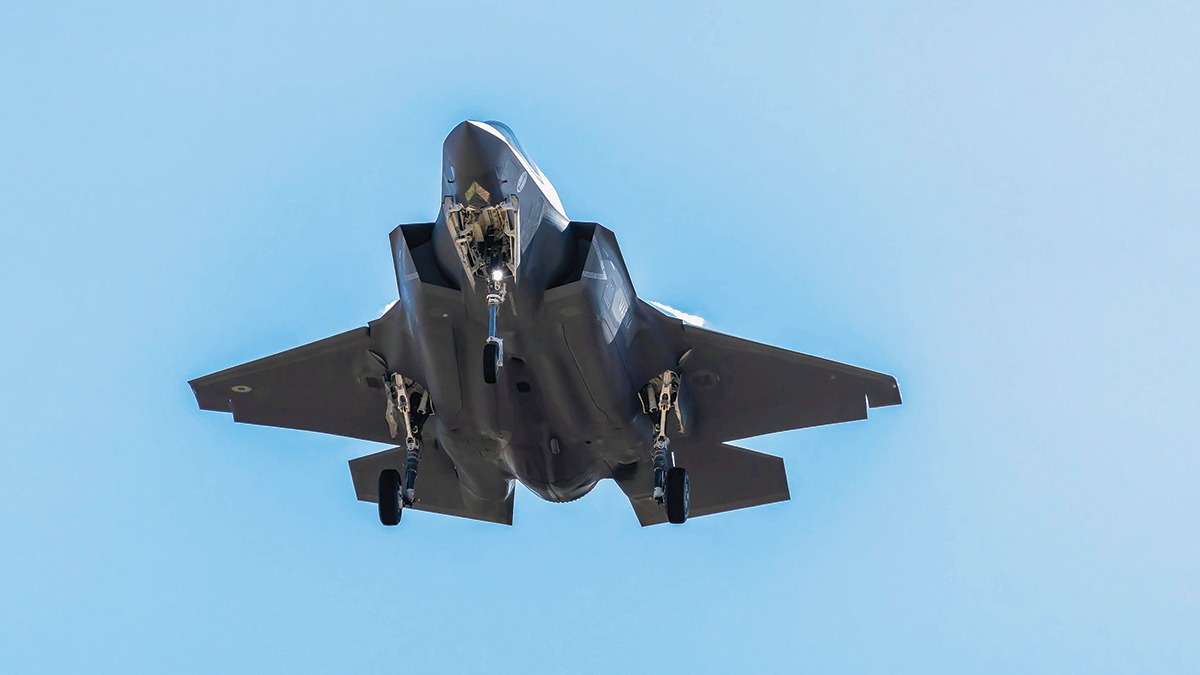
- Lockheed Martin’s F-35 program has continually invested in supplier capability upgrades to meet increasing order volumes and quality expectations.
- Safran and Pratt & Whitney suppliers supporting the LEAP and GTF engines have had to stabilize processes to meet record demand.
These cases underscore a universal truth: innovation without structured quality resilience can lead to instability at the exact moment the industry needs reliability most.
- Why Agile Supplier Recovery Matters
Traditional supplier development models — built for slow, sequential programs — often cannot keep pace with today’s dynamic aerospace environment.
The Supplier Quality Recovery Program (SQRP)TM takes the opposite approach. Instead of lengthy corrective-action cycles and paperwork backlogs, it uses:
- short improvement sprints,
- structured 8D-based root-cause analysis,
- rapid verification loops, and
- digital dashboards for real-time visibility.
A practical example is the Airbus A320neo engine supply chain, where agility became essential as Pratt & Whitney and CFM suppliers worked to correct material and durability issues without slowing aircraft deliveries.
Agile recovery frameworks allow teams to rapidly diagnose issues, implement containment, validate controls, and return to stable throughput — sometimes in weeks rather than months.
- Aerospace Innovations as a Catalyst for Quality Collaboration
The Supplier Quality Recovery Program (SQRP)TM helps bridge the gap between early-stage research and production-readiness. They often work with specialized machine shops, composite manufacturers, additive manufacturing suppliers, and electronics integrators — many of whom excel technically but lack mature aerospace quality systems.
This environment mirrors what major OEMs experience, but at a smaller scale:
- suppliers with strong engineering talent but inconsistent documentation,
- small batch production with variable processes,
- insufficient calibration controls, and limited capacity for formal audits or AS9100 compliance.
By integrating agile quality disciplines into innovation workflows, the Supplier Quality Recovery Program (SQRP)TM helps ensure that novel designs reach the OEMs in a state that is not only functional but also repeatable, traceable, and certifiable.
Industry Parallel
This model is similar to how Northrop Grumman collaborates with smaller suppliers in hypersonic materials development or how Blue Origin partners with rapid-prototyping firms during early propulsion R&D. Agile quality principles allow innovation integrators to maintain speed while preparing suppliers for future production volumes.
- Inside the Agile Supplier Recovery Framework
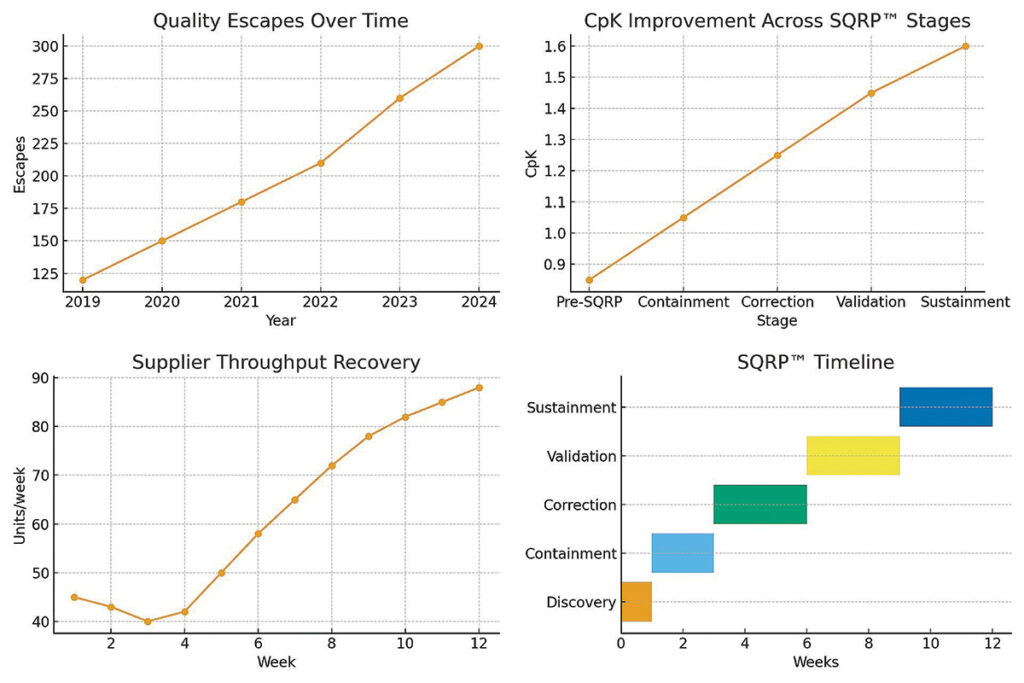
The agile supplier recovery framework used widely across the industry — whether by OEMs, Tier-1 suppliers, or engineering partners
— follows a five-phase cycle:
Stage 1: Discovery & Containment
Within the first 48–72 hours:
- defects are isolated,
- high-risk processes are secured,
- interim checks are implemented, and
- defect propagation is halted.
This approach was applied during Safran’s LEAP engine supply-chain stabilization, where rapid containment prevented further spread of dimensional deviations.
Stage 2: Root Cause & Correction
Cross-functional teams conduct deep 8D analysis, identifying:
- process drift,
- equipment wear,
- spec misinterpretation, or
- training gaps.
Stage 3: Process Revalidation
Critical-to-quality features are reverified using capability studies or short-run process checks — mirroring how Rolls-Royce revalidated turbine-blade forging processes after production issues.
Stage 4: Readiness Assessment
A structured readiness audit evaluates:
- documentation completeness,
- calibration compliance,
- operator qualification,
- change-control discipline, and
- capacity stability.
This mirrors the “Rate Readiness Reviews” practiced by Airbus during A350 ramp-up phases.
Stage 5: Sustainment and Knowledge Transfer
Long-term controls are institutionalized through:
- standardized work,
- visual controls,
- digital inspection logs, and
- periodic verification audits.
- The Rise of Innovation Ecosystems
Aerospace is shifting from linear supply chains to distributed innovation ecosystems. Instead of a single supplier delivering a complete subsystem, multiple specialized partners collaborate on components that must integrate seamlessly.
Examples include:
- Boeing’s MQ-25 unmanned tanker, which connects dozens of subcontractors across avionics, structures, sensors, and propulsion.
- NASA Artemis and Orion programs, which require unprecedented multi-tier supplier coordination.
- Emerging eVTOL manufacturers (Joby, Archer, Wisk), which rely heavily on small high-tech suppliers transitioning from prototyping to certifiable production.
In these contexts, agile supplier recovery is essential not only for fixing problems but for synchronizing maturity across the entire ecosystem.
- Human Factors and Supplier Confidence
Supplier recovery is more than a process — it’s a psychological reset. Many aerospace suppliers experience:
- audit fatigue,
- fear of losing contracts,
- misalignment between engineering and quality teams,
- or morale drops during intense correction phases.
Agile supplier recovery mitigates these risks by using:
- coaching-based audits,
- collaborative workshops,
- transparent dashboards, and
- cross-functional communication rituals.
These are similar to the approaches used by Lockheed Martin’s Supplier Development teams, who emphasize capability-building rather than punitive escalation.
When suppliers feel supported — not cornered — they sustain improvements longer and commit more deeply to quality ownership.
- Turning Compliance into Competitive Advantage
The Supplier Quality Recovery Program (SQRP)TM is not simply about closing findings — it is about restoring flow.
Consistent, conforming flow leads to:
- On-time delivery
- Predictable throughput
- Stable manufacturing rhythm
- Fewer late-stage surprises
- Protecting certification timelines
Examples in Practice
- Airbus improved A320neo delivery cadence after stabilizing engine supply disruptions.
- RTX strengthened composite and turbine suppliers through capability reinforcement efforts.
- Boeing and Spirit AeroSystems implemented joint recovery plans that reestablished fuselage assembly stability.
The lesson is clear:
Quality recovery is a strategic enabler for schedule confidence.
- The Future: Scaling Agility Across Aerospace
To meet future demand, aerospace organizations will increasingly rely on:
- AI-enabled audit analytics,
- digital twins for supplier processes,
- predictive maintenance for production equipment,
- blockchain-based parts traceability, and
- integrated risk dashboards from Tier-3 to OEM.
But technology alone cannot solve these challenges.
The core remains:
- Systems thinking
- Human alignment
- Cross-functional discipline
- Rapid learning cycles
- Structured problem-solving
In this environment, aerospace media platforms like Aerospace Innovations will play a vital role in distributing the insights, frameworks, and best practices that suppliers across all tiers need to adapt and grow.
Conclusion
Aerospace is entering a new era — one where breakthroughs in propulsion, autonomy, and materials must coexist with strict certification requirements and unyielding safety expectations.
Agile supplier recovery is the bridge between invention and execution.
It ensures that while the industry pushes boundaries, it also maintains stability, repeatability, and compliance at every tier.
The organizations that succeed in the next decade will not be those who innovate the fastest, but those who can recover the fastest, stabilize the deepest, and scale the smartest.
By Azita Hajihassani, Ph.D., MBA
Supplier Quality & Operational Excellence Consultant