Getting the hang of digital
Alex Preston talks to some of those helping airlines and MROs make the transition to a paperless hangar
Paper is being eliminated from the passenger interfacing side of aviation. Ryanair, for example, made headlines recently when it moved to 100% Digital Boarding Passes, no longer accepting printed boarding passes. The move, it says, will save it up to €40 million (£35 million) annually and help pass on lower ticket prices to its passengers.
On the operational side, various paperless technologies are already in use to optimise airline processes, but significant challenges still remain when moving forward to ensure proper transition from paper to digital processes and activities.
Chris Clements, Senior Sales Representative for Swiss-AS believes it would be fair to say that whilst paperless is on every aviation organisation’s roadmap, not all have managed the transition as yet. “Whilst some key areas will have been digitalised and eliminated paper processes, challenges such as differing customers’ requirements and industry standards not being taken up across the board remain in place and are a key obstacle of MROs in going fully paperless,” he says.
“While many airlines and MROs have invested heavily in digital solutions, a surprising amount of maintenance execution remains paper-driven—particularly on the hangar floor,” adds John Stone, Vice President of Product Management at Ultramain Systems.
He says that whilst work cards, task signoffs, shift turnover notes, and informal findings may originate electronically, they are frequently printed because paper is still perceived as more dependable at the aircraft.
“Airlines that perform the majority of their own maintenance tend to be further along in the paperless journey, having invested more consistently in mobile execution and data collection at source. In contrast, operators that outsource maintenance often leave paper embedded in the process, transferring the responsibility to the MRO to manage, reconcile, and ultimately digitise that information.”
By definition
It may seem obvious, but what exactly is paperless hangar? A paperless hangar is an aircraft maintenance environment where the primary record of work is created and maintained digitally, at the point where maintenance actually happens. This includes all maintenance processes from jobcard production and sign-off through to workpackage completion and billing.
As Stone says, a paperless hangar is often referred to as data collection at source or shop floor data collection, because information is captured directly by technicians and inspectors as tasks are performed, rather than transcribed later from paper. Instead of relying on printed task cards, handwritten notes, and end-of-shift data entry, maintenance teams use mobile tools to receive work, reference procedures, record findings, and complete regulatory signoffs on the hangar floor.
Considering that the average C check consists of around 800 scheduled tasks which are managed by means of a jobcard that is one or more pages, plus a number of findings that will be raised in the form of NRCs (Non-Routine Cards) or defects, and the volume of paper starts to increase dramatically.
“That does not even consider the fact that many organisations will have produced working copies for the technicians to use out in the hangar to preserve the original document,” Clements points out.
An IT priority?
From the experience within the AMOS community, and indeed the wider climate, both Swiss-AS and Ultramain are seeing increased momentum toward paperless hangar initiatives for a variety of reasons; and how companies are positioned internally makes a big difference.
This is true for both Swiss-AS’s airline and MRO customers who, says Clements, have clearly identified the advantages to the business and the opportunities that technology is creating. “The demand for paperless and digitalisation is both from an internal optimisation point of view as well as the ability to better exchange data with their suppliers, customers and partners,” he adds.
“When framed purely as an IT investment, these programs can struggle to compete for budget against other technology priorities,” Stone cautions. “The organisations that are moving fastest tend to view paperless hangars as an operational and safety initiative rather than a systems upgrade. The real drivers are improved productivity on the hangar floor, stronger compliance and accountability, reduced risk from manual processes, and better support for technicians doing the work.
“Equally important is the data aspect. Paperless execution ensures that maintenance data is captured accurately and consistently at the point of work, rather than reconstructed later from paper. That creates a reliable foundation for analysis—whether it’s improving planning accuracy, identifying repeat defects, or strengthening continuous improvement programs. When positioned around operational performance, safety, and data-driven decision making, paperless hangar initiatives are far easier for airlines and MROs to justify and prioritise.”
Both Clements and Stone have confidence that 100% paperless is realistic and achievable.
“A truly paperless hangar will support all of the processes that stem from the paperless maintenance workscope, such as consulting OEM documents, requesting material and booking tools out of the tool store,” says Clements.
From a product perspective, mobile execution is the enabler. Stone cites solutions like ULTRAMAIN Mobile Mechanic that allows work to be performed naturally at the aircraft while a complete, time-stamped, and auditable digital record is created in the background, improving visibility and control without compromising compliance.
Beyond green ambitions
Whilst the environmental benefits of going paperless are clearly a target that most industries are looking to improve upon —Ryanair for example, claims its move to digital boarding passes will reduce its use of paper by 300 tonnes annually —Stone says the primary goals of a paperless hangar are often misunderstood, because eliminating paper is not the objective—it’s the enabler.
“Paperless execution is the path to improving how maintenance is performed, controlled, and continuously improved. The focus is on supporting technicians at the aircraft with accurate information, structured workflows, and real-time system updates so the maintenance record reflects what is actually happening as work progresses.”
Beyond environmental benefits, the gains are primarily operational. Productivity improves by removing non-value-added activities like searching for documents or re-entering data. Compliance and accountability are strengthened through structured, time-stamped digital signoffs. With paperless processes fully adopted, eradicating working copy paper job cards from the hangar floor, the transcribing of handwritten notes into the M&E system is eliminated ensuring that there are no legibility issues due to individuals handwriting whilst at the same time benefiting from real time data entry. Safety is also improved by ensuring technicians are always working from current, approved data.
“Having access to OEM documentation on AMOSmobile/EXEC (AMOS mobile application used by technicians) ensures that the current revision of the documentation for the A/C that they are working on is in their hands without having to leave the work area to print documents. This OEM data can be used in solutions such as AMOS to ensure that requesting or installing the incorrect part number can be virtually eliminated,” says Clements.
Another benefit is that problems encountered during execution—unexpected findings, task conflicts, or parts constraints—are surfaced earlier, allowing issues to be resolved faster. The real time data entry allows processes such as findings approvals, material requests and engineering support queries to be handled immediately according to priority therefore minimising any impact to operational activities.
For instance, when communicating with the customer, in the case of an MRO, throughout the execution of base maintenance, AMOS can be paired with Aviatars MRO Base Maintenance which provides a comprehensive customer portal allowing the customer visibility of the current progress and status of the maintenance. As and when documents need to be exchanged such as a finding approval, digital photographs or invoices, MRO Base Maintenance provides the essential centralised solution that enables the swift and complete communication portal utilising and supporting the paperless hangar.
With digital workflows like those enabled by ULTRAMAIN, even ancillary processes such as engineering reviews and approvals become part of the same digital flow, reducing delays and improving turnaround times. “The result is higher-quality data captured at source, supporting defect reduction, better planning, and continuous improvement—reinforcing that paperless is the means, not the end,” comments Stone.
Clements also says that management of tooling in a paperless hangar has to be a clear target as a part of the control of a maintenance input. “Whilst AMOS has a strong means of managing tooling in a digital manner, giving both the tool store and the production controller a clear overview of tools currently booked out and their location, we also have customers that have integration with third-party tool control systems offering smart tool boxes and cabinets,” he remarks.
An additional key part of supporting the paperless hangar and delivering a high level of service whilst ensuring that the audit trail for all material is maintained is material management processes. Swiss-AS also has customers investigating the use of robots to deliver material to the hangar maintenance bay further optimising the inventory delivery process reducing the need for users to leave their work area when retrieving of delivering stock.
Cloud bursting
Paperless is not dependent on a cloud-based solution. For its part, Swiss-AS offers both on-premises and cloud-based solutions.
As Clements points out, there are challenges to be faced in various regions that have data sovereignty and data residency laws to be respected. In cases such as these, the challenges are based on the cloud data centre providers available. In the experience of Swiss-AS, the majority of its new customers are selecting a cloud hosted solution when implementing AMOS, he says, adding that the company is seeing a rising number of existing customers opting to move their AMOS environment into the cloud.
“Swiss-AS has an amazing team of experts who support our customers in moving their AMOS into the cloud and in some cases updating their database as a part of the process. Having well in excess of 50 customers now in a Swiss-AS hosted cloud solution it is clear that the benefits outweigh any challenges faced,” Clements states.
From an IT and data perspective, the biggest challenges in moving to cloud-based MRO platforms are less about the cloud itself and more about organisational readiness, data discipline, and operational alignment, argues Stone. Maintenance touches many interconnected functions—engineering, supply chain, flight operations, and finance—and cloud platforms are most effective when those relationships are clearly defined and governed with consistent data standards.
“Connectivity is often cited as a challenge, but in practice it should be treated as a foundational enabler, not a limitation to work around,” he contends. “Reliable network access in hangars is critical to realising the full benefits of paperless execution, real-time visibility, and immediate issue resolution. While modern solutions must be resilient by design, poor connectivity should not be accepted as the norm or used to justify continued reliance on paper or a solution’s offline capabilities.
“The value of paperless maintenance—improved productivity, compliance, and data quality—depends on investing in the infrastructure that supports it. When cloud platforms are paired with dependable connectivity and mobile tools designed for maintenance workflows, they enable real-time execution and decision-making rather than delayed or fragmented processes.”
The road to digital
Whether it’s an airline or MRO looking to digitalise, or continue to develop their exiting digital processes, the most successful transitions to a paperless hangar start with structure and intent, not just technology.
As Stone remarks, airlines and MROs need to clearly define the workflows that will become digital, how those workflows align with regulatory requirements, and—critically for MROs—how customer approvals and visibility are handled in a paperless model.
“Establishing regulatory and customer acceptance early removes uncertainty and ensures that digital records are trusted as the authoritative source, not treated as a secondary copy of paper,” he says.
From an operational standpoint, he makes the case for prioritising certain workflows because they create the greatest downstream impact.
“Maintenance planning and work package creation set the foundation for execution,” he reasons. “Engineering requests and dispositions are key to resolving issues quickly during execution, and financial reporting depends on accurate, timely capture of labor and material at source. Bringing these workflows into a single digital flow prevents paper handoffs and delays. Supporting this transition also requires investment in the right technology—mobile devices, reliable networks, and governance to ensure consistency. When workflows, approvals, and technology are addressed together, paperless becomes a practical operational transformation rather than a fragmented IT initiative.”
Over at Swiss-AS, the company has supported its customers in such transitions for a number of years now and its highly skilled and experienced team of project managers and consultants have produced documentation and developed specific services to support its customers to make the transition.
“Of course, there are several factors to take into consideration starting with data, ensuring that the data is clean and complete is a critical step to supporting paperless processes and delivering the full value,” says Clements.
“Reviewing processes and implementing e-sign is a project that should not be underestimated, but once again Swiss-AS has had experience of this and supports customers in this stage. As a part of the LHT (Lufthansa Technic) Digital Tech Ops Ecosystem, AMOS and Flydocs can be used together to manage the Digital Records Management side of things.
“Hardware is another piece of the puzzle to be considered, and the investment required from the business. To enable paperless processes in maintenance and stores the selection of the most suitable mobile devices and how they are issued to the end users, individually or in a similar manner to tools. Swiss-AS has taken an approach that ensures that the customer has the flexibility to select the hardware and OS (operating system) when implementing AMOSmobile/EXEC and AMOSmobile/STORES as optional solutions.”
End of the road for the paper trail?
So, what comes next for the paperless hangar? Stone believes it’s a shift from digitising work to fully optimising the business around it. “Once maintenance execution is truly paperless and data is captured consistently at the source, organisations can move to the next level—using that data to drive smarter commercial, operational, and engineering decisions. Accurate, real-time execution data dramatically improves contract management and billing, reducing disputes and ensuring that work performed, labour consumed, and materials used are reflected correctly and transparently,” he says.
Whilst the industry continues to catch up with and adopt the technology that is available today with the likes of ULTRAMAIN Mobile Mechanic and AMOS from Swiss-AS as part of Lufthansa Technic (LHT) Digital Tech Ops Ecosystem (DTOE) there is never a shortage of concepts and ideas focused on the hangar of tomorrow. “Swiss-AS and the DTOE are constantly evaluating how our solutions will be a part of this, if not defining the next big thing to hit the market,” comments Clements.
Now that data has been harnessed within AMOS and optimisation and analytics further enabled through the DTOE, Clements says that the focus turns to the hangar floor and how to better put all this data to work in the physical world.
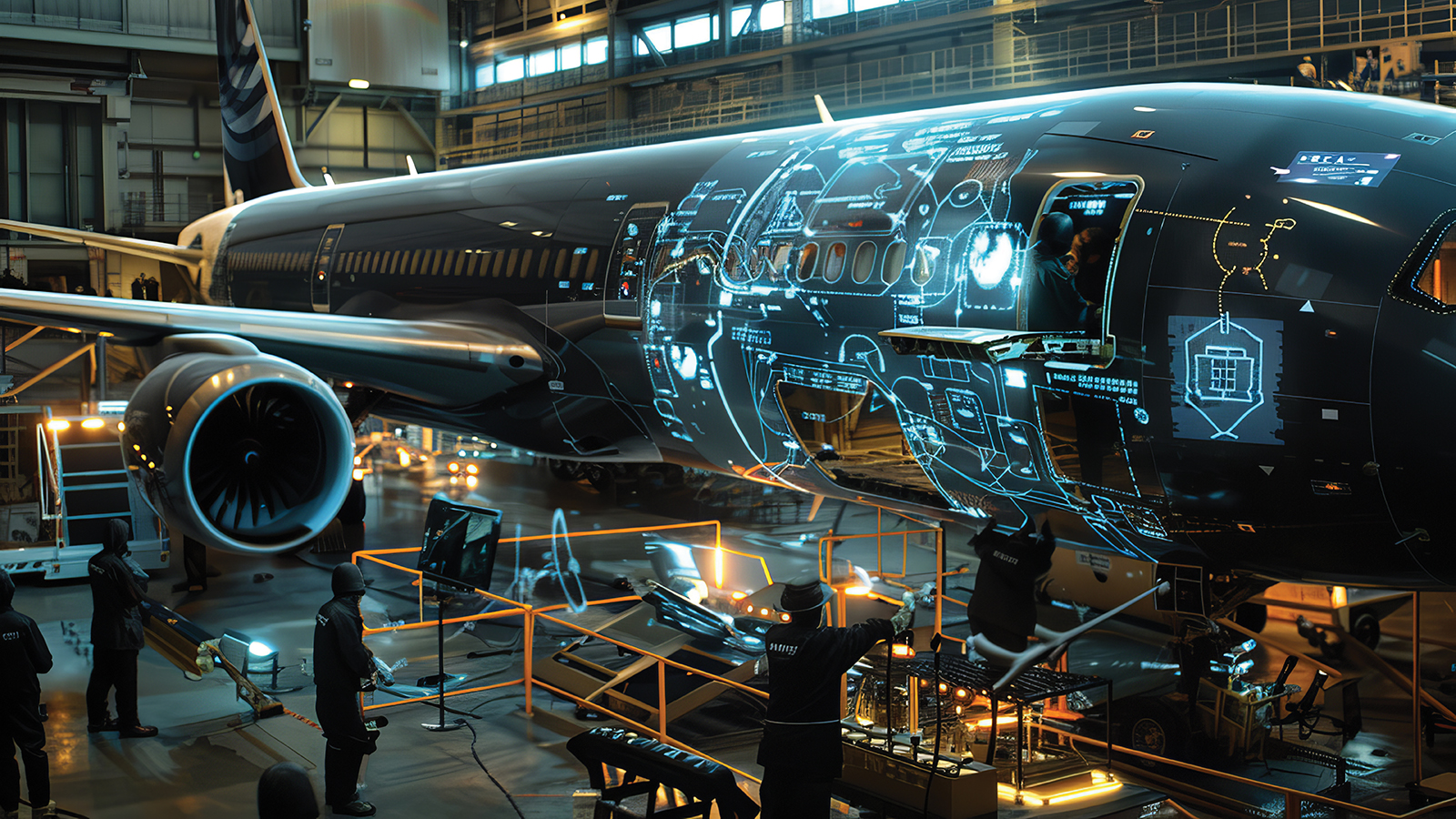
“Many studies have been performed into different technologies to support the hangar whether that be drones for fuselage inspections, robots inspecting lower fuselage areas for damage, 3D mapping of damage and AR for technicians to view maintenance information overlayed over the physical aircraft or system and some have come to the fore and are used productively in the maintenance arena,” he says.
“This industry is notoriously slow in adopting new technology, for the most part for very good reason usually safety related, but the last five years or so has seen a rapid acceleration in testing, approval and adoption of new technology.”
As Stone explains, this foundation also enables more advanced use of AI and analytics. We’re beginning to see intelligent support for bidding and quoting, drawing on historical execution data to improve accuracy and reduce risk. AI can assist in problem resolution by analysing similar past events and recommending proven solutions when issues are raised during maintenance. Planning optimisation, automated identification of execution risks, and early detection of cost or schedule overruns all become possible when high-quality data is available.
“In that sense, paperless is no longer the destination—it’s the prerequisite for a more intelligent, predictive, and commercially efficient maintenance operation.”
By Alex Preston