Check Ride
Air data testing is a vital maintenance task to ensure that pilots are presented with accurate speed and altitude information.
Aerospace Innovations spoke to a pair of leading specialists in the field
An aircraft’s pitot static system combines a forward facing pitot tube and a static port. The pitot tube measures the dynamic pressure of the air entering it, or the difference between the ambient air pressure and the force of the air caused by the aircraft’s forward movement. The greater the force, the greater the airspeed. The static port measures the ambient air pressure and so is located out of the airflow. As pressure decreases with altitude, the system can determine altitude and the rate of climb or descent. A pitot static tube combines both functions.
The system is relatively simple and very effective, so there has been little change over the years. The most significant development happened between between 1997 and 2005, with introduction of Reduced Vertical Separation Minima (RVSM). This was intended to increase upper airspace capacity between FL290-410 by allowing aircraft to fly 1,000ft above or below each other, a halving of the previous requirements,, However, it was mandatory to have two independent altitude measurement systems; an altitude alerting system; an automatic altitude control system; and a transponder with altitude reporting system that connected to the altitude measurement systems.
ATEQ
Aviation is one of the four divisions of the ATEQ Group (which celebrated its 50th anniversary in 2025), says Sandra Kadded, Marketing & Communication Manager – Aviation division. The main markets served are OEMs and MROs, airlines, business aviation FBOs and military and defence. She adds that general aviation is another key market, especially in the USA, where demand is high. The Aviation division of the ATEQ Group is constantly rethinking and evolving its offering to meet market expectations. This resulted in the acquisition of Cobra Systems based in the USA in 2018. The integration of this brand has enabled it to expand the ADTS offering. It now has a wide range of pitot adapters and kits compatible with more than 400 types of commercial, civil and military aircraft and helicopters. She notes that, given the current global situation, an increase in demand from the military market is more than likely.
The company has a worldwide sales team, as well as a global after-sales service network that is constantly adapting to developing markets and customer demand for proximity and responsiveness. To further expand access to customers, the company has added distribution partners to its sales strategy in certain markets, such as general aviation in the United States.
Distribution partners also support sales teams around the world in getting referenced in Aircraft Maintenance Manuals (AMMs).
Technical Development and innovation is led by a team based in France. New developments often start with customers coming to ATEQ looking for an expert and reliable partner to help them with a specific application, which, by building on that experience with customers and partners enables continuous improvement.
The company launched a secured service cloud platform a year ago, initially with two products (battery testers), but the intention is to add more over time. This platform allows centralised fleet management, enhanced traceability and compliance as well as integrated support and service documentations. This is the case for customers who are increasingly considering the digitalisation of processes and have to keep up with the work. The test results are recorded and stored in the cloud for further analysis. Customers also have access to technical and calibration certificates.
In March, ATEQ Aviation acquired the T-RX avionics test solution from CCX Technologies. to expand its avionics offering. The combination of ADTS and T-RX allows maintenance organisations to more efficiently perform comprehensive tests for compliance with 14 CFR 91.411 and 91.413 standards for aircraft certification and continuity of airworthiness.
Druck
Chris Roberts, Test & Calibration Product Leader at Druck, says the company is the market leader for military multi-channel ADTS systems, particularly in the US. The commercial product uses similar technology and is used for widebodies and narrowbodies, with single channel units for business jets, helicopters, trainers and light aircraft. The product was part of Baker Hughes’ Precision Sensors & Instrumentation (PSI) line until it was sold to Crane Company in June 2025.
He notes that technology requirements are generally driven by manufacturers, and, being risk averse, they have a tendency to stick to tried and tested methods. However, Jonny MacGregor, VP Technology, points out that the company‘s TERPS (Trench Etched Resonant Pressure Sensor) technology, which uses a resonating silicon MEMS (Micro Electro Mechanical Systems) pressure sensor technology is 10 times more accurate and stable than traditional pressure measurement technologies. Indeed, Roberts says it can calculate a person’s height based on the change in air density from their head to their feet.
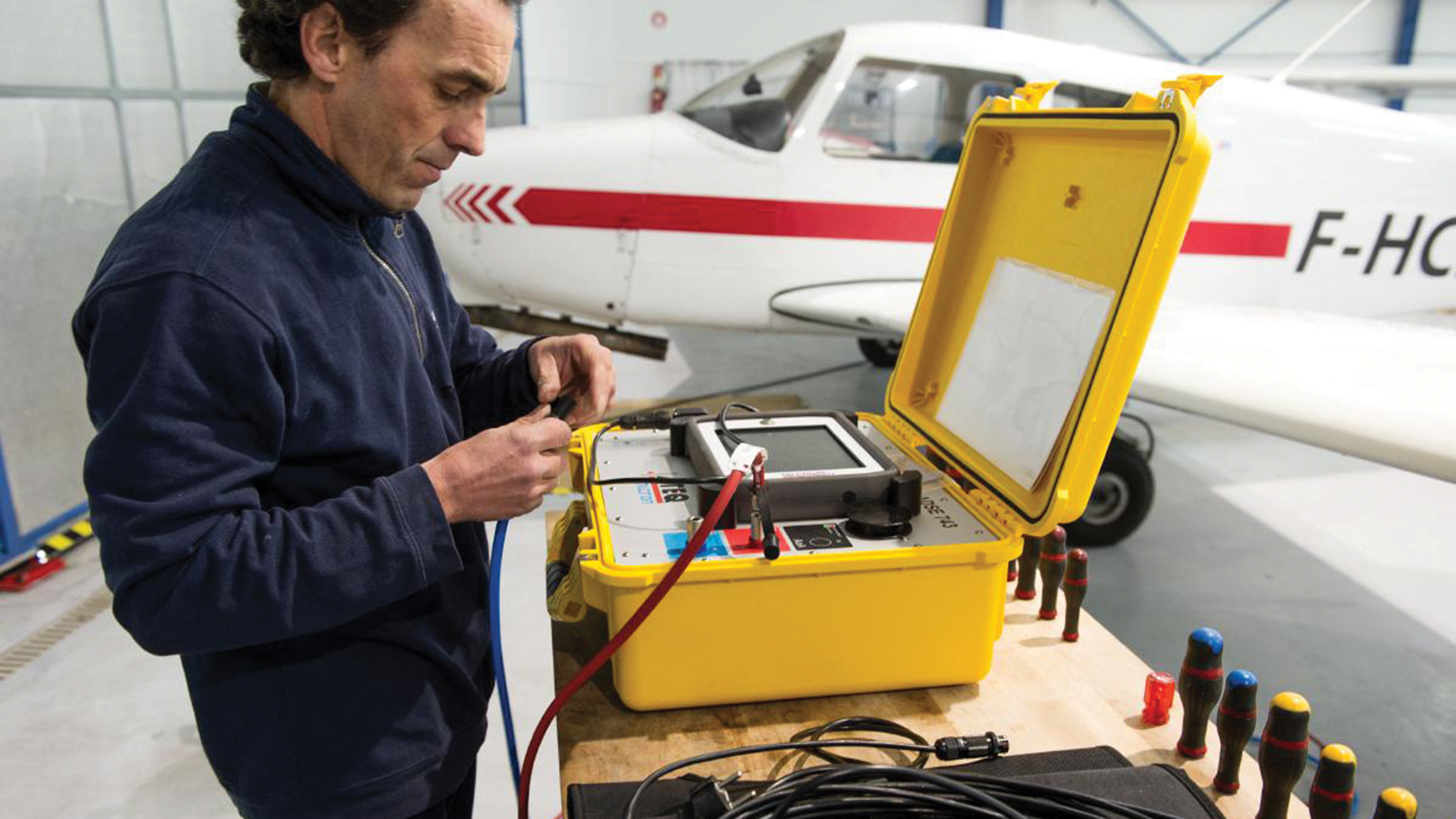
This is the general approach, to add value to the product to reduce operational times for customers. An example is to combine several test routines onto one test card. Last year, it teamed with VIAVI to combine ADS-B, transponder and pitot static testing in a single solution. The units have also become smaller and more portable.
Another example is the addition of Bluetooth. The test set generally sits on the apron next to the aircraft, connected to the pitot static system by hoses and adaptors. The technician will then go into the cockpit to carry out the procedures, which means cables from the test set running in through the cockpit window or up the stairs. By getting rid of the cables, the time is reduced. Having said that, the company had to overcome some challenges, since the fuselage acts like a Faraday cage, blocking external electric fields and electromagnetic radiation. However, he says clever design in various aspects of the product means that the industrial Bluetooth system that is used is more stable and reliable than wifi systems used by some competitors.
The wide range of customers means the company can learn from operational experience – with the military, robustness is top of the list – and transfer it back into product design. Part of this requirement is because of forward deployments. Commercial operations are generally hangar-based, but units can be deployed in the field in widely different climatic conditions. Another challenge that was overcome was deployment on aircraft carriers, where huge air defence radars were a source of interference.
MacGregor says a significant advantage for Druck is that it is first and foremost a sensor manufacturer, so products are designed for a specific application, rather than taking an existing sensor and trying to adapt it to meet the requirements. A good example is the PACE Tallis Transfer Standard Calibrator, that was introduced last year, with an accuracy four times that of ADTS.
He explains that calibration usually requires a dead weight, a piston gauge or a laboratory instrument. These are notoriously difficult to set up properly, requiring training and some knowledge to ensure success. That is clearly not practical in the field, nor is shipping units back for calibration, whereas PACE Tallis weighs just a few kilos, making it simple to deploy.
By Ian Harbison