The 25-Hour Retrofit: How New Mandates and Connected Tech are Redefining the ‘Black Box’
An exclusive Aerospace Innovations experts’ roundtable
Flight data recorders (FDRs) and Cockpit Voice Recorders (CVRs) are undergoing evolutionary changes. New regulatory mandates are driving a shift from 2-hour to 25-hour CVRs to prevent critical data from being overwritten during long-haul flights or non-catastrophic incidents. The push to create Automatic Deployable Flight Recorders (ADFRs) to resolve the “lost wreckage” problem is being overtaken by “connected recorders” that stream flight data via satellite for real-time analysis. And, to avoid repeat scenarios of lost aircraft like AF447, Underwater Locator Beacons (ULBs) are being upgraded from 30-day to 90-day transmission lives, to give investigators much more time for recovery.
To look at all of these issues more closely, Aerospace Innovations magazine brought together two FDR/CVR experts to discuss these and other issues. James Kemmitt is Product Line Manager for Flight Data Recorders at Curtiss-Wright. Dror Yahav is CEO of Universal Avionics.
Curtiss-Wright has been involved in crash-protected flight recorders since their inception. Today it is known for its modern Fortress FDR product family and its collaboration with Honeywell. These systems are designed to meet current global safety mandates, including the 25-hour recording requirement. Curtiss-Wright’s lineup includes standalone and multi-purpose units that combine data, voice, and image recording.
Established in 1981 and now a subsidiary of Elbit Systems Ltd., Universal Avionics provides flight management systems, recorders, and display solutions for over 35,000 aircraft worldwide. The company specializes in commercializing military-grade technologies, including wearable head-up displays, multispectral Enhanced Vision Systems (EVS), and AI-integrated avionics. Serving business, cargo, and airline sectors, their portfolio focuses on enhancing situational awareness through connected avionics and advanced visual guidance tools.
Aerospace Innovations: What is the current state of the FDR/CVR market, in terms of the capabilities of the installed base?
James Kemmitt: All aircraft above a certain weight or passenger number—depending on which side of the pond you’re on—are mandated to have flight data recorders, and have been for many years. Another mandate from the ‘80s or ‘90s required these to be solid-state devices, so today’s installed base consists of modern, electronic, state-of-the-art, and very reliable devices.
Typically, every aircraft is fitted with one cockpit voice recorder (CVR) that records pilot communications and ambient cockpit noise, which is vital for investigators. There is also a flight data recorder (FDR) that records data buses.
As aircraft have become more electronic, the volume of data has increased, so recorder capacity has grown significantly. However, physically, they remain about the same size. Ironically, there is a minimum size requirement so they can be easily located in wreckage, even though modern technology could make them much smaller.
Dror Yahav: Operators flying with the latest recorders are equipped with 25-plus hours of cockpit voice and flight data capabilities, along with a 10-minute independent power supply.
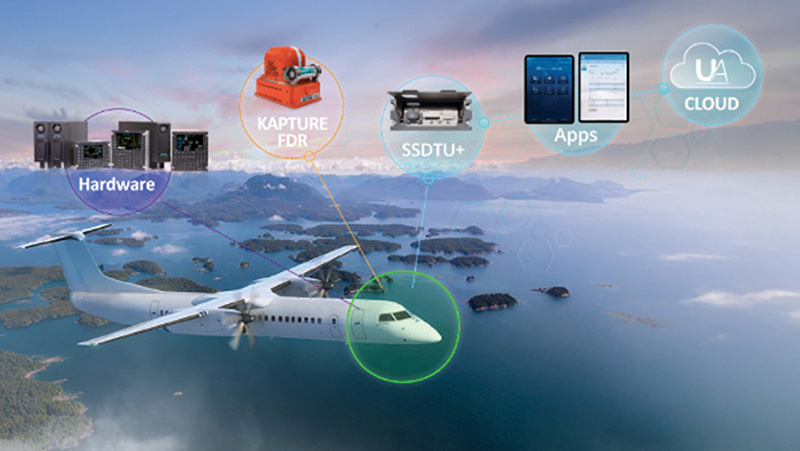
In addition to meeting emerging regulations for data recording and ensuring quick installation for large fleets, Universal’s KAPTURE recorder is further connected across avionics systems or cloud apps, enhancing data analysis and reporting in real-time, while preventing incidents through predictive maintenance alerts. This allows airlines to transform compliance into opportunity by improving operations rather than just meeting the mandates.
Aerospace Innovations: What impact has MH370 and AF447 had on the development of FDRs and CVRs, notably the 25-hour trend?
Dror Yahav: These incidents have called for increased storage limits, necessary for longer international trips or when the flight recorder cannot be immediately retrieved. This has led to a prioritization of data accessibility throughout the flight, rather than just focused on collection post-flight.
James Kemmitt: A typical Curtiss-Wright recorder will record up to 25 hours of data or cockpit voice. Our current premier recorder, the Fortress, is a “combination recorder” that does both in the same box. It has the capacity for 25 hours of flight data, 25 hours of cockpit voice, and 25 hours of datalink recording—essentially the text message service between air traffic control and the aircraft. It can also record up to two hours of low-bitrate images if there is a camera in the cockpit. While not currently on civil airlines, some military customers require this to see button presses and dashboard alerts.
The move to 25-hour recording addresses a significant gap. Previously, the requirement was only two hours. On modern transatlantic or transpacific flights lasting 17 to 18 hours, any incident occurring early in the flight would be overwritten multiple times before landing. For example, an aircraft involved in a runway incursion issue flew to London from America after the incident cleared. Six hours later, the recordings had been overwritten, preventing investigators from analyzing the event.
These recordings are crucial for safety improvements, not just for accidents but for any serious incident. Following AF447 and other events where data was lost or overwritten, the FAA introduced a requirement for 25-hour voice recordings. This is now mandated for new-build aircraft since the early 2020s, and rules will likely require retrofitting existing aircraft by around 2030.
Aerospace Innovations: What about Automatic Deployable Flight Recorders (ADFRs)? What is the story behind them?
James Kemmitt: This concept emerged as a recommendation following Air France 447, where it took a long time to recover the recorders from the ocean floor. The idea was that sensors would detect a crash and physically eject the recorder from the aircraft skin. The recorder would then float and transmit a locator beacon, allowing for rapid discovery.
However, there are practical issues. The recorder must be integrated into the aircraft’s skin or a deployment port, and crucially, you must ensure it never ejects inadvertently. Curtiss-Wright—working with Honeywell—has chosen a different route: “Connected Recorders” or the “Black Box in the Sky.” This involves real-time transmission of data via a secure satellite link. This allows airlines and investigators to analyze data in real-time without needing to physically recover a box, which we believe is a more practical solution to the problem of timely data recovery.
Dror Yahav: Many of today’s innovative aerospace advancements stem from proven military solutions, like the ADFR. This ongoing digital transformation for flight recorders involves minimizing the time it takes to retrieve critical information from the unit, without delays caused by a unit that is significantly damaged or challenging to locate.
Aerospace Innovations: What improvements have been made to Underwater Locator Beacons (ULBs), and why?
Dror Yahav: Underwater Locator Beacons bring both data reliability and accessibility. KAPTURE’s 90-day ULB also features a Lithium-free battery, which greatly supports ease of shipping the unit during data extraction and mandatory reporting, saving time and costs for maintenance teams.
James Kemmitt: The goal is “timely recovery.” Investigators need data immediately to analyze incidents and implement safety improvements. Previously, ULBs were required to transmit for 30 days. After AF447, where locating the wreckage in the middle of the Atlantic took a very long time, French authorities recommended increasing this to 90 days. The extra battery life gives search teams a much wider window to get ships into position and detect the signal.
This shift hasn’t caused problems for manufacturers. We buy industry-standard, third-party beacons—most recorder manufacturers use the same reliable brands—and 90-day devices are now readily available and fully tested.
Aerospace Innovations: What is the story behind the Global Aeronautical Distress and Safety System (GADSS) and Autonomous Distress Tracking (ADT)? Is this an improvement that is on the horizon? And would it have made any difference in MH370?
James Kemmitt: Yes, this is a major initiative with two key parts. First, aircraft already report location every 15 minutes via ADS-B or satellite. Second is Autonomous Distress Tracking (ADT). If the aircraft detects a serious anomaly—like an unusual flight pattern or high bank angle—it triggers an alert: “We have an issue.”
Once triggered, the system begins reporting location and data much more frequently, potentially narrowing the crash location to within six nautical miles. This allows search and rescue to arrive as fast as possible, which is critical for survivors. It also facilitates timely data recovery because investigators can begin piecing together events immediately via the transmitted data stream.
Would it have made a difference for MH370? I believe so. Even if systems were shut down manually, the ADT requirement typically specifies an autonomous power supply. This means that even if aircraft power fails or is cut, the distress tracking should continue to operate, transmitting the aircraft’s location and status.
Dror Yahav: Historically, data was only stored in the black box until it was physically recovered. By making data available remotely or early during an incident, teams on the ground already have a virtual snapshot of its position, altitude, and mechanical state. This would theoretically fill gaps in the story for MH370 since the recorder was never recovered. Similarly, UA FlightReview can allow us to offload critical flight data while the aircraft is still in service, a capability that can exist as part of our flight recorder services.
Aerospace Innovations: What other advances do you foresee in FDRs and CVRs? And can this technology be made fail-safe?
Dror Yahav: Universal Avionics is focused on both ensuring data reliability with integrated software improvements, as well as collecting more critical yet currently untapped data from connected cameras and sensors such as the ClearVision EVS-5000. This visual information could enable greater accuracy when performing flight analysis, with awareness of what the pilot sees out the window during operations. By syncing in real-time to the cloud, data is still accessible prior to or following any service disruptions.
James Kemmitt: Timely recovery of data remains the cornerstone. While linked/streaming recorders are fantastic for instant access, crash investigators will always want the raw data from the physical recorder “from the horse’s mouth.”
The future lies in redundancy. Our Curtiss-Wright Fortress recorder is a “combination recorder” (Voice, Data, Datalink, and Image) that is the same size as previous single-channel units. I foresee a mandate for fitting two of these combination recorders per aircraft. Instead of one CVR and one FDR, you would have two identical boxes recording everything. Electronic devices are incredibly robust—we put them through grueling qualification—but they can fail. With two combination recorders, if one fails, you still have a complete copy of all data on the other. That redundancy will be vital for ensuring we always have a solid recording for investigation.
The Industry Responds to the 25-Hour Recording Era
As James Kemmitt and Dror Yahav made abundantly clear, the global aviation industry is making major progress in flight safety and data preservation. Spurred on by new regulatory frameworks, including the FAA Reauthorization Act of 2024, commercial aircraft are now required to upgrade their Cockpit Voice Recorders (CVRs) and Flight Data Recorders (FDRs) to retain at least 25 hours of recording time.
This is a significant leap from the previous two-hour standard, and is designed to prevent critical investigative data from being overwritten during long-haul flights or subsequent operations. The need for this advance was underscored by the National Transportation Safety Board (NTSB), which noted that 14 investigations since 2018 were hampered because CVR data had been overwritten due to insufficient recording capacity.
While newly manufactured aircraft must comply with the 25-hour CVR/FDR standards immediately, existing aircraft fleets have until 2030 to meet their retrofit deadlines. In response to this requirement, leading avionics manufacturers have introduced a new generation of recording solutions that not only meet these mandates but also offer advanced features like real-time streaming, cloud connectivity, and simplified maintenance. Here are some of them, based on materials made available on their websites.
Honeywell and Curtiss-Wright have jointly developed the Honeywell Connected Recorder-25 (HCR-25). This recorder is designed to support the industry’s move toward automation and “connected” aviation. The HCR-25 is already type-certified for the Boeing 737, 767, and 777 platforms, with certification for the Airbus A320 series in the works. According to Brian Perry, Senior Vice President at Curtiss-Wright Defense Solutions, the goal of this partnership is to provide “open access for airline operators to retrieve their own data,” enhancing flight safety through real-time situational awareness. This connected approach improves the ability to identify the root causes of incidents by ensuring data is accessible even before a physical recorder is recovered.
Focusing on the world’s massive Airbus A320 fleet, Lufthansa Technik (LHT) and HENSOLDT have launched the SferiRec family of integrated CVRs/FDRs. These units have been engineered specifically as a practical retrofit option that exceeds international standards.
Worth noting: The SferiRec system offers storage capacities that go well beyond the minimum 25-hour requirement. In fact, the CVR can capture up to 45 hours of crew conversations and 170 hours of datalink communications, while the FDR captures up to 1,600 hours of flight parameters. The SferiRec also offers real maintenance efficiency through an on-wing Readout Kit, a software tool that runs on a standard laptop. This allows technicians to download data directly from the aircraft without removing the recorder, which is a real time-saver.
Universal Avionics has introduced its KAPTURE line of 6th-generation 25-hour recorders, which includes five lightweight models covering CVR, FDR, and combination (CVFDR) configurations. The KAPTURE series features a patented internal Recorder Independent Power Supply (RIPS), which uses a capacitor pack rather than batteries to provide 10 minutes of backup recording in the event of a power outage. As well, every KAPTURE recorder is equipped with a 90-day Underwater Locator Beacon (ULB). This triples the transmission duration of previous generations to aid in long-term recovery operations.
For operators looking to replace legacy systems without complex modifications, Acron Aviation offers the SRVIVR25™ series. Weighing as little as 6 pounds, the SRVIVR25 is one of the lightest and most compact ED-112 compliant recorders available. It provides more than 25 hours of cockpit audio (CVR) and over 140 hours of flight data (FDR) recording capability. The SRVIVR25 is being marketed as a seamless retrofit solution, serving as a direct replacement for ARINC 757 systems (such as the FA2100) with no aircraft rewiring or mounting changes needed. This “plug-and-play” capability is a real boon for airlines facing the 2030 retrofit deadline, minimizing aircraft downtime.
CGI has taken a “cloud-first” approach with its CGI VirtualFlightRecorder, which provides Global Aeronautical Distress and Safety System (GADSS) compliance as a service. This cloud-based solution replicates the function of a traditional crash-protected recorder in a secure online environment, providing immediate access to critical flight data during emergencies. Using advances in mobile satellite connectivity, CGI VirtualFlightRecorder is designed to integrate seamlessly with existing Flight Data Monitoring (FDM) and Flight Operations Quality Assurance (FOQA) systems.
Finally, the Handheld Multipurpose Tool (HHMPI) from Flight Data Systems has been licensed by Honeywell to support data extraction from that company’s new HCR-25 recorders. The HHMPI is a ground support tool that makes data retrieval easy. It supports nearly 50 different recorders from various OEMs and features intelligent storage that organizes downloads by specific aircraft tail numbers. “Our collaboration with Honeywell enhances the functionality of our HHMPI tool, delivering significant value to our customers,” said Shane LaPlante, Vice President of Sales and Marketing at Flight Data Systems. “With HHMPI currently supporting nearly all of Honeywell’s flight recorders, this partnership underscores our commitment to innovation and operational excellence, equipping our customers with essential tools that streamline maintenance processes while ensuring regulatory compliance.
The bottom line: The transition to 25-hour recording (and beyond) represents a fundamental upgrade in how the industry captures, protects, and utilizes flight data. Whether through the “connected” capabilities of Honeywell and Curtiss-Wright, the cloud-based services of CGI, the maintenance-friendly innovations of LHT and Universal Avionics, or the compact retrofits from Acron Aviation, operators now have a capable, useful range of solutions available to keep their fleets properly tracked well into the next decade.
By James Careless