Why SESAR Deployment Manager matters
For more than a decade, Europe has been pursuing something that is easy to describe but complex to deliver: the coordinated modernisation of its air traffic management (ATM) system.
The mission is not simply to introduce new, ground-breaking technologies; it’s to make hundreds of organisations, operating across national borders and under different operational, financial and regulatory conditions, adopt those technologies in a harmonised way. Airlines, airports, air navigation service providers (ANSPs), military authorities, the Network Manager and the aviation industry all need to work as one team for the benefits of a digital European sky to materialise. This is where the SESAR Deployment Manager (SDM) matters.
Since its establishment in 2014 as the management level of the SESAR deployment governance framework, SDM has provided the modus operandi through which European ATM modernisation is synchronised, monitored and translated from European policy into operational reality. More than a decade later, the results are substantial. Hundreds of projects have been implemented EU wide, billions of euros have been invested, and measurable benefits have been delivered in capacity, efficiency, fuel consumption, emissions and passenger experience. The question now is whether Europe can maintain that momentum.
With the Common Project One (CP1) regulation coming to an end in 2027, ATM modernisation shall continue even beyond its deadline. That is because digital, sustainability, resilience, and capacity challenges faced by European aviation require, more than ever, the upmost coordinated efforts from every actor involved in the transformation of European skies. The SDM and its underpinning industry-led SESAR Deployment and Infrastructure Partnership (SDIP) are therefore entering a new phase: one in which the value of the organisation is measured not only by its role in implementing SESAR solutions, but by its ability to preserve the continuity, trust and coordination needed for the next generation of European ATM transformation.
A decade of turning European ambition into operational reality
Europe’s ATM system has been undergoing a transformation that is sometimes easy to overlook, mostly because much of it happens behind the scenes. Passengers rarely see the new digital infrastructure, cross-border airspace arrangements or information-sharing systems that allow aircraft to fly more efficiently. Yet these improvements are becoming increasingly important to preserve the competitiveness, resilience and sustainability of European aviation.
The European ATM Master Plan presents SESAR (the Single European Sky ATM Research programme) as a three-steps endeavour: definition of the future ATM system, development of the technologies needed to achieve it, and the deployment of mature innovative solutions across European skies.
While the SESAR Joint Undertaking plays a central role in research and development, the SESAR Deployment Manager sits between the ambitious transformative vision and operational reality, coordinating and synchronising the implementation of the most important advances through the SESAR Deployment Programme. Research can demonstrate that a technology works; regulations can establish the roadmap to follow, but only SDM can guide hundreds of ATM actors implementing it in a timely manner, using compatible systems and procedures.
The benefits of the committed mission of SDM and its members and implementing partners are now tangible. As of early 2026, 343 of the current 359 implementation projects coordinated by SDM were completed and in operation, with the remaining work packages progressing towards full deployment.
The latest SESAR Deployment Programme Monitoring View, published in June 2026, shows that 95% of the entire CP1 scope is either completed or under implementation (53% already in operations at the end of 2025, while a further 42% is still ongoing). Six implementation families had already been fully deployed, covering areas including advanced airspace management, initial Free Route Airspace, enhanced short-term air traffic flow and capacity management, the Interactive Rolling Network Operations Plan and common SWIM public-key infrastructure and cybersecurity.
Beyond the figures, this progress demonstrates that the SDM coordinated deployment approach is flexible and scalable enough to address the evolving drivers and needs of the industry.
The results are also impacting positively the network performance: Free Route Airspace (FRA), for instance, has progressively expanded across all Europe, allowing aircraft to plan more direct routes instead of being constrained by fixed trajectories. Other ATM functionalities are improving the way traffic, airspace and information are managed across national boundaries.
The economic aspect of CP1 deployment is equally significant. SDM assessment estimate benefits of €27.8 billion for the 343 deployed projects by 2040, and almost €52 billion once CP1 reaches its full potential. The figures demonstrate a central principle of SESAR deployment: ATM modernisation is not an end in itself. Investment in technology and infrastructure must translate into measurable improvements for the network and its users.
Partnership, resilience and sustainability : the three building blocks of ATM modernisation
The future of European aviation is being shaped by three challenges that are inevitably interconnected: sustainable air travel, a resilient network, and the ability of the sector to act collectively. SESAR Deployment Manager and its founding pool of experts know the drill and have been successfully coordinating the implementation of transformational changes in air traffic management, improving the way Area Control Centres (ACCs), airports, aircraft, and control towers operate.
ATM modernisation helps to make the European aviation network smarter, ensuring that airspace capacity is optimally used and that aircraft operate as efficiently as possible. More direct trajectories, better coordination, improved predictability: they all reduce unnecessary flight time, delays, holding and fuel burn. The environmental benefit is therefore a consequence of making the network work better as a whole.
Figures prove that SDM delivers significant fuel and CO2 savings. But the strategic relevance of these estimations lies in the wider picture: relatively small, local improvements repeated across the European network generate substantial cumulative environmental benefits. Blurring airspace fragmentation and overcoming implementation gaps is key to maintain coordination and digitalisation consistency across borders so the whole network can, eventually, operate as an integrated system.
Europe’s climate ambitions extend beyond the lifespan of past, present and future ATM regulatory cycles: that is way is so important to preserve a model that can make the most of the ambitious improvements European passengers are already benefiting from.
When the European aviation industry works as one team, flexibility shall be regarded as an effective asset to navigate complex geopolitical scenarios that constantly arise to put ATM modernisation efforts at stake; recent crises have shown how quickly the assumptions underlying network planning can change.
When airspace is closed or air traffic is disrupted, consequences do not remain local. Routes and traffic flows have to be modified, demand shifts, capacity constraints emerge elsewhere and airlines have to adapt their operations. The ability of the European network to respond depends on how effectively its different actors can coordinate.
Resilience and adaptability are instrumental to mitigate disruptions. Stakeholders have been in the game long enough to understand ATM systems shouldn’t be merely built around redundancy and contingency planning, but it should rely on a service-oriented approach. A revised service delivery model would ensure resilient, cybersecure, and interoperable infrastructure that allows the reduction of single points of failure tied to specific locations or systems and enable scalability through shared and pooled services.
When it comes to civil-military coordination, same principles should apply. European airspace is increasingly influenced by shifting defence requirements, implying the need to accommodate civil and military aviation demands in record time. The ability of SESAR Deployment Manager to coordinate ANSPs, airports, and airlines and drive them to common goals can be extrapolated to the fruitful relationship with defence and military bodies.
While technology and investment may enable ATM transformation, there’s a non-tangible element that ties everything together: partnership. The wide range of stakeholders involved in ATM modernisation —airlines, airports, ANSPs, the Network Manager, military authorities, European institutions, and manufacturers—, which all have different responsibilities and priorities, requires a big deal of trust building and buy-in to make sure everyone is on board of the SDM mission; at the end of the day, their decisions are interdependent. It is at this juncture that the SESAR Deployment and Infrastructure Partnership (SDIP), the industry partnership behind SDM, is strategically vital.
It brings together organisations representing different parts of the aviation value chain and gives them a common framework through which they can contribute to ATM modernisation. Its success lies in creating a space where stakeholders that do not always have identical priorities can work towards common network outcomes. Over more than a decade of deployment, relationships have been built between the operational community and European institutions. Stakeholders have gained a better understanding of each other’s constraints, while the deployment process has created mechanisms for discussing implementation challenges before they become obstacles.
This collaborative model is particularly important for strategic documents such as the SESAR Deployment Programme (SDP). The SDP is much more than a translation of the European policy requirements, it provides a realistic roadmap for implementing partners that ultimately invest, deploy, and operate the improvements the programme describes.
Its requirements and technical details stem from the operational stakeholders’ involvement since its initial draft. The approved SDM Stakeholder Consultation Process (SCP) comprises a series of steps and iterations through stakeholders’ participation is seriously taken into account, and it results in consolidated, peer reviewed and solid building blocks to continue implementing modernisation.
When airlines, airports, ANSPs and other stakeholders contribute their expertise to the development of the Deployment Programme, they help testing whether European ambitions can be translated into operational reality. Their participation also creates ownership: organisations are more likely to support and implement a common direction when they have had a meaningful role in shaping it.
Flying EU skies after CP1
The strongest indication that SESAR deployment has strategic value beyond CP1 is the commitment of its stakeholders themselves.
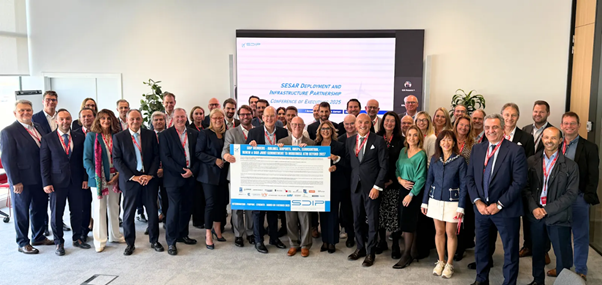
In 2025, SDIP members renewed their commitment to continue the modernisation and digitalisation of European ATM beyond 2027. This is significant because it demonstrates that the need for coordinated deployment is recognised not only by European institutions but by the organisations that ultimately invest in and operate the system.
The results in implementing CP1 should not be overlooked nor taken for granted. The closer CP1 completion gets, the more important it becomes to ensure that the established investment coordination mechanisms and stakeholder commitment are safeguarded, and that the future of ATM modernisation builds upon these accomplishments.
SDM has identified a series of priorities to maintain momentum: mitigating risks associated with planning beyond regulatory deadlines, accelerating adoption of System-Wide Information Management (SWIM), advancing Flight and Flow Information for a Collaborative Environment (FF-ICE), and stimulating the transition towards Trajectory-Based Operations (TBO).
Europe’s skies cannot be modernised through a series of disconnected projects. Only consistency with which has been carried out so far can overcome the structural fragmentation that traditionally hindered for ATM modernisation. Digitalisation depends on interoperability and interoperability depends on common standards and coordinated implementation, hence continuity is strategically vital for the deployment journey beyond CP1.
The expiration of CP1 may mark the end of a legal obligation, but it does not repeal the interdependencies that exist between stakeholders. The European network will continue to require coordinated investment and implementation long after the current regulatory framework expires.
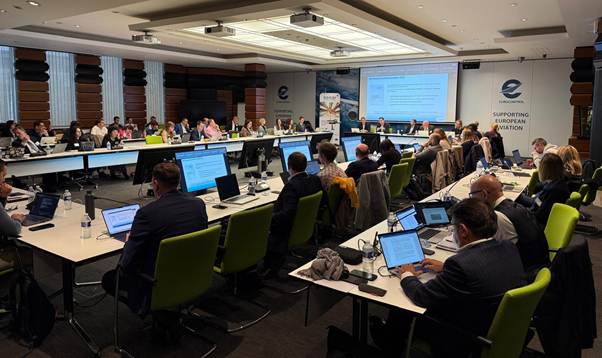
The next generation of ATM modernisation will be based on a continuous transition towards a more digital, data-driven and collaborative European sky. It will require investment decisions to address capacity, sustainability, resilience, safety and competitiveness. It will require a function that can bring stakeholders together around common objectives, and supports them in their pursuit.
A function that supports coordinated deployment and builds buy-in is as important as the funding and support from the European institutions: mandatory investments for stakeholders require public support and assistance to overcome hesitancy and favour early movers, not just during industrialisation but very well into implementation and operational uptake.
The past eleven years have created more than a portfolio of completed projects. They have created relationships, institutional knowledge, common processes, and a shared understanding of how European ATM can be modernised. This model has worked, and it is an asset worth preserving.
Far more important, the most decisive measure of success will be whether a passenger flying across Europe experiences a network that is safer, predictable, resilient, environmentally efficient, and able to absorb disruption. That’s what air traffic management modernisation will always ultimately be about; and that is why SESAR Deployment Manager matters.