The AI Nobody Sees
Article by: Michael Bettua, CEO, Volan Technology
Most people hear “AI” and picture something visible. A chatbot. A robot. A voice assistant. Something you interact with. But in aviation, the most valuable AI may end up being the kind nobody sees or even thinks about. No interface. No dramatic dashboard. Just pattern analysis applied to operational data, running quietly in the background, making complex operations work a little better, a little faster, a little safer.
This is what the best airport and airline operators already understand. They’re not looking for technology that demands attention. They’re looking for technology that makes the operation work better for everyone involved — without anyone needing to change how they do their job.
I’ve been thinking about this a lot since attending the Airport AI Alliance Summit in Dallas, where airport and airline leaders gathered to discuss AI adoption across the industry. The conversations covered everything from passenger flow optimization to ground service coordination. But the most important takeaway wasn’t about any single technology or solution. It was about what success actually looks like — and how the industry is rethinking its entire approach to growth.
Bytes Over Bricks
The summit was attended by C-level executives of major airports in North America, Europe and Asia. CIOs. Chief Technology Officers. VPs of emerging technology. These are the people leading the effort to innovate for their airports through technology.
The conversations were substantive, practical, and — in one memorable moment — crystallized into a phrase that I think captures where the industry is headed.
One airport leader described the shift as prioritizing “bytes over bricks.”
The room loved it. And for good reason.
For years, the default response to growing passenger volumes, increasing complexity, and evolving security requirements has been to build. More terminals. More gates. More infrastructure. Airports across the world have been in a near-continuous cycle of capital construction projects, often stretching budgets and timelines in the process. Some of the airports represented at the summit have 30,000 or more people working on-site. The complexity of keeping these operations running smoothly, safely, and within budget is enormous — and it’s growing faster than infrastructure alone can keep up.
But something is shifting. The leaders in that room weren’t talking about the next terminal expansion. They were talking about optimization. How do you get more out of what you already have?
The answer, increasingly, is data. And not just the data airports already collect.
There’s an entire category of operational data that most airports still don’t capture: the physical movement of people, equipment, and assets across the operation. How long does it take ground equipment to get from a staging area to the gate? Where do maintenance crews actually spend their time? Which corridors and ramp routes are creating bottlenecks?
This kind of movement data — captured across terminals, hangars, ramps, underground corridors, and everything in between — is the raw material that AI can use to find underlying patterns, flag anomalies, predict asset and labor utilization, and drive operational decisions with unprecedented insight. And most of it has never been digitized. It exists as institutional knowledge, radio chatter, and best guesses. Turning it into machine-readable intelligence is the prerequisite for the kind of optimization these airport leaders are asking for.
None of that requires a new building, hiring more people, or installing expensive infrastructure.
It requires making the invisible visible.
What the Systems Can’t See
If you’ve spent any time around airport operations, you’ve probably heard some version of this: “We have more data than we know what to do with.”
I heard it repeatedly at the summit. And it’s true — airports are drowning in information. Flight schedules, gate assignments, staffing rosters, maintenance logs, passenger counts, all of it pouring out of six, ten, sometimes twenty different systems. But for all that data, there’s one question most airports still can’t answer with confidence: where, exactly, are my people and equipment right now?
At the center of most airport operations sits the Airport Operations Database — the AODB. Think of it as the beating heart of the airport. It tracks flights, gate assignments, arrivals, departures. It’s the system that everything else orbits around.
And for the most part, it does that job brilliantly. But while the AODB can tell you a flight landed at 11:42, it can’t tell you whether the fuel truck assigned to it is still three gates away, or whether the mechanic who needs to clear it is two buildings over, searching for a part. The physical movement of people, vehicles, and assets across the airport is, for most operations, the one blind spot none of the systems can fill.
What airport leaders told me they want is deceptively simple: one operational view.that brings together everything — the system data they already have and the movement data they’ve been missing — into something actionable. Not a new platform. Not another vendor dashboard. The missing layer, fused with what they already run.
This is where AI can quickly earn its value in airport operations. Not by replacing what works, but by connecting what’s been disconnected — and by also illuminating what was never visible in the first place. By analyzing data across systems and across the airfield to surface patterns, inefficiencies, and opportunities that no single application — no matter how sophisticated — could ever identify on its own.
Imagine being able to see, in real time, how a delayed arrival on one runway cascades into gate congestion, disrupts ground crew deployment, pushes back departures, and ultimately shows up as a dip in passenger satisfaction metrics — all in one view. That’s not a theoretical exercise.
Most of the data already exists. The real-time movement layer is the missing piece — and it’s the one that ties the rest together.
The most encouraging thing I took away from the summit is that airports aren’t waiting for someone to hand them a solution. They’re actively working on integration strategies. They’re in conversations with technology partners about how to layer intelligence onto existing infrastructure without ripping and replacing what already works.
And the cost of that blind spot — the gap between what the systems know and what’s actually happening on the ground — shows up in two ways. One is dangerous. The other is expensive. Both are avoidable.
Where It Gets Real
The movement data blind spot isn’t just an efficiency problem. It’s a safety problem. Vehicles and people end up in areas they shouldn’t be — delivery drivers who get separated from escorts, maintenance equipment that drifts into restricted zones, and other vehicles whose positions aren’t precisely tracked by existing surveillance systems.
That’s the dangerous cost of the blind spot. The expensive one is quieter — and it plays out every single day.
Ground service operations involve multiple providers coordinating dozens of moving assets to turn an aircraft in as little as 15 to 20 minutes. Fuel trucks, catering vehicles, cleaning crews, baggage handlers, pushback tractors — different companies, different radio channels, all converging on a single gate under a tight clock. If one is late, the departure is late. And a single late departure can cascade across a hub for hours.
At many airports, this coordination still relies on walkie-talkies and line of sight. There’s no shared real-time visibility into where ground service equipment is — whether it’s staged inside a maintenance facility, moving across the ramp, or parked between terminals. Layering movement intelligence onto that problem changes the equation. Knowing where every asset is, regardless of environment. Predicting which ones will be late. Redirecting resources before the delay happens — not after.
The challenge doesn’t stop at the gate.
Tracking large aircraft parts as they move around complex maintenance operations is a persistent, costly problem for carriers. A component gets repaired in one hangar bay, moved to a staging area, transferred to a cart in an underground corridor, and ends up in a different building altogether. Multiply that across hundreds of critical parts in a sprawling maintenance complex and the permutations of where a given part could end up are staggering.
The result is predictable. Mechanics spend valuable time tracking down components instead of doing the work they were trained to do. Maintenance delays cascade into departure delays. Passengers wait on the tarmac, checking their watches, wondering why the plane hasn’t pushed back yet.
An airline’s interest is likely not in having a flashy AI interface but in using precise location data to understand where parts are at any given moment — and, over time, to understand movement patterns well enough to position parts where they’ll be needed before anyone has to go looking.
The common thread across these challenges is movement data. People, parts, and equipment moving through massive, complex environments — across ramps, inside terminals, through hangars, underground — and nobody has the complete picture. Companies like Volan are working to digitize that kind of movement data, turning what’s been a blind spot into something that can be visualized, analyzed, and acted on before problems cascade.
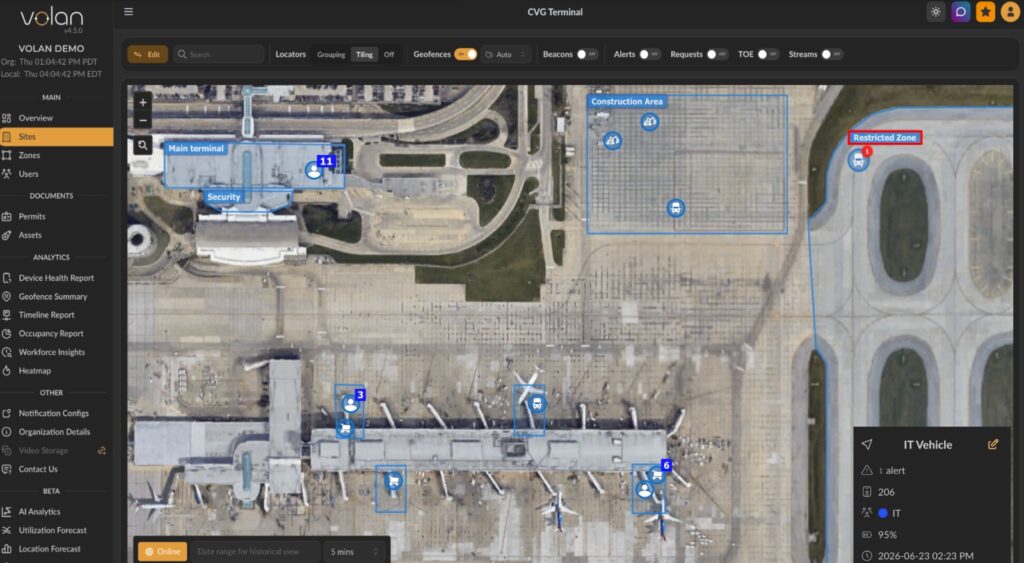
Image: Volan Positioning. The bytes-over-bricks shift, which is already operational at CVG.
The kind of real-time movement visibility airport leaders say they’re pursuing is already running at Cincinnati/Northern Kentucky International Airport. This representative view of Volan Technology’s live map shows how the system tracks workers, vehicles, and equipment across CVG’s airfield — each icon is a person or asset carrying a Volan locator on the system’s own wireless network, no GPS or Wi-Fi required. Color-coded geofences around a construction zone, security perimeter, and restricted taxiway area alert operations automatically the moment anyone crosses a boundary. CVG has operated the system since a 2023 pilot and today uses it across both the air side and passenger side of the airport.
The Invisible Standard
If the system works the way it should, the mechanic never hunts for the part. It’s just there when they need it. The departure goes out on time. The passenger never knows anything was different.
That’s the invisible standard that the best operational technology should aspire to. Not technology that people interact with, but technology that makes their work and their experience better without them needing to think about it.
Passenger flow analysis that quietly adjusts staffing before lines get long. Gate allocation intelligence that prevents congestion before passengers feel the bottleneck. Ground service coordination that gets the right equipment to the right gate at the right time.
And then there’s construction. Major airports run major projects year-round, with hundreds of contract workers needing access to secure areas near active taxiways and ramps. These workers require escorts to ensure the workers don’t wander into restricted areas – and traditionally, each escort can only effectively monitor about five workers at a time. If a project with a hundred workers needs twenty escorts, that can cost an airport a million dollars or more per year.
And in many markets, qualified escorts are increasingly hard to find — high turnover, labor shortages, people who leave before they learn the complex safety protocols of the facility. Technology that establishes virtual boundaries around authorized work zones and alerts both workers and operations when someone approaches a restricted area doesn’t replace the escort. It expands their effective span of control from five workers to dozens — maintaining safety standards while addressing the labor reality.
The airports that were furthest along in their AI adoption shared a common trait: they weren’t chasing the technology for its own sake. They were applying it to specific, measurable operational problems — and treating AI adoption with the same change management discipline they’d bring to any major organizational initiative. Guardrails in place. Governance applied. This isn’t experimentation. It’s integration.
The shift from bricks to bytes isn’t a trend. It’s a strategic repositioning of how airports are starting to think about growth, efficiency, and safety. For an industry that has historically moved cautiously with new technology, the pace of this shift is notable. And the clarity of what airport leaders are asking for — not more tools, but better integration of the tools they have — tells me that the next wave of airport innovation won’t come from a new terminal.
When AI works, nobody notices. And that’s the point.
About Michael Bettua
Michael Bettua is CEO and Founder of Volan Technology, where he’s focused on a problem airports have been trying to solve for years: capturing the real-time movement of people, vehicles, and assets at scale across massive, complex environments. Until now, no technology was built for it. Volan’s microlocation platform digitizes that movement layer — turning what’s been an operational blind spot into data that AI can actually act on.