PACE & DDC-I Solution: Software Rendering for Graphical Displays
VAPS Software Renderer + Deos™ for Displays
Software rendering that is highly portable, less expensive, reliable and secure, easier to certify and faster to implement than GPU rendering
DDC-I and PACE have partnered to deliver a development solution that accelerates the creation and certification of safety-critical avionics graphics. Combining VAPS Software Renderer (VSR) and Deos enables you to deploy HMI graphics that run on the latest multi-core processors, is certifiable up to DO-178C DAL A, and frees the system developer from GPU-related technical interference and safety critical certification process complications.
Challenges:
- Certification: Obtaining DO-178C or ED-12C certification can be time-consuming and expensive. Using GPUs increases the complexity, cost and time to develop and verify a safety critical system.
- Portability and MOSA Compliance: The ability to re-use components that have already been developed (and even certified) can be difficult.
- Size, Weight and Power: As embedded platforms increase capabilities, there is a strain on the need for better SWaP.
- Complexity of Hardware Rendering: Though powerful, GPUs introduce system risk, especially when certification is required, and face rapid obsolescence issues.
Benefits:
- Path to Certification: Using CPUs rather than GPUs simplifies, expedites, and reduces the cost to field a display system. GPUs complicate certification due to complex non-deterministic timing and interference issues that need to be addressed. GPU cores competing simultaneously for shared memory buses and caches create severe timing interference that is difficult to bound. Also, GPUs are often missing design artifacts and face rapid obsolescence. Software rendering significantly reduces system complexity and accelerates development timelines.
- Modular: Combining Deos, VSR and VAPS XT supports MOSA and is developed in alignment with the FACE® Technical Standard and ARINC 661. Deos offers a fine-grained means of modularity and abstraction that greatly reduces the cost of developing commercial product lines or supporting long-term system maintenance and upgrades.
- Reduced SWaP: Removing the need for a discrete GPU reduces size, weight and power requirements.
- Portable, Upgradability and Software Reuse: Modular structure enables rapid updates and enables you to port solutions across hardware platforms. Specifically with Deos, VSR libraries and user applications can migrate across use-cases and system implementations at the binary, or machine code level. This preserves prior testing and verification work of the modules and reduces the scope of work to add or change these modules as system requirements change.
- Hardware Independence – The VSR library doesn’t carry GPU dependencies. This allows the display provider to migrate to different processors when the need arises. GPU-based display systems are constrained as the GPU driver and display stack are coupled to a specific GPU model and version. This creates obsolescence and single source supply headaches.
Solution Overview:
PACE VSR running on the Deos RTOS provides a software rendering solution for displays. With no GPU required, you avoid the complexity of managing hardware that can interfere in deterministic performance and can face obsolescence issues.
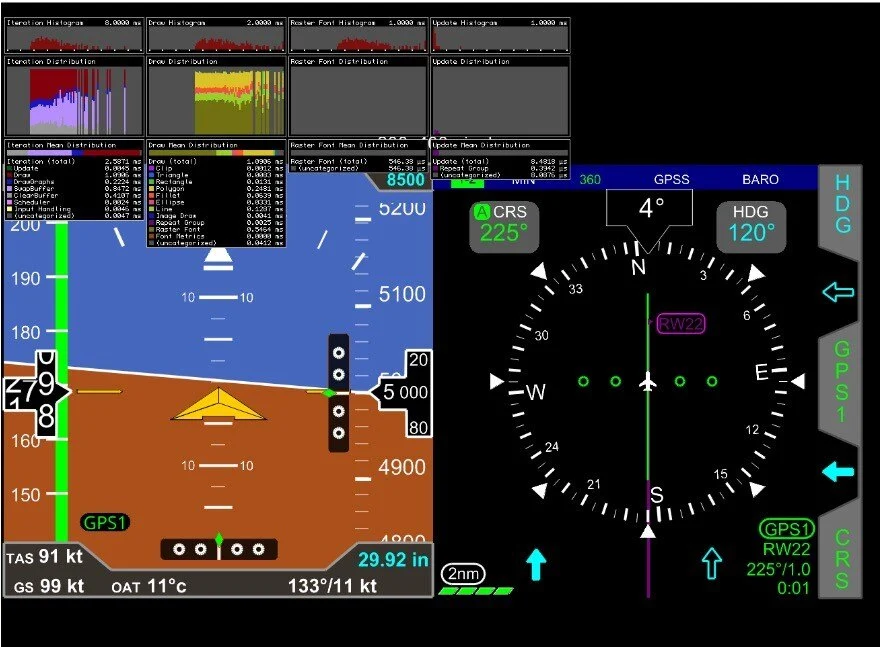
VSR is an avionics graphics rendering engine that operates without physical GPUs, simplifying safety certification up to DO-178C DAL A. VSR allows Aerospace Developers to build and deploy Human Machine Interfaces (HMI) onto platforms when GPU usage is not available or GPU certification would be complex or delay program timelines. VSR provides pixel-level rendering, is deterministic by design and includes a reusable high DAL-ready library. This offers system developers more control over design and accelerates the certification process.
VSR operates seamlessly on the Deos RTOS which provides time and space partitioning delivering deterministic performance. The solution can run on single-core or multi-core configurations and interfaces to Deos’ ARINC-653, Rate Monotonic, and FACE applications.
For higher performance, multi-core systems, Deos SafeMC technology allows developers to run VSR efficiently on its own processor core(s) with bounded interference per AMC 20-193. And SafeMC provides cache partitioning for strict memory management. This optimizes display performance and reduces display application interference with other applications.