
One Aircraft, Two Patients: The Economics and Ethics of Multi Patient Missions
By Adam Mikulski, General Director at Medical Air Service
International air ambulance operations involve significant costs, from aircraft positioning and fuel to medical personnel, specialised equipment and airport services. For patients, families and insurance providers, these expenses can represent a considerable financial burden, particularly when long-distance medical repatriation is required.
However, there is one method of mitigating those costs that might work. Combining the transportation of two patients within a single mission allows for improved aircraft usage rates and lower costs per flight, thus potentially providing financial relief to all parties involved.
At the same time, using an international air ambulance to service multiple patients cannot be solely defined by available cabin space alone. Every patient requires individualized care, and multiple cases add complexity, medical considerations, operational challenges, and ethical dilemmas that must be properly considered.
The central question is whether the economic benefits of transporting two patients together can be achieved without compromising their safety, medical care or dignity.
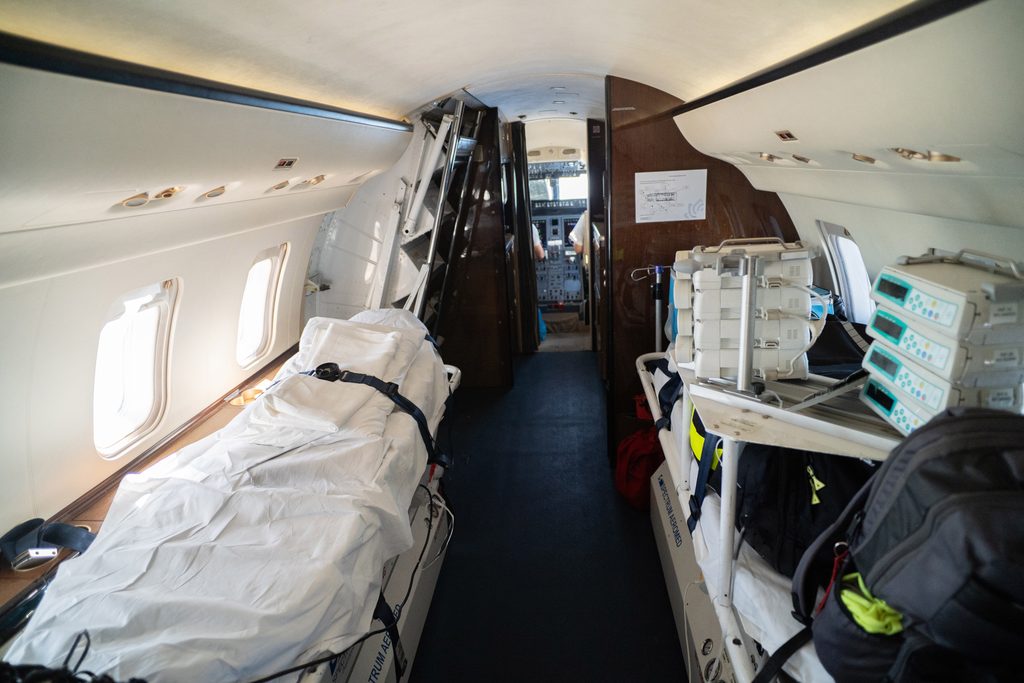
The economics of sharing an air ambulance
Operating an air ambulance flight involves expenses that remain relatively similar whether the aircraft carries one patient or two. In other words, aircraft positioning, flight crew, fuel, airport handling and certain operational costs must be covered regardless of the number of patients on board.
What does differ significantly is the distribution of these costs among the missions. In certain scenarios, it becomes beneficial to combine two or even several cases for transport in a single aircraft operation.
Consider, for example, two patients requiring repatriation from the same destination country to locations in relatively close proximity. In such an instance, it would be logical to fly one plane containing both patients instead of splitting their flights. It saves the positioning effort, reduces the required flight time, and lowers overall transportation costs for both cases.
Insurance companies, when arranging international medical repatriations, can derive great benefits from such economic efficiency. At the same time, families covering their own costs may find a significant reduction in the expenses incurred. Overall, the goal is simple – to make specialized medical transport available at lower costs. It works only as a matter of cost efficiency.
However, the savings are not always straightforward. Additional medical personnel, equipment, airport stops and longer flight times can offset some of the benefits.
A shared mission must therefore be evaluated according to its actual operating costs, rather than assuming that transporting two patients automatically reduces the price by half.
Medical compatibility must determine feasibility
The most important consideration in any multi-patient mission is whether both individuals can safely travel together.
Even when patients are being repatriated using air ambulances and have compatible flight paths, it doesn’t necessarily mean that they require similar medical attention and conditions throughout the process.
One patient might need transport after orthopaedic surgery, with no major health concerns aside from limited mobility. Meanwhile, another person might need continuous monitoring, supplemental oxygen supplies, and specific medications administered regularly. These factors dictate whether the transportation of two people is possible.
A combination of two patients for a joint flight may be possible in the context of two patients with few medical complications, requiring basic monitoring and minimal interventions. Yet, if the case is complicated, the added risk cannot be justified, regardless of any associated financial gains.
Infectious diseases represent another important concern. Even when patients are stable, the possibility of transmitting an infection may make shared transportation inappropriate.
Medical personnel also have to plan for the possibility of medical events occurring unexpectedly during transit. If one of the patients requires urgent care or intervention, he/she cannot be left unattended.
Therefore, in order for any combination to happen, medical compatibility between the patients should precede any other evaluation. No matter how economical or convenient this solution seems to be.
Two patients do not necessarily mean one medical team
One misconception about multi-patient transportation is that the same medical team can automatically care for two individuals.
Medical team requirements depend on the clinical picture and treatment needs. Depending on the severity of a condition, additional medical professionals might be required to maintain constant observation and monitor their respective patients continuously. Others with less complex medical needs may be suitable for different staffing arrangements, provided these are supported by a comprehensive medical assessment.
The main takeaway point is clear – sharing an aircraft doesn’t equal sharing the medical crew.
Medical equipment presents similar challenges. Oxygen supplies, monitors, ventilators, infusion pumps and emergency medication must be available in quantities sufficient to support both patients, including foreseeable contingencies.
These requirements may increase the cost of a combined mission, but they are essential to maintaining appropriate standards of care.
Aircraft limitations and operational planning
It would seem obvious that an aircraft’s capability plays an important role. But let us consider this concept in more detail.
Cabin size, installed stretchers, medical equipment configuration, ability to reach each patient inside the aircraft cabin safely, emergency exits, availability, and location – all of these points define whether a joint mission becomes feasible.
Some aircraft types allow placing two stretchers without creating difficulties during transit, yet the limited space might prevent medical personnel from performing necessary interventions comfortably.
Accessing patients quickly, in case of emergency events, becomes a critical issue. Flight crews need assurance that the aircraft provides safe operation under all conditions encountered during flight.
Weight and balance become another key point. Extra stretchers, additional equipment units, medical staff, oxygen supplies, and luggage must be considered and factored into calculations. For long-range missions, it influences aircraft range and fuel planning significantly.
Ground operations present further challenges. Two patients travelling to different destinations may require separate ambulance transfers, airport arrangements and coordination with receiving medical facilities.
These considerations demonstrate why aircraft suitability cannot be determined simply by counting available seats or stretchers.
The entire operation must be planned around the medical requirements of both patients.
Privacy, consent and patient dignity
Finally, beyond all other practical considerations stands ethics. Patients requiring medical transportation are often experiencing vulnerable moments. People recovering from a severe disease, facing medical emergencies, or arriving back home after spending considerable time abroad usually face a challenging mental state.
This fact must be accounted for when proposing joint aircraft utilization. Being confined to one aircraft cabin with another patient can have negative effects on personal security and the confidentiality of conversations and consultations between patients, physicians, and nurses.
When a patient retains his/her decision-making capabilities, obtaining permission and consent to share the aircraft cabin would be wise. Otherwise, when lacking cognitive abilities, proper medical and legal measures should be taken.
Financial pressure is another consideration. A patient or family facing a substantial repatriation bill may feel compelled to accept a shared flight because it is more affordable.
Operators must recognise this vulnerability and ensure that cost considerations do not overshadow medical suitability or patient dignity.
When one patient’s emergency affects another
One of the greatest operational challenges of transporting two patients together is that their medical needs can change independently.
Imagine two patients being transported safely until an acute episode of illness occurs unexpectedly. A medical emergency demands an immediate landing at the closest feasible airport for emergency medical care. In doing so, it complicates matters greatly.
On the contrary, unexpected developments affecting one patient might impact other patients’ departure schedules. Such situations require proper contingency planning, evaluating the impact on one passenger, diverting plans, and choosing new airports for emergency landing, among others.
Both patients must remain central to the decision-making process throughout the mission.
Efficiency should never override medical responsibility
Multi-patient missions can benefit several stakeholders. Insurance providers may reduce repatriation expenses, patients and families may access more affordable transportation, and operators may improve aircraft utilisation.
These are legitimate advantages, particularly in an industry where specialised aircraft and medical resources are expensive to operate.
However, the interests of patients, insurers and operators are not always identical.
An insurer’s objective of controlling costs is understandable, as is an operator’s responsibility to use resources efficiently. Neither should override an independent medical assessment.
I believe multi-patient missions have a legitimate place in international air ambulance transportation when the circumstances are appropriate.
But there will also be situations where operating two separate flights is the responsible decision, even when combining them would offer considerable financial savings.
As international medical transportation continues to evolve, finding efficiencies will remain important. More efficient operations can make specialised medical transport accessible to more patients while supporting the sustainability of air ambulance services.
In practice, we occasionally conduct two-patient missions, although they are uncommon because the right circumstances rarely align.