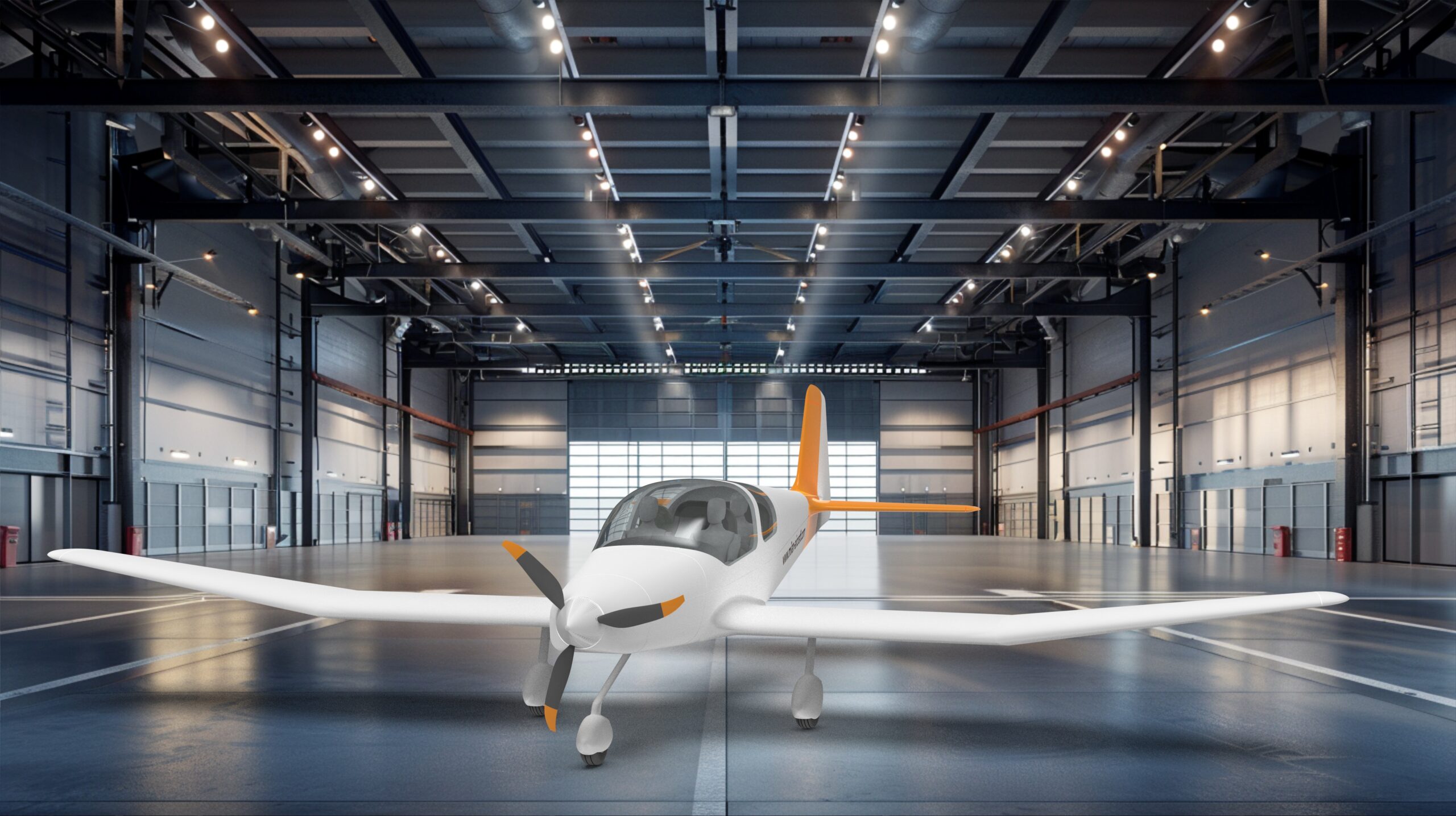
Milan Aircraft unveils new performance data for the electric trainer MA-2 with two-hour useful endurance
Making electric flight truly practical – combining quiet operation, low operating costs, and a real two-hour endurance. That is Milan Aircraft’s goal. At the AERO Friedrichshafen event, the Swiss start-up is presenting the latest update on its development program.
In November 2025, Milan Aircraft first introduced the concept of its electric training aircraft, highlighting a target of two hours of usable flight time. At AERO 2026, the company is now unveiling additional technical details of the battery-electric four-seat aircraft.
Instead of a full-scale aircraft, visitors can see Milan Aircraft’s flight-capable 1:7 scale demonstrator at its compact AERO booth. It gives a clear impression of the MA-2 and showcases its distinctive flap system – a design element that differs significantly from conventional training aircraft.
Endurance, low noise and short-field capability
The key updates are contained in the freshly printed data sheet available at the stand. Milan Aircraft’s core differentiator – two hours of real-world usable flight time – remains unchanged. However, new figures are attracting strong interest, for example the low noise level of just 59 dB(A) during take-off. This makes the aircraft especially relevant for noise-sensitive aerodromes.
Despite a maximum take-off weight of 1.75 tons, the aircraft is capable of taking off in less than 350 meters. This is enabled by a jointly developed, air-cooled radial flux motor delivering 330 hp at take-off power.
CEO and co-founder Simon Wiedmer comments: “The motor is not only lightweight and powerful – its triple- redundant design also significantly enhances operational safety.” Asked why a training aircraft needs to cruise at 170 knots, Wiedmer says: “It doesn’t have to. But it can.”
The aircraft’s short-field optimization requires a powerful motor at maximum take-off weight, resulting in high performance while also providing additional safety margins. For training operations, speed is specified at 100 knots.
Space-saving hangar design
Concerns that the 12-meter wingspan may be unsuitable for conventional flight school hangars are addressed by foldable wingtips, allowing the span to be reduced to under 7 meters when parked.
The aircraft’s battery system can be gently charged overnight in the hangar. Fast charging at up to 150 kW enables a full recharge in under one hour when required.
Development status and outlook
Development of the MA-2 is progressing according to plan. The propulsion system prototype is scheduled to enter operational testing later this year. A flying prototype is planned for 2027, with first flight expected in 2028. The company is currently finalizing its seed financing round.
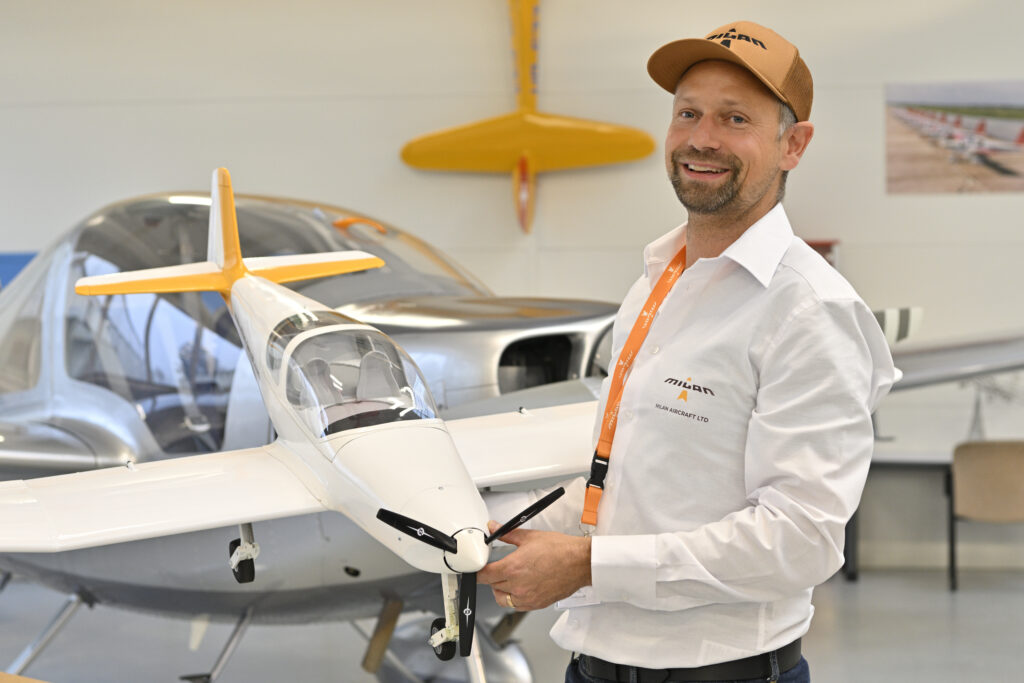
Simon Wiedmer, CEO and co-founder of Milan Aircraft, with the 1:7 scale model of the MA-2.
(Quelle: Markus A. Jegerlehner)