Flying Three Feet Above the Sea
Article by: Marijan Jozic, Managing Director, Jozic Engineering & Consultancy
In the 1960s, American spy satellites photographed something extraordinary in the Caspian Sea. It was too big to be an aircraft, too fast to be a ship, and unlike anything intelligence analysts had ever seen. One puzzled analyst reportedly described it as a monster. A colleague jokingly asked, “The Loch Ness Monster?” The reply came back: “No – the Caspian Sea Monster.”
The mysterious machine turned out to be one of the Soviet Union’s most ambitious engineering projects: the Ekranoplane, a giant wing-in-ground-effect vehicle that flew just a few feet above the sea at speeds approaching 310 mph (500 km/h).
It looked like an aircraft, floated like a boat and behaved like neither.
The secret behind its remarkable performance was the ground effect. When a wing flies very close to the surface, the air trapped beneath it increases lift while reducing drag. Birds such as pelicans exploit exactly the same aerodynamic principle, gliding effortlessly just above the waves for miles without wasting energy.
The Soviet engineers believed they had found the future of maritime transport. Their gigantic machine could fly faster than any ship, skim over naval mines, remain invisible to sonar and carry enormous payloads while presenting only a small radar signature.
Unfortunately, it also suffered from serious drawbacks. Saltwater was unforgiving on jet engines. The turning radius was enormous, making obstacle avoidance difficult, and rough seas quickly grounded the vehicle. Despite years of development, the Ekranoplane never fulfilled its promise, and eventually the project disappeared into the history books.
Or so everyone thought.
Fast forward six decades.
Battery technology has improved dramatically. Composite materials are lighter and stronger than ever. Digital flight controls, satellite navigation and autonomous systems have transformed aviation. Perhaps, after all these years, the world is finally ready for a second attempt.
That thought occurred to a group of young American engineers in Rhode Island, who founded a company called REGENT—short for Regional Electric Ground Effect Nautical Transport. Like NASA, the name is pronounced as a word rather than as individual letters.
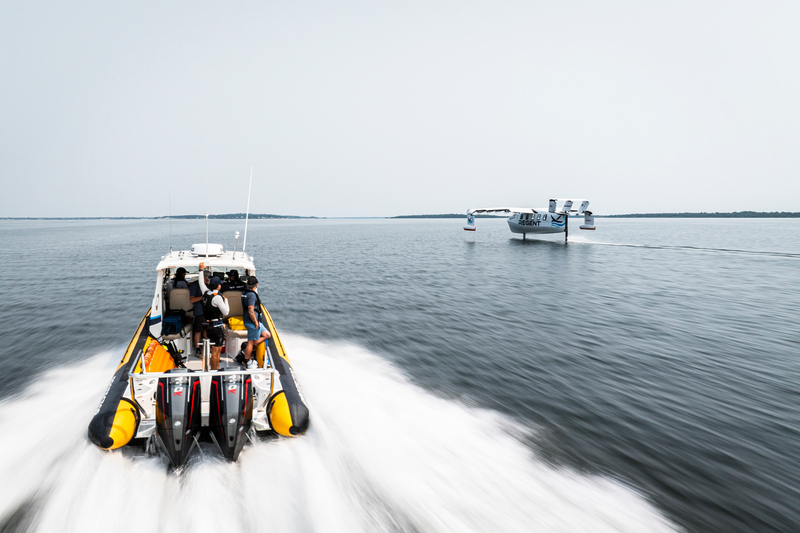
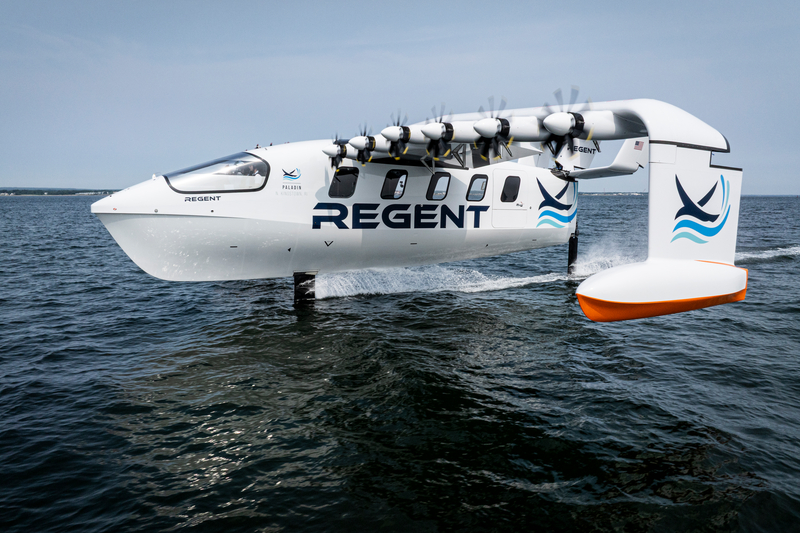
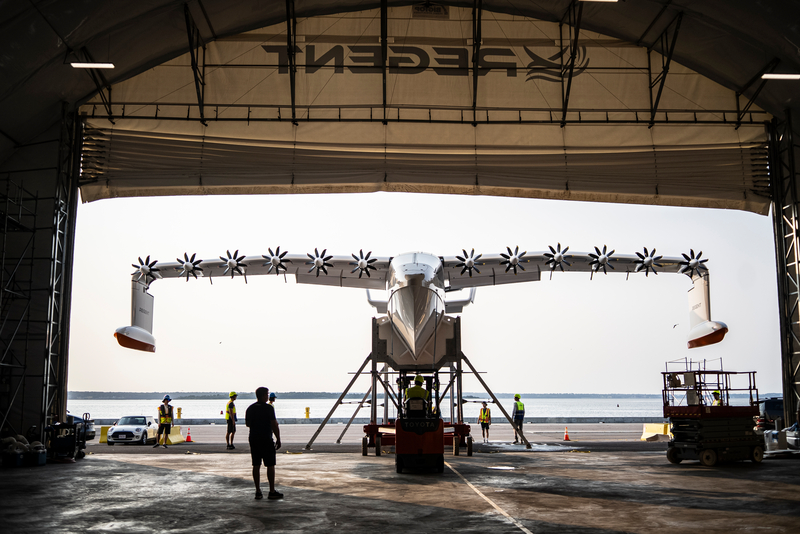
Instead of recreating the Soviet monster, REGENT has developed something elegant: the Seaglider.
Like its Cold War predecessor, the Seaglider flies only a few feet above the water, using the wing-in-ground effect to combine the speed of an aircraft with the efficiency of a boat.
The result is remarkable.
The fully electric vehicle has a range of around 180 miles (290 km) with today’s battery technology and could eventually reach nearly 500 miles (800 km) as batteries improve. Because it operates from existing docks rather than airports, expensive new infrastructure is largely unnecessary.
It is easy to imagine where such a vehicle could thrive.
Island chains such as Hawaii or the Greek Islands would be obvious candidates. Along Europe’s North Sea coast it could connect coastal cities far more quickly than conventional ferries. It could even provide a fast, zero-emission alternative for crossing the English Channel. California offers another attractive market, where journeys between San Diego and Los Angeles could be dramatically shortened without adding congestion to roads or airports.
Is It a Boat or an Aircraft?
Here comes the million-dollar question.
What exactly is this thing?
It has wings.
It has propellers.
It has a cockpit.
So is it an aircraft or a ship?
The answer is surprisingly complicated.
Passengers probably won’t care whether the person at the controls is called a pilot, an operator or a skipper. Regulators, however, care very much.
Certification often determines not only safety requirements but also operating costs, crew qualifications and maintenance procedures.
Rather surprisingly, the Seaglider is legally classified as a Type A Wing-in-Ground Effect (WIG) craft—in other words, a maritime vessel rather than an aircraft.
That means certification falls under maritime regulations supervised internationally by the International Maritime Organization (IMO), while in the United States the Coast Guard oversees its approval rather than the Federal Aviation Administration.
Building an entirely new type of vehicle is difficult. Deciding which rulebook applies can be even harder.
REGENT is currently developing its first production model, the Viceroy.
It will carry two crew members and twelve passengers at speeds of up to 180 mph (290 km/h), completing journeys of approximately 180 miles on a single battery charge.
The company hopes to begin customer deliveries in 2027.
Although the vehicle has yet to enter commercial service, interest has been extraordinary.
Among REGENT’s strategic investors are Japan Airlines, Alaska Airlines, Hawaiian Airlines, Mesa Air Group and aerospace giant Lockheed Martin.
Even more remarkably, Brittany Ferries has already placed the first commercial order.
That says a great deal about confidence in the concept.
Having spent my career in aviation, I naturally skipped straight to the cockpit.
My own speciality was cockpit instruments and electronic displays. I even led the certification programme for one of the first Boeing 747 Classics fitted with electronic flight displays instead of traditional “steam gauges.”
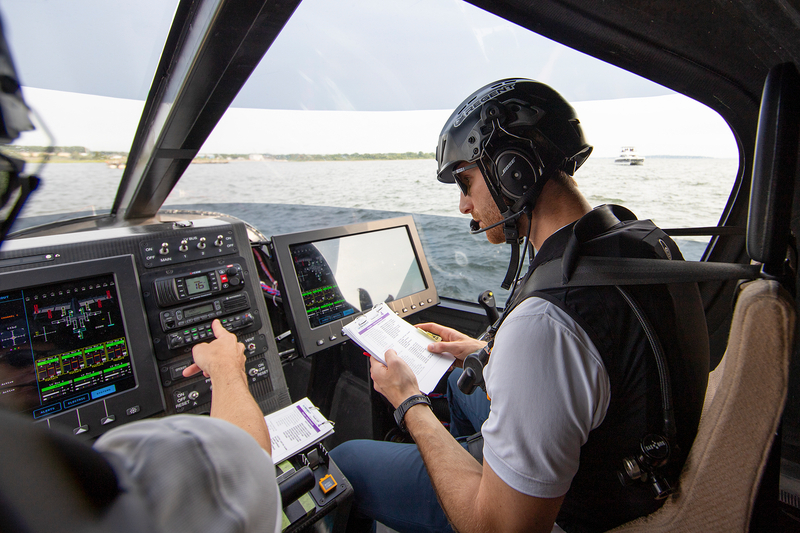
The Seaglider’s cockpit immediately caught my attention.
Although officially part of a ship, it looks remarkably like the flight deck of a modern aircraft.
The vehicle is fully fly-by-wire, controlled by sidesticks rather than steering wheels. Large panoramic displays replace conventional marine instruments and present moving maps, electronic charts, synthetic vision, infrared imagery, maritime radar, forward-looking sonar and traffic information for both aircraft and ships.
The cockpit windows are enormous, giving the crew outstanding visibility—something particularly important when travelling only a few feet above the sea.
I suspect that anyone with modern airline experience would feel surprisingly at home.
REGENT has clearly done its homework.
Around 40 percent of the world’s population lives in coastal regions. In countries such as Japan and Indonesia, that figure approaches 80 percent.
The potential market is enormous.
If even a small percentage of today’s short-haul airline passengers switched to electric Seagliders, regional transport could become significantly cleaner while reducing carbon emissions.
The twelve-seat Viceroy is only the beginning.
Industry reports already suggest that much larger versions, possibly carrying around one hundred passengers, are being studied.
If that happens, we may be witnessing the birth of an entirely new category of transport.
The Soviet Ekranoplane may have been ahead of its time. REGENT’s Seaglider might simply have arrived at exactly the right moment.
Flying into the Future
After spending a lifetime around airplanes, I never imagined that one day I would become excited about travelling on something officially classified as a ship.
Yet the thought of skimming just three feet above the waves at 180 miles per hour is irresistible. If REGENT succeeds, I would happily be among the first passengers.
After all, how often do you get the chance to fly without really flying?